




President Donald Trump pardoned Juan Orlando Hernández, the former president of Honduras, on Dec. 1, claiming without evidence that his prosecution had been a “setup” by the Biden administration and that Hernández was targeted because he was president of a country where drug cartels operated.
“If somebody sells drugs in that country, that doesn’t mean you arrest the president and put him in jail for the rest of his life,” Trump said in explaining the pardon.
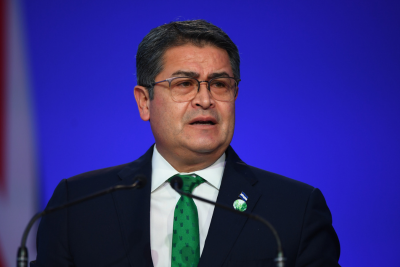
But Hernández had been found guilty by a jury after a three-week trial. He was sentenced by a U.S. District judge last year to 45 years in prison for using his position to help drug traffickers import more than 400 tons of cocaine into the United States, while accepting bribes to fuel his political career and protecting violent drug cartel leaders from prosecution in return.
White House Press Secretary Karoline Leavitt defended Trump’s action as a reversal of “over-prosecution” by the Biden administration. Hernández had been targeted because he was “opposed to the values of the previous administration,” Leavitt told reporters on Dec. 1.
We asked the White House for evidence or further explanation that Hernández’s case had been a “setup” or “over-prosecution” by the Biden administration, but we didn’t receive any response beyond the statements made by the president and Leavitt on Dec. 1.
Hernández was released from a federal prison in West Virginia on Dec. 1.
Here, we will examine the case against Hernández, Trump’s explanation for the pardon, and the response to Trump’s action.
The Indictment
According to the indictment filed on Jan. 27, 2022, in the U.S. District Court in the Southern District of New York, from about 2004 to 2022, Hernández “participated in a corrupt and violent drug-trafficking conspiracy to facilitate the importation of tons of cocaine into the United States.” He received “millions of dollars from multiple drug-trafficking organizations in Honduras, Mexico, and elsewhere, including from the former leader of the Sinaloa Cartel, Joaquin Guzman Loera,” the Mexican drug kingpin known as “El Chapo.”
Hernández used the drug money to fund his political campaigns and commit voter fraud, the indictment said. “In exchange, Hernández protected drug traffickers, including his brother and former member of the Honduran National Congress Juan Antonio Hernández Alvarado … from investigation, arrest, and extradition; caused sensitive law enforcement and military information to be provided to drug traffickers to assist their criminal activities; caused members of the Honduran National Police and military to protect drug shipments in Honduras; and allowed brutal violence to be committed without consequence.”
Hernández “contributed with his co-conspirators to Honduras becoming one of the largest transshipment points in the world for United States-bound cocaine,” the indictment also said. Loads of cocaine were trafficked through Honduras from Colombia and Venezuela by boat and air.
(The Trump administration has been building up the U.S. military presence in the Caribbean in recent months and striking alleged drug-running boats off the coasts of Venezuela and Colombia, as we’ve previously written.)

Hernández, who had served two terms as president of Honduras from 2014 to 2022, was extradited to the U.S. in April 2022 and was convicted in March 2024 after a three-week jury trial on cocaine trafficking and weapons offenses.
The investigation into Honduras as a drug-trafficking route and the eventual prosecution of Hernández dates back to 2015, the New York Times reported. Emil Bove III, who was then a Department of Justice prosecutor, helped lead that investigation. Bove later became a key defense lawyer for Trump and is now an appeals court judge.
During the trial, according to news coverage, Hernández testified that he had championed anti-crime legislation and worked with the U.S. to fight drug cartels. He said the witnesses against him — which included former drug traffickers — were “professional liars.” Hernández also said he was the victim of “a political persecution.”
In addition to former drug traffickers, the witnesses included a Honduran investigator and evidence from notebooks of drug transactions with Hernández’s initials.
In closing arguments, Assistant U.S. Attorney Jacob Gutwillig said Hernández had protected some drug traffickers “with the full power of the state” and that he “paved a cocaine superhighway to the United States.”
On June 26, 2024, Hernández was sentenced to 45 years in prison by District Court Judge P. Kevin Castel, who was nominated by President George W. Bush. Castel called Hernández “a two-faced politician hungry for power” who pretended to be fighting against drug traffickers while working with them.
U.S. Attorney Damian Williams said in a Justice Department press release at the time: “Hernández helped to facilitate the importation of an almost unfathomable 400 tons of cocaine to this country: billions of individual doses sent to the United States with the protection and support of the former president of Honduras.”
Attorney General Merrick B. Garland said Hernández “abused his power to support one of the largest and most violent drug trafficking conspiracies in the world, and the people of Honduras and the United States bore the consequences.”
The Pardon
In late October, a month before Trump announced he would pardon the former Honduran president, Hernández sent a letter, obtained by the Times, to Trump seeking a review of his case.
In the letter to Trump, Hernández, who led the conservative National Party, said he “suffered political persecution, targeted by the Biden-Harris administration not for any wrongdoing, but for political reasons.” He also told Trump that “like you, I was recklessly attacked by radical leftist forces who could not tolerate change, who conspired with drug traffickers and resorted to false accusations, lawfare, and selective justice to destroy what we had achieved and clear the path for the Honduran radical left’s return to power.”
Trump ally and adviser Roger Stone, who had supported the release of Hernández, said he gave the letter to Trump, Reuters reported. A White House official told the Times that Trump had not read the letter before announcing he would pardon Hernández.
In a Truth Social post on Nov. 28, in which Trump expressed support in the recent Honduran presidential election for conservative candidate Nasry “Tito” Asfura, a political ally of Hernández, Trump wrote, “I will be granting a Full and Complete Pardon to Former President Juan Orlando Hernandez who has been, according to many people that I greatly respect, treated very harshly and unfairly.”
(The Honduran election results, delayed by technical problems, showed Asfura and Liberal Party candidate Salvador Nasralla in an extremely close race as of Dec. 4.)
Explaining the pardon to reporters on Nov. 30, Trump said, “Well, I was told, I was asked by Honduras, many of the people of Honduras, they said it was a Biden setup. … The people of Honduras really thought [Hernández] was set up and it was a terrible thing.”
“He was the president of the country, and they basically said he was a drug dealer because he was the president of the country,” Trump continued. “And they said it was a Biden administration setup. And I looked at the facts and I agreed with them.”
The next day at a White House briefing, Leavitt was asked how Trump’s defense of Hernández differs from the administration’s targeting of Venezuelan President Nicolás Maduro, whom the administration has called the leader of a drug cartel.
Leavitt responded: “You’re cherry-picking the president’s statement a little bit yesterday, as he also said yesterday the people of Honduras have highlighted to him how the former President Hernández was set up. This was a clear Biden over-prosecution. He was the president of this country. He was in the opposition party. He was opposed to the values of the previous administration and they charged him because he was president of Honduras.”
Leavitt noted that Hernández “shared that his conviction was lawfare by the leftist party who, quote, struck a deal with the Biden-Harris administration.”
“Hernández has highlighted there was virtually no independent evidence presented,” Leavitt said, and “his conviction was based on testimony from many admitted criminals who hoped that cooperating would reduce their own penalties.” Trump “heard the concerns from many people, as he does, and he’s of course within his constitutional authority to sign clemency for whomever he deems worthy of that,” Leavitt said.
Hernández could still face charges in his home country. After Trump’s plan to pardon Hernández was announced, Honduras Attorney General Johel Zelaya reportedly said prosecutors there would be “obligated to take action … so that justice may prevail and impunity may be brought to an end.” Zelaya did not specify what charges Hernández may face, but the Associated Press reported there were various corruption investigations during his two terms in office.
Reaction to the Pardon
There was bipartisan criticism from U.S. lawmakers in the aftermath of the pardon announcement.
Democratic Rep. Norma J. Torres of California sent a letter to Trump on Nov. 29 urging him not to grant the pardon, writing: “The victims of Hernández’s crimes, including tens of thousands of American families who lost loved ones to cocaine overdoses, deserve justice. … A pardon would tell these victims that their lives don’t matter and that power can buy freedom even after conviction.”
Republican Sen. Bill Cassidy of Louisiana asked on X, “Why would we pardon this guy and then go after Maduro for running drugs into the United States? Lock up every drug runner! Don’t understand why he is being pardoned.”
Democratic Rep. Seth Moulton of Massachusetts said in a Dec. 1 interview on CNN that the pardon is “completely absurd. It’s totally hypocritical and it just shows that they are completely unserious about actually dealing with narcotraffickers. They’re not addressing the drug problem. And this Honduran president has been proven in a court of law to be responsible for poisoning thousands of Americans and Trump gives him a pardon?”
Republican Rep. Maria Elvira Salazar of Florida told CNN that while she supports Trump’s efforts to oust Venezuela’s Maduro, she did not agree with his decision to pardon Hernández. “I would have never done that,” she said. “I would have not taken that action.”
Speaking to reporters on Dec. 2 about the pardon, Republican Sen. Thom Tillis of North Carolina said, “I hate it. It’s a horrible message. … It’s confusing to say on the one hand we should potentially even consider invading Venezuela for drug traffick[ing], and on the other hand let somebody go.”
Editor’s note: FactCheck.org does not accept advertising. We rely on grants and individual donations from people like you. Please consider a donation. Credit card donations may be made through our “Donate” page. If you prefer to give by check, send to: FactCheck.org, Annenberg Public Policy Center, P.O. Box 58100, Philadelphia, PA 19102.