




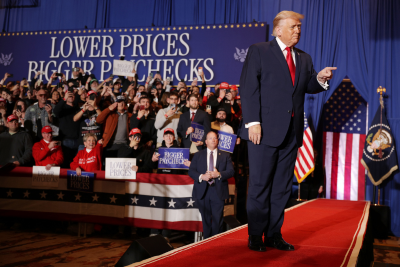
In a campaign-style rally in Pennsylvania on Dec. 9, President Donald Trump honed a message of “lower prices, bigger paychecks” ahead of next year’s midterm elections. Some of his talking points on the economy missed the mark.
- The president falsely claimed he had “inherited the worst inflation” in U.S. history and that it “stopped” since he returned to the White House. The worst inflation period occurred after World War I, and inflation was up 3% for the 12-month period ending in September.
- Trump was right to say that oil prices had declined, but the data are mixed for “energy prices,” a phrase he also used.
- The national average for a regular gallon of gasoline is $2.94. Trump claimed it was at $1.99 in three or four states, but no state average is that low. Some individual gas stations advertised such prices in four states.
- He exaggerated when he said he had attracted about $18 trillion in new investments in the U.S. since January. A White House webpage says the total is $9.6 trillion as of Dec. 10, and experts say many of those “investments” are only promises that shouldn’t be counted yet.
- Trump took credit for the creation of 4,000 new manufacturing jobs in Pennsylvania, but Bureau of Labor Statistics data show that in the U.S. overall, manufacturing jobs are down 49,000 since January.
- The president repeated an old claim that “more Americans are working today” than ever before, but that’s largely due to population growth. The employment-population ratio is down slightly since January.
Inflation
Trump said during his remarks in Pennsylvania that his administration “inherited the highest prices ever and we’re bringing them down. We inherited the worst inflation in the history of our country.” He later claimed that “inflation is stopped.”
He has made similar claims many times before — but they’re still false.
Trump did not inherit “the worst inflation” in American history. The worst inflation occurred after World War I, when the largest 12-month price increase was 23.7% from June 1919 to June 1920. Also, from March 1979 to March 1980, overall inflation rose 14.8%.
Inflation had climbed substantially during the first half of former President Joe Biden’s term, mainly due to the economic effects of the COVID-19 pandemic, as we’ve written before. For the 12-month period ending in June 2022, the Consumer Price Index increased 9.1%. That was “the largest 12-month increase since the period ending November 1981,” the Bureau of Labor Statistics said.
In the six months before Trump began his second term, however, the annual CPI was below 3%. For the 12 months ending in January, it was 3%.
Contrary to Trump’s claims, not all prices are now “down” and inflation hasn’t “stopped.”
Based on the CPI, the inflation rate ticked up 3% for the 12 months ending in September — the last month for which data are available because of the 43-day government shutdown — and was up 1.7% from January to September. Core inflation, which doesn’t include the categories of food and energy, also rose 3% from September 2024. From January to September, core inflation was up 1.8%.
While announcing the year’s third interest rate cut on Dec. 10, Federal Reserve Chair Jerome Powell also noted that “inflation remains somewhat elevated,” contradicting the president’s claim that “inflation is stopped.”
“Although important federal government data for the past couple of months have yet to be released, available public and private-sector data suggests that the outlook for employment and inflation has not changed as much since our meeting in October. Conditions in the labor market appear to be gradually cooling and inflation remains somewhat elevated,” Powell said.
Oil, Gasoline and Energy Prices
The president correctly said that oil prices had come down since he took office, but “energy prices” are mixed. He exaggerated in saying that the price of gasoline was at $1.99 in three or four states.
“Our oil prices are coming down very substantially, energy prices,” Trump said.
The price for West Texas Intermediate crude, which is the U.S. oil benchmark, was $59.04 per barrel as of Dec. 8, according to the Energy Information Administration. That’s down 24.8% from $78.56 on Jan. 17, the most up-to-date price before Trump’s inauguration.

As for energy overall, the picture isn’t so clear. BLS’ measure for energy inflation shows a decrease of 0.5% from January to September, the latest data available. BLS’ measure for household energy, which considers the overall cost of services used for heating, cooling, lighting, cooking, and running appliances and household equipment, shows an increase of 4.3%.
The president attributed lower oil prices to more drilling, saying “the greatest amount of drilling, the greatest amount of fuel being produced right now in our country than ever before by far. It’s not even a contest.” Monthly production of crude oil in the U.S. in September was up 5.4% from January, according to EIA. The annual per day average is certain to be higher this year than last, when the U.S. hit a record of 13.2 million barrels on average per day. However, the EIA has said that a decrease in crude oil prices has been “driven by increasing global crude oil supply,” not only oil produced in the U.S.
Retail gasoline prices have remained low since January. The national average for a regular gallon of gasoline was $3.11 when Trump took office, and it was $2.94 as of Dec. 8, according to EIA. It dipped below $3 this month for the first time since May 2021.
But Trump exaggerated in saying that three or four states had it at “$1.99 a gallon.” No statewide average is that low, according to figures published by AAA. The lowest statewide average was Oklahoma, $2.37 per gallon. It is possible to find some individual gas stations in some states charging that amount. In looking at the 10 states with the lowest average price, we found gas stations in four states advertising a price of $1.99 or lower, using GasBuddy, a site that lists prices for more than 150,000 stations.
Investments in U.S.
Trump also told his audience in Pennsylvania, “In four years under Biden, Democrats secured less than $1 trillion in new investments in our country.” Trump said he had brought in “right around $18 trillion” in investments to the U.S. If Biden had been reelected, he said, “it would have been negative because companies were pouring out of our country.”
The president’s estimate of how much new investment he has attracted to the U.S. has grown dramatically over the course of the year and is exaggerated, according to experts and a White House webpage.
On the day after his inauguration, Trump said, “Before the end of my first full business day in Washington in the White House, we’ve already secured nearly $3 trillion of new investments in the United States.” The number grew by trillions in the months that followed, according to Trump, and by May he said, “I think we can say that we’ll be close to $10 trillion of investment” because of his policies on trade and tariffs. On Dec. 9, Trump’s estimate had grown to “around $18 trillion.”
Yet a webpage curated by the White House that keeps a running tab of “Total U.S. and Foreign Investments” shows a total of $9.6 trillion as of Dec. 10.
Even that number is questionable because it includes pledges and plans for investment that may not be realized, experts have said, as we reported in May.
“There’s no guarantee that any of the investments that are announced actually come to fruition,” Adam Hersh, a senior economist at the left-leaning Economic Policy Institute, said. Economists “wouldn’t count them until they’re actually in the ground,” Hersh said about the listed projects.
“[T]hey’re just promises — and often vague ones at that,” Scott Lincicome, vice president of general economics at the libertarian Cato Institute, said in an April analysis of Trump’s claims.
Trump’s claim that “companies were pouring out of our country” during Biden’s presidency also lacks evidence to support it.
Harry C. Moser, the founder and president of Reshoring Initiative, which works to bring manufacturing jobs back to the U.S., told us in an email that his nonprofit organization measures reshoring and foreign direct investment in the U.S. “‘Pouring out’ sounds like offshoring, which no one measures,” Moser said.
According to BLS data, the U.S. added 610,000 manufacturing jobs during Biden’s presidency, a 5% increase. (The total jobs added under Biden will be adjusted in February, when BLS completes its benchmarking process, as we’ve written.)
The Biden administration announced in November 2024 that “datapoints show” that private-sector investments in the U.S. during Biden’s term “now total over $1 trillion.”
Biden “‘bought’ most of the increase in his term via grants,” Moser said, referring to the Inflation Reduction Act and the CHIPS and Science Act, Biden’s initiatives aimed at creating jobs in clean energy and the manufacturing of semiconductors, among other incentives.
Trump “is using tariffs to motivate companies. So far 2025 is just slightly below 2024 [in reshoring jobs and foreign investment] due to delays in tariff agreements,” Moser said. Trump “claims about $20 trillion in [manufacturing] project announcements. Bloomberg reduced that to $7T. Much of that amount is still not firm, waiting for tariffs to become solid and long-term. When/if the tariffs are solidified, we expect a surge way above the level under” Biden, he said.
We reached out to the White House for data to support Trump’s claims regarding the amount of investment he has attracted to the U.S. so far and the loss of companies during Biden’s term, but we didn’t receive a response.
Manufacturing Jobs
Regarding manufacturing jobs, Trump also said, “Since my inauguration, we’ve created nearly 60,000 new Pennsylvania jobs, including 4,000 Pennsylvania manufacturing jobs that the Democrats gave up on.”
Since Trump took office in January, the number of new manufacturing jobs in Pennsylvania had grown by 4,000 jobs by August, according to BLS data.
But manufacturing jobs in the U.S. overall declined by 49,000 jobs, or 0.4%, from January to September, BLS data show.
Jobs
The president also said, “More Americans are working today than at any time in the history of our country.”
Trump has made such statements before. In 2018, he said the same thing at a rally in Elko, Nevada. It’s not wrong, but it doesn’t mean much.
According to the BLS, there were nearly 160 million total nonfarm employees as of September, the last month for which data are available, and the United States reached the highest total number of workers in history in that month. But the nation also has its largest population in history.
Considering population growth, the president’s claim doesn’t carry much weight.
“The labor force participation rate, at 62.4 percent, changed little … over the year,” the BLS reported on Nov. 20. It was 62.6% in January. (The labor force participation rate is the number of people age 16 and older who are working or seeking work, as a share of the working-age population.)
“The employment-population ratio, at 59.7 percent, also changed little in September,” the BLS reported. In fact, the employment-population ratio — the portion of the population that was employed — was “down by 0.4 percentage point over the year,” according to the BLS. It was 60.1% in January, when Trump took office.
Editor’s note: FactCheck.org does not accept advertising. We rely on grants and individual donations from people like you. Please consider a donation. Credit card donations may be made through our “Donate” page. If you prefer to give by check, send to: FactCheck.org, Annenberg Public Policy Center, P.O. Box 58100, Philadelphia, PA 19102.