




President Donald Trump and former Secretary of Transportation Pete Buttigieg have sparred over the condition of the air traffic control system, which is complex and carries a history of planned upgrades and overhauls that stretches back decades.
Trump has promised since he took office to update the system and, in December, awarded a contract with an initial $12.5 billion payment to Peraton to deliver on the Brand New Air Traffic Control System plan that he announced in May.
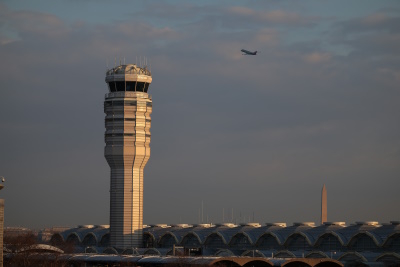
As he has touted his plan, Trump has also cast blame on the Biden administration for letting the system deteriorate. For example, the president referred to Buttigieg on Nov. 10, saying, “he spent billions of dollars trying to patch together our air traffic control system, which was a conglomeration of all different systems in all different cities. He spent — they had hundreds of companies working on it and they were spending billions of dollars. And when they turned it on, it didn’t work, it didn’t even work a little bit. That’s why you had a helicopter crashing into an airplane.”
Trump has made some version of this claim multiple times this year.
Buttigieg responded on Nov. 10 that the president’s claim was “false and confusing” and that the Biden administration had begun “a long-term communications fix that is still underway that he is now passing off as his idea.”
Neither one of their claims is quite right.
It’s true that the Trump administration has devoted more funding to upgrading the system than the Biden administration did, but experts also told us that much of Trump’s plan is an extension of a project that began in 2003 and continued under Biden.
We’ll explain what the state of the air traffic control system is and what each administration proposed to do about it.
As for Trump’s suggestion that Biden-era projects were responsible for the midair collision between a U.S. Army helicopter and a passenger plane on Jan. 29, that’s not supported by the National Transportation Safety Board investigation so far. The investigation is still ongoing, but the initial report published on March 7 cited a yearslong problem with helicopters and planes being too close to each other. “Existing separation distances between helicopter traffic operating on Route 4 and aircraft landing on runway 33 are insufficient and pose an intolerable risk to aviation safety by increasing the chances of a midair collision,” the report said.
The U.S. System
The U.S. air traffic control system is comprised of more than 400 towers across the country that shuttle millions of passengers to and from the nation’s airports every day.
“This is an incredibly complex system,” Lance Sherry, director of the Center for Air Transportation Systems Research at the College of Engineering and Computing at George Mason University, told us in a phone interview.
“You can’t turn this off and start over,” he said of updating the system. “You’ve got to change the tires while it’s going 100 miles per hour on the highway.”
The system is a network that broadly involves communications from the ground to aircraft in the sky — which requires each airline to equip planes with compatible technology — and management of air traffic flow. Communications and navigation are done by both radio and satellite-based technology.
“[M]odernization has long been plagued by delays, cost overruns and under-delivery of promised benefits,” John Strong, a professor at the College of William & Mary who serves on the National Academy of Sciences Committee on air traffic control, told us.
He gave an overview of efforts starting in 1984, when IBM led the implementation of the Advanced Automation System, which had originally been proposed to cost $2.5 billion but ended up costing more than twice that when it was restructured and largely cancelled 10 years later without having been completed.
Then, in 2003, the Federal Aviation Administration began what Strong called “[t]he most ambitious recent project” — the Next Generation Air Transportation System, or NextGen. Among its many components was the goal of shifting from radar-based to satellite-based technology by 2025. “This included important applications in approach control to airports (for example, curved merging approaches rather than stacking up in a line in the sky) and moving from towers using paper flight data strips to electronic ones,” Strong said. “The technologies were rolled out to a limited number of airports.”
A September report by the Department of Transportation’s Office of Inspector General said that the FAA had spent about $15 billion by the end of 2024 to deliver “new capabilities and benefits,” but ultimately fell short, concluding that “FAA’s efforts have not delivered the vision of a transformed and modernized air traffic system.”
“So the FAA has a long history of problems that extended from the George W. Bush administration, through Obama, Trump I, and Biden,” Strong said.
But technology, alone, is only one part of the picture, Sherry said. “The way to improve the system is to better manage the flow,” he said.
The flow of air traffic can be managed by changing the number or direction of runways at an airport or by adjusting the flight paths into the airport.
“For sure, you don’t want the sector controller using an old system, but, at the end of the day, that’s not where the bottlenecks are,” Sherry said, the bottlenecks are in the flow.
There are other factors, too, such as staffing shortages. While the number of flights has increased by about 10% over the last decade, the number of air traffic controllers has decreased by about 6%, according to a December report from the Government Accountability Office.
What Trump Has Proposed
As we said, in May, the Trump administration issued a proposal “to build a brand new, state-of-the-art air traffic control system that will be the envy of the world,” according to a press release. The initial contract for that project was awarded in December to Peraton, a security and technology company.
The One Big Beautiful Bill Act that passed in July provided $12.5 billion for the project, which Secretary of Transportation Sean Duffy said is expected to total $31.5 billion and be finished by the end of 2028.
But experts have characterized the plan as more of an extension of NextGen than a completely unique plan to overhaul the air traffic control system.
“FAA will continue to deploy NextGen systems beyond 2025 and other key capabilities beyond 2030,” the GAO said in its September report reviewing its oversight of the NextGen program. “Furthermore, the Secretary of Transportation recently announced a $31.5 billion plan for FAA to build the Brand New Air Traffic Control System, a state-of-the-art system that will replace core infrastructure including automation, communication, surveillance, and facilities. These plans include accelerating deployment of several key NextGen programs to be complete by 2028.”
A list of projects for the initial contract issued by the FAA on Dec. 4 shows technology and hardware upgrades, such as new radios, some updated radar systems, and additional weather-related systems.
“Everything listed there is some equipment located at some facility in the air traffic control system,” Sherry said. “It’s not to say those things aren’t necessary, but it’s a bottom up approach — it looks like a list of things people have wanted.”
The existing equipment has some limitations — some of it is old and unreliable, he said. “So, all of that needs to be upgraded. And that’s what’s been released by the FAA. But it would be nice to take this opportunity to update the principles, not just the technology,” Sherry said.
Strong told us something similar. “What is being promoted now [is] quite a step change and well beyond the incrementalism in recent years. That said, I think it mainly is modernization of facilities and equipment, but not a fundamental rethinking of how the ATC system might operate, how it should be governed, operated, and funded,” he said. “I do think the current Trump admin proposal will be a major improvement – if it can be completed on time and on budget. But both the timeline and past experience makes me withhold judgment at this point.”
The Brand New Air Traffic Control System, or BNACTS, is going to finish off what NextGen never got to do, Sherry said.
For example, as described in the GAO report, the NextGen plan had envisioned installing a tool that would help to more efficiently move planes between gates and runways called a Terminal Flight Data Manager program, or TFDM, at 89 airports. The first one was deployed in 2025, but the plan reduced the total number of airports to 49 and delayed the rollout for those airports to 2030.
“However, as part of the Brand New Air Traffic Control System, FAA now plans to deploy TFDM to all 89 planned sites,” the report said, and, indeed, the TFDM system is included in the BNACTS plan.
“It’s an extension of NextGen,” Sherry concluded of BNACTS.
What Biden/Buttigieg Did
The 2021 Infrastructure Investment and Jobs Act provided $5 billion specifically for air traffic control improvements — $1 billion per year for five years.
Of the funding for air traffic control, $3 billion was spent by the end of fiscal year 2024, Strong said. About a third of that was spent on tower replacements and upgrades, largely in secondary places, such as Grand Junction, Colorado; Missoula, Montana; Wheeling, West Virginia.
“The remaining $1.9b was allocated across updating power and communications systems (such as the one at Newark and Philadelphia which caused all the problems in 2024 and earlier this year), navigation/weather/tracking equipment, tower approach and departure facilities, long range radar and enroute flight centers,” Strong said.
Another $284 million was used to fund a surge in controller hiring to begin to address the shortfall in the number of controllers, Strong said. “This was an important down payment on staffing shortages.”
Katie Thomson, who served as deputy administrator for the FAA during the Biden administration, noted the $5 billion included in the Infrastructure Investment and Jobs Act, too, when we asked her about the competing claims from Trump and Buttigieg.
She also noted a 15-year contract that was given to Verizon in 2023 to provide faster and more secure communications called the FAA Enterprise Network Services Program, or FENS, and the budget proposal for fiscal year 2025 for facility replacement and modernization, or FRRM, that would have spent $9 billion over five years to replace some facilities and modernize radar systems, although Congress didn’t allocate those funds during the Biden administration.
“The current efforts to build a ‘Brand New Air Traffic Control System’ are derivative of the FENS contract and the FRRM proposal – both initiated by the Biden Administration,” Thomson told us in an email.
We reached out to Buttigieg to ask what he was referring to when he said that Trump was “passing off as his idea” a Biden era plan, but we didn’t hear back.
“My assessment is that the failure of [air traffic control] modernization predates the Biden administration,” Strong said. “However, the funding during the Biden administration was mostly carrying on with plans that were inadequate in both scope and funding. The Infrastructure bill provided very little funding for [air traffic control] (in relative terms) and much of it was to deal with immediate problems (staffing, equipment breakdowns, etc.)”
Copper Wire
One of Trump’s frequently repeated claims is about the use of copper wire, as compared to fiber optic cable, for air traffic communications systems.
For example, Trump said while visiting Qatar in May, “They wasted billions of dollars on trying to hook up air systems to copper and they tried to hook up copper to glass.”
The White House didn’t respond to specific questions about several of the president’s claims, but a spokesperson did point to the highly publicized issue at the Newark Liberty International Airport this spring, when there were at least three outages of air traffic communications equipment for up to 90 seconds. Some lawmakers said outages were due to a “fried” copper wire.
“The FAA has multiple communications systems including copper wire and fiber, as well as some wireless,” Strong told us, and those systems are patched into one another.
Sherry considers references to copper wire as a euphemism for old infrastructure, like a landline phone. Part of the NextGen plan was to upgrade air traffic control systems to optical cable, which has better speed, accuracy and reliability, he said.
We asked the FAA how much of the older wire had been replaced across the system, but we didn’t get a response.
Editor’s note: FactCheck.org does not accept advertising. We rely on grants and individual donations from people like you. Please consider a donation. Credit card donations may be made through our “Donate” page. If you prefer to give by check, send to: FactCheck.org, Annenberg Public Policy Center, P.O. Box 58100, Philadelphia, PA 19102.