




Nearly eight years ago, President Donald Trump denied using the word “shitholes” to describe African countries during an Oval Office meeting on immigration.
But now he has fessed up.
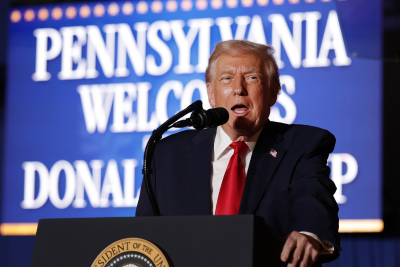
In a speech Tuesday night in Pennsylvania, Trump boasted about pausing migration from what he called “Third World” countries, when he was interrupted by an audience member who yelled out “shithole.” That triggered Trump to recall a White House meeting during his first term that caused a stir over whether the president used a vulgar term to describe African countries.
Trump, Dec. 9: I’ve also announced a permanent pause on Third World migration, including from hellholes like Afghanistan, Haiti, Somalia and many other countries.
Audience member: Shithole.
Trump: I didn’t say shithole, you did. [Laughter.] Remember, I said that to the senators. They came in, the Democrats. They wanted to be bipartisan. So, they came in, and they said this is totally off the record. Nothing mentioned here. We wanted to be honest, because our country was going to hell, and we had a meeting and I say, “why is it we only take people from shithole countries,” right? Why can’t we have some people from Norway, Sweden — just a few — let us have a few, from Denmark. Do you mind sending us a few people? Send us some nice people, do you mind? But we always take people from Somalia, places that are a disaster, right? Filthy, dirty, disgusting, ridden with crime.
Trump’s new account of the Jan. 11, 2018, meeting confirms what Democratic Sen. Dick Durbin said at the time.
A day after the meeting, Durbin – who was at that meeting — said the president was commenting on immigration from Africa when he said, “‘Those shitholes send us the people that they don’t want.’” Durbin added, “He repeated that. He didn’t say that just one time.”
Durbin also quoted Trump as saying, “‘We don’t need more Haitians.’”
As we wrote at the time, Trump repeatedly denied Durbin’s account.
In social media posts on Jan. 12, 2018, Trump said his words at the meeting were “tough,” but “this was not the language used,” and he claimed that he “[n]ever said anything derogatory about Haitians.” Two days later, the president told reporters that the remarks attributed to him “weren’t made,” and he tweeted that Durbin “totally misrepresented what was said at the DACA meeting,” referring to the Obama-era Deferred Action for Childhood Arrivals program.
(DACA prevents the deportation of more than 500,000 U.S. residents who were illegally brought to the United States as children. At the 2018 meeting, Durbin and Republican Sen. Lindsey Graham met with Trump to discuss their bipartisan plan to save DACA, which Trump was trying to phase out.)
In our Jan. 16, 2018, article, we were unable to definitively state what was said at the immigration meeting. There was no recording of the private meeting. Instead, we provided firsthand accounts from some of those who attended.
There were at least seven members of Congress at the meeting and then-Homeland Security Secretary Kirstjen Nielsen. In addition to Durbin, four other members of Congress and Nielsen made public statements about the meeting, which we included in our 2018 article and summarize here:
- Like Trump, Nielsen said there was an “impassioned conversation” on immigration at the meeting, but she did not hear “that specific phrase being used.”
- Sen. Tom Cotton and then-Sen. David Perdue, both Republicans, initially also said in a joint statement that they “do not recall the President saying these comments specifically.” Perdue said days later that Trump “did not use that word,” calling Durbin’s account a “gross misrepresentation.” (The Washington Post reported, based on accounts from anonymous White House officials, that Perdue and Cotton told the White House that they heard “shithouse” rather than “shithole,” which the Post wrote allowed both men to deny Durbin’s account of the president’s comments.)
- In a statement at the time, Graham initially did not confirm or deny the allegations about Trump’s language. But days later, he appeared to criticize Cotton and Perdue for their selective memories of the meeting. “My memory hasn’t evolved,” he told reporters in South Carolina on Jan. 15. “I know what was said and I know what I said.”
- Rep. Mario Diaz-Balart, a Florida Republican, would neither confirm nor deny whether Trump used the obscenity at the meeting to describe African nations.
As fact-checkers, we must rely on irrefutable evidence, such as memos, emails and recordings, to render a judgment when trying to settle a dispute like this between two parties. All we can do – and what we did in this case – is lay out what we know and let readers draw their own views of what may have happened.

But now there is no disagreement. Trump admitted that he said, “why is it we only take people from shithole countries?”
Asked for comment, White House Deputy Press Secretary Abigail Jackson told us the controversy over Trump’s language at the 2018 meeting is “another Fake News narrative peddled by Democrats.”
“Instead of digging up another Fake News narrative peddled by Democrats almost 10 years ago, the media should focus on the substance of what President Trump correctly pointed out: Aliens who come to our country, complain about how much they hate America, fail to contribute to our economy, and refuse to assimilate into our society should not be here,” Jackson said in an email.
But based on Trump’s own account, this wasn’t “another Fake News narrative.” Instead, his denials at the time were false.
Editor’s note: FactCheck.org does not accept advertising. We rely on grants and individual donations from people like you. Please consider a donation. Credit card donations may be made through our “Donate” page. If you prefer to give by check, send to: FactCheck.org, Annenberg Public Policy Center, P.O. Box 58100, Philadelphia, PA 19102.