




Upending decades-old guidance, the Centers for Disease Control and Prevention’s vaccine advisory committee voted to no longer issue a blanket recommendation that all newborns receive a hepatitis B vaccine at birth. Throughout the meeting, many panelists made misleading claims about the vaccine.

Here, we address claims about the vaccine’s effectiveness and safety, and other countries’ vaccination policies.
The hepatitis B vaccine, which is typically given in a three-dose series, is highly effective in preventing disease and has a strong safety record. As the Children’s Hospital of Philadelphia explains, there are no known serious side effects other than anaphylaxis, or a life-threatening allergic reaction, which is very rare and can be treated.
A universal birth dose was first recommended in 1991, after risk-based approaches had not brought cases down. Young children are the most likely to develop a chronic infection that can lead to liver cancer and other problems. In the decades since, rates of hepatitis B in children have fallen by 99%.
In an 8-to-3 vote on Dec. 5, the CDC’s Advisory Committee on Immunization Practices decided to end that policy. If accepted by the CDC director, parents of babies born to mothers who test negative for the virus will now be advised to discuss vaccination with a doctor to decide “when or if” to give the vaccine. For those who opt to forgo a birth dose, the panel “suggested” waiting at least two months to vaccinate.
This type of recommendation, which is known as shared clinical decision-making, has typically been reserved for cases in which experts do not think a vaccine is universally necessary for the recommended group, and there is no “default” answer on whether to vaccinate.
The hepatitis B vaccine would remain recommended at birth for babies born to mothers who are infected with the virus and to mothers with unknown status. The changes should not affect health insurance coverage of the shots.
Numerous experts and medical groups have slammed the decision to end the universal birth dose.
“This irresponsible and purposely misleading guidance will lead to more hepatitis B infections in infants and children,” American Academy of Pediatrics President Dr. Susan J. Kressly said in a statement. “I want to reassure parents and clinicians that there is no new or concerning information about the hepatitis B vaccine that is prompting this change, nor has children’s risk of contracting hepatitis B changed. Instead, this is the result of a deliberate strategy to sow fear and distrust among families.”
The panel also voted to advise parents to “consult with health care providers” about whether antibody testing should be done to determine if a child needs an additional HBV vaccine.
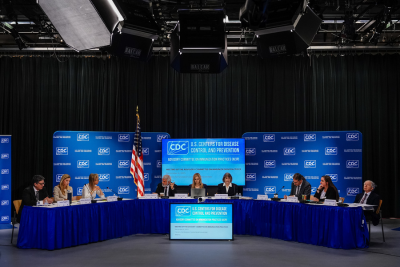
However, experts present at the meeting emphasized that it is not known whether a child who achieves a certain level of antibodies after an incomplete vaccination series will in fact have long-term protection from hepatitis B. Dr. Adam Langer, a CDC staff member with a leadership role in the division tasked with preventing hepatitis, called this “a really huge assumption.” He added, “There really is no reason not to give the full series.”
In the past, members of ACIP were scientists and physicians with particular expertise in vaccinology, pediatrics, and other relevant fields. Many of the current panelists, who were hand-selected by Health and Human Services Secretary Robert F. Kennedy Jr. beginning in June after he dismissed the existing panel, do not have the typical qualifications and also have expressed views opposed to vaccination.
None of the scientific presentations were given by career CDC staff, as is typical. Instead, presentations were given by ACIP member Vicky Pebsworth, a nurse with a doctorate in public health who has ties to anti-vaccine groups; Cynthia Nevison, an environmental scientist who has volunteered for SafeMinds, an anti-vaccine group, and is now a CDC consultant; and Mark Blaxill, a well-known anti-vaccine advocate with no medical training who was recently hired as a senior adviser at the CDC.
Presenters also did not use the committee’s usual frameworks to evaluate evidence.
Dr. Joseph R. Hibbeln, neuroscientist and ACIP member, repeatedly complained about the lack of a rigorous scientific framework and the evidence to support the votes. He voted no on both.
“No rational science or discussion has been presented on these two novel issues,” he said, noting that no information had been given on why the group should advise vaccination after two months rather than any other timeline, and that there was “no data” on whether the antibody testing would actually work to ensure protection if people were not getting the full series of shots.
Claims About Hepatitis B Safety Studies
In a presentation on the safety of the hepatitis B vaccine birth dose, Blaxill claimed that the “safety evidence is limited” and implied the vaccines were not properly tested in placebo-controlled trials.
“There were basically no randomized or placebo controlled trials, meaning an inert placebo applied to infants and in comparison to the vaccine,” he said of the clinical trials previous ACIP members cited when making the 1991 birth dose recommendation.

This family of claims about placebo-controlled trials, advanced in the past by Kennedy, relies on narrowly defining placebos and on the faulty assumption that a randomized trial with a saline placebo is the only way to show the safety of a vaccine. Vaccines often are compared with other types of controls, such as other vaccines.
Looking at the data available today, there have been more than half a dozen randomized, controlled trials on the safety of the hepatitis B vaccine birth dose, a Dec. 2 report from the Vaccine Integrity Project, an initiative of the University of Minnesota’s Center for Infectious Disease Research and Policy, found. These include studies that compared the safety of giving vaccines at birth versus on a delayed schedule. In addition, the review detailed other types of safety studies done in the decades the vaccine has been given to infants at birth and also pointed out that the U.S. and other countries have ongoing vaccine safety programs.
“Results of randomized trials, large national safety monitoring programs, and long-term follow-up studies consistently demonstrate that the hepatitis B vaccine is safe regardless of vaccine timing,” the review said. “No safety benefits were identified for a delayed first dose versus vaccination at birth.”
Flawed Claim About Multiple Sclerosis
Dr. Evelyn Griffin, an ACIP member who is an ob-gyn from Louisiana, misleadingly suggested during discussions that the hepatitis B vaccine might cause multiple sclerosis, an autoimmune disease in which the body mistakenly attacks the protective covering around nerve fibers.
“There are signals of autoimmune conditions,” she said of the hepatitis B vaccine. “Multiple sclerosis, for example, is a large signal.”
Later, she claimed that “a large number of studies” show an association between the vaccine and “multiple sclerosis and other autoimmune conditions,” while acknowledging that associations are not necessarily causal. She wondered whether hepatitis B vaccination should “be paused in the meantime, so that we don’t continue autoimmune risks.”
It’s true that in the 1990s, case reports in France sparked concerns about the hepatitis B vaccine and MS. But as an archived CDC webpage explains, the issue has now been studied more rigorously.
“A large body of scientific evidence now shows that hepatitis B vaccination does not cause or worsen MS,” the webpage, which was last reviewed in 2020, says.
A 2007 French study failed to find any link between hepatitis B vaccination and childhood onset MS, while numerous others have looked at adults and also not found associations.
The World Health Organization’s Global Advisory Committee on Vaccine Safety has concluded that there is “no association” between the hepatitis B vaccine and MS. The group has also reviewed a couple of outlier studies that have claimed to identify possible links, but has found the evidence unconvincing. Several systematic reviews have also concluded there is no link.
Misleading Claim About Antibody Waning
In her presentation, Nevison misleadingly suggested that starting hepatitis B vaccination at birth could be putting people at risk later in life because of waning immunity. While antibody levels do drop over time, there is no evidence that people are getting sick as a result of declining immunity.
Antibodies “wane the most rapidly in children who begin their primary series as infants, especially as newborns,” Nevison’s slides read. “While most vaccinees respond well to a booster dose, some of those vaccinated as infants may lack protection when they enter their years of highest risk for acquiring hepatitis B.”
Noting that he disagreed with many statements in the earlier presentations, including Nevison’s, Dr. H. Cody Meissner, a pediatric infectious diseases expert and ACIP member, explained that it is well known that antibodies wane and in some cases disappear after hepatitis B vaccination. But the focus on antibodies is faulty, he said, because other parts of the immune system are very strong and can still provide protection even if antibodies have declined. He said he did not know of a single healthy vaccinated person later developing hepatitis B disease as a result of waning immunity. “I think the evidence is very strong that there is lifelong immunity to hepatitis B after completing the series,” he said. Meissner voted against both proposals.
Langer, the CDC expert, confirmed later in the meeting that the only instances of breakthrough infections had been in people who had, for example, immunocompromising conditions, and that the agency was not aware of any instances of a properly vaccinated, healthy person ever developing hepatitis B.
Dr. Amy Middleman, a pediatric and adolescent medicine physician at University Hospitals Babies & Children’s in Cleveland and a liaison to ACIP for the Society for Adolescent Health and Medicine, objected to Nevison’s interpretation of one of Middleman’s studies from 2014.
“The entire point of our study is that for most vaccines, the anamnestic response is really their superpower,” she said, referring to the immune system’s ability to respond more quickly and more strongly when encountering a particular antigen again. “So this study shows that memory cells exist such that when they see something that looks like the hepatitis B [virus], they actually attack. The presence of a robust and anamnestic response, regardless of circulating antibody years later, shows true protection, and there was no difference in response based on when the dose was given.”
“In fact, 99% of those with any detectable antibody and 82% of those with zero antibody displayed persistent immunity to a challenge,” Middleman added, referring to a 2015 follow-up study she co-authored.
Comparisons Between Countries
Meeting attendees repeatedly compared the U.S. hepatitis B vaccine recommendations with those in other countries, calling the U.S. an “outlier” among peer nations.
“The United States’ universal recommendation of the hepatitis B vaccine birth dose is an outlier among developed countries with low hepatitis B prevalence,” an HHS press release announcing the altered recommendations also said.
However, as we’ve written previously, countries that do not have universal policies differ from the U.S. in multiple ways. In countries with these so-called selective strategies, children whose mothers test negative for hepatitis B typically are recommended to receive the vaccine later, often at 2 months of age, although sometimes as late as adolescence.
“The United States is a unique country,” Langer said during the meeting. “I think that most of us would agree that we don’t really have a peer nation in this world.”
The World Health Organization recommends a birth dose of the hepatitis B vaccine, and 115 out of 194 member states have adopted this policy. Nations with more selective vaccination strategies are concentrated in Europe.
“While appropriate to consider US vaccine guidance in the context of global recommendations, US vaccination policies were developed and revised to address real-world challenges related to hepatitis B epidemiology, populations at risk, continuity of care, access to care, costs, and other considerations —that are unique to the US and its healthcare system,” the Vaccine Integrity Project report says.
ACIP member Pebsworth presented a slide showing that a variety of countries with relatively low chronic hepatitis B prevalence do not give a universal birth dose. “This graph shows that the U.S. is an outlier,” she said. She is chair of the committee’s new work group on the childhood and adolescent vaccine schedule, which was tasked with assessing the hepatitis B birth dose in advance of the meeting.
However, the U.S. achieved its relatively low rate of hepatitis B after decades of using public health measures to prevent childhood infections, including recommending a universal birth dose.
On her slide, Pebsworth cited data on international vaccine policy that Langer had presented at the prior September ACIP meeting. But at that meeting, Langer also showed data indicating that countries with selective birth dose policies generally have higher rates of successful screening for hepatitis B during pregnancy and also have universal health care — context Pebsworth did not mention.
During the December meeting, Langer expanded on this point, using Denmark as an example. Denmark’s vaccine policies have often been cited to question U.S. recommendations.
But Langer said that not only does Denmark have a lower population than New York City and a high rate of hepatitis B screening in pregnant women, it also provides free prenatal care “for both citizens and refugee or asylum seekers,” unlike the U.S.
In addition, he said that Denmark collects health information on its population on an individual level, tying it to an identification number, and follows babies of mothers who screen positive for hepatitis B to make sure the babies are protected. “In the United States, many of these infants are lost to follow-up as soon as they leave the hospital,” he said.
Langer said that perhaps a better peer nation is Canada. While hepatitis B vaccination recommendations for children there vary by region, he said, studies recently “have shown that universal hepatitis B birth dose is going to be needed to achieve elimination of hep B in Canada.”
Indeed, a May 2025 study by Canadian researchers argued for a universal birth dose, explaining that a current risk-based policy in Ontario has not entirely prevented hepatitis B cases in children. In addition, the researchers wrote that areas that long ago adopted the universal birth dose now have lower hepatitis B rates in adults than those areas with selective policies. Canadian analyses have also found the birth dose to be cost-effective compared with delaying the vaccine until adolescence.
Editor’s note: FactCheck.org does not accept advertising. We rely on grants and individual donations from people like you. Please consider a donation. Credit card donations may be made through our “Donate” page. If you prefer to give by check, send to: FactCheck.org, Annenberg Public Policy Center, P.O. Box 58100, Philadelphia, PA 19102.