




In discussing his reasoning for launching U.S. airstrikes on Iran, President Donald Trump said, “An Iranian regime armed with long-range missiles and nuclear weapons would be a dire threat to every American.” But arms control experts have disputed his claim that Iran “soon” could have missiles capable of reaching the U.S., and they say there’s a lack of evidence that the country “attempted to rebuild” nuclear enrichment facilities damaged by U.S. strikes last year.
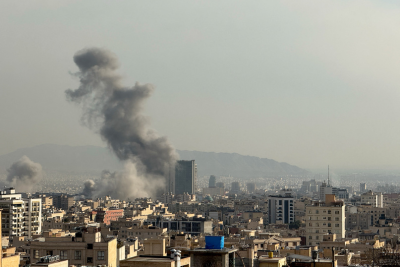
Trump first made his case for the U.S. and Israeli military bombing, which started on Feb. 28, in two videos that day and the next. In his first remarks, he said, “Our objective is to defend the American people by eliminating imminent threats from the Iranian regime, a vicious group of very hard, terrible people. Its menacing activities directly endanger the United States, our troops, our bases overseas, and our allies throughout the world.” He specifically focused on stopping Iran from having a nuclear weapon.
“It has always been the policy of the United States, in particular, my administration, that this terrorist regime can never have a nuclear weapon. I’ll say it again. They can never have a nuclear weapon,” Trump said. The White House on March 2 sent out a list of 74 times Trump has said something similar, saying in the press release, “This position — rooted in longstanding, bipartisan American policy — guides his actions to ensure the leading state sponsor of terrorism cannot threaten the world with nuclear devastation.”
A year ago, in late March 2025, the U.S. Intelligence Community assessed that “Iran is not building a nuclear weapon and that [Supreme Leader Ayatollah Ali] Khamenei has not reauthorized the nuclear weapons program he suspended in 2003.” However, in a congressional hearing about that assessment, Director of National Intelligence Tulsi Gabbard also said, “Iran’s enriched uranium stockpile is at its highest levels and is unprecedented for a state without nuclear weapons.”
Last June, Trump said he believed Iran was “very close” to obtaining a nuclear weapon, an apparent contradiction to the IC assessment. Days later, the U.S. bombed three Iranian nuclear facilities. In his Feb. 28 remarks, Trump repeated his claim that those military strikes had “obliterated the regime’s nuclear program” at those sites. (As we’ve written, experts and a classified U.S. intelligence report said the sites were damaged and the enrichment program set back — but the sites and nuclear capabilities weren’t completely destroyed.) Trump said that Iran refused to make a deal after the June bombings and refused to “renounce their nuclear ambitions, and we can’t take it anymore.”
“Instead, they attempted to rebuild their nuclear program and to continue developing long-range missiles that can now threaten our very good friends and allies in Europe, our troops stationed overseas, and could soon reach the American homeland,” the president said.
We’ll explain what arms control experts say about Iran’s long-range missile capabilities and the state of its damaged nuclear enrichment program.
Nuclear Program
In his Feb. 28 comments, Trump said the U.S. “will ensure that Iran does not obtain a nuclear weapon” and that after the June 2025 U.S. bombing of Iranian nuclear facilities, “they attempted to rebuild their nuclear program.” Arms control experts told us that last year’s bombing set back Iran’s nuclear program and there’s a lack of evidence that the country was rebuilding it.
“In the absence of IAEA monitoring, accurate information is scant,” Emma Sandifer, program coordinator at the nonpartisan Center for Arms Control and Non-Proliferation, told us in an email, referring to the International Atomic Energy Agency. The IAEA hasn’t been able to assess the three bombed nuclear program sites, though it has inspected all other declared nuclear facilities in the country, the IAEA chief told Reuters in January.
“These actions are right,” Trump said in his March 1 video statement, “and they are necessary to ensure that Americans will never have to face a radical, bloodthirsty terrorist regime armed with nuclear weapons and lots of threats.”
A week before the recent military operation, on Feb. 21, Trump’s special envoy to the Middle East, Steve Witkoff, was more definitive in describing a time frame for Iran’s nuclear ambitions. Witkoff said in a Fox News interview that while Iran says that its nuclear capability is “about their civil program … they’ve been enriching well beyond the number that you need for civil nuclear. It’s up to 60%. They are probably a week away from having industrial-grade bomb-making material, and that’s really dangerous.” But experts told us it would likely take months for Iran to enrich uranium to that level and then much longer before the “bomb-making material” could be made into a weapon.
Daryl G. Kimball, executive director of the Arms Control Association, a nonpartisan organization that provides analysis on arms control and national security issues, told us that “it is clear that it would take Iran years to fully rebuild its enrichment plants” that were bombed in June 2025. “It is possible that Iran may have a very small number of operational centrifuges somewhere undisclosed,” Kimball said. “But it would still take months for a smaller number of centrifuges to accomplish what thousands of centrifuges at these major facilities could’ve done,” which would be to enrich small amounts of uranium to weapons-grade level and then turn it into metal to be used for a weapon. “It would take longer to fashion a nuclear explosive device.”
Eliana Johns, a senior research associate with the nuclear information project at the Federation of American Scientists told us that “if Iran enriches uranium to weapons-grade, they will need to weaponize the material and develop a nuclear device with other sensitive components. It’s relatively easy to put various payloads on a missile; however, while Iran certainly has ballistic missiles that could theoretically be used for this purpose, there are still challenges with designing a nuclear device that can be mated with the intended missile, will detonate when desired, survive reentry, and arrive accurately at its target.”
As we’ve reported before, the “breakout time” — a term that refers to the time Iran would need, if it chose to do so, to produce weapons-grade uranium that could then be used for one bomb — had been about a week or so for at least the past few years. However, “‘breakout time’ is often misleading,” Sandifer said. “While the time it may have taken Iran to enrich enough weapons-grade uranium for a nuclear weapon may have once been a matter of weeks, that is only one piece of the puzzle. After this point, once you have the weapons-grade uranium, Iran would then need to manufacture the rest of the weapon. This process would likely take much longer, perhaps months to a year.”
She said that estimating this time is difficult, since the IAEA hasn’t been able to assess Iran’s operations since the June 2025 airstrikes. “Regardless, the damage to Iran’s nuclear weapons program, however severe, likely lengthened any ‘breakout time’ whether it relates to Iran’s stockpile of highly enriched uranium or the manufacturing of a nuclear weapon.”
Kimball said that last year’s bombings “severely damaged Iran’s major uranium enrichment facilities, but not its resolve to retain a nuclear program or its nuclear know-how. Nor did the operation remove or help account for 400 kilograms of uranium enriched to 60 percent U-235 that Iran already had stockpiled, and that the IAEA reported this week is buried [at] Iran’s nuclear complex near Isfahan.”
To be weapons-grade, the uranium would need to be enriched to 90%. Isfahan is one of the sites hit in the June strikes, but, again, the IAEA hasn’t had access to the site in order to account for the 60% enriched material.
As for Trump’s statement that Iran “attempted to rebuild their nuclear program” after last year’s airstrikes, Kimball and Sandifer said there wasn’t evidence of that. “There is no evidence from the IAEA, from independent analysis of commercial satellite imagery, nor any evidence presented to Congress from the U.S. intelligence Community that Iran was rebuilding the damaged nuclear facilities and preparing to restart enrichment operations,” Kimball said.
Sandifer said that satellite images in January “showed repair activity at two of the Iranian nuclear sites bombed in June of 2025, the Natanz and Isfahan facilities. However, there is a lack of evidence that Iran had taken steps toward rebuilding its nuclear program beyond these repairs. Some experts believe that this activity was not a sign of reconstruction but an assessment of the damage to key assets.”
Other experts similarly have said there’s not evidence of Iran restarting a nuclear enrichment program. “There’s a general conclusion today that there’s a de facto suspension of enrichment,” Robert Einhorn, a senior fellow in the arms control and non-proliferation initiative at the Brookings Institution think tank and a former State Department official during the Obama administration, told the Wall Street Journal. “There’s no enrichment taking place.”
Before the June 2025 bombings, a May 31, 2025, report from the IAEA said it “has no credible indications of an ongoing, undeclared structured nuclear programme” to develop nuclear weapons in Iran, and it noted high officials in the country have said that using nuclear weapons was “incompatible with Islamic Law.” But the IAEA said it had concerns about “repeated statements by former high-level officials in Iran related to Iran having all capabilities to manufacture nuclear weapons.”
The agency said, “[T]he fact that Iran is the only non-nuclear-weapon State in the world that is producing and accumulating uranium enriched to 60% remains a matter of serious concern, which has drawn international attention given the potential proliferation implications.”
In Trump’s Feb. 28 remarks, he spoke generally of “eliminating imminent threats from the Iranian regime.”
Kimball told us that “[w]hile Iran’s nuclear program remains a medium- to long-term proliferation risk, there was and is no imminent Iranian nuclear threat; Iran is not close to ‘weaponizing’ its nuclear material so as to justify breaking off negotiations and launching the U.S.-Israeli attack.”
Speaking in the White House on March 3, Trump said of the U.S. military strikes: “If we didn’t do what we’re doing right now, you would have had a nuclear war, and they [Iran] would have taken out many countries.”
Missiles Capable of Reaching U.S.?
In his State of the Union address on Feb. 24, Trump said Iran was “working to build missiles that will soon reach the United States of America.”
While “soon” is a subjective term, experts say the threat of Iran developing an intercontinental ballistic missile capable of reaching the mainland of the United States was not particularly imminent. One expert put the time frame at several years, while others have said it would take Iran a decade or more to develop a functioning ICBM.
“Iran’s missile arsenal remains one of the pillars of its security strategy,” Sandifer, of the Center for Arms Control and Non-Proliferation, told us. “However, there is little evidence that Iran could build missiles that reach the United States in the near future. Recent estimates determined that not only does Iran have no intercontinental ballistic missile capability, but the country appears to have maintained its self-imposed missile range limit of 2,000 km.”
Rosemary Kelanic, director of the Middle East program at Defense Priorities, a Washington-based think tank advocating restraint in U.S. foreign policy, said Iran currently lacks the technological ability to build an effective ICBM.
“If you’re building an ICBM, there’s lots of technical details behind it, but broadly speaking, you’ve got to be able to shoot something out of the atmosphere into low Earth orbit,” Kelanic told us in a phone interview. “Then you need to be able to have it reenter the atmosphere and not burn up on reentry, which is a different level of technological difficulty. There’s no evidence Iran can do that yet. And then you also have to be able to put a warhead on it … and the added difficulty that you need to miniaturize the warhead, to put it on a missile that would be capable of shooting that far out of the atmosphere and then coming back in and not burning up on reentry. Then you also have to do guidance systems to make sure it lands in the right place. And there’s no evidence that Iran can do that either.”
In addition to the State of the Union speech, Trump has on two other occasions this past week said that Iran is developing long-range missiles that could “soon” reach the U.S.
A day after the State of the Union address, Secretary of State Marco Rubio was more circumspect when a reporter asked how far away Iran was from achieving the development of missiles that could reach the U.S.
“I won’t speculate as to how far away they are, but they are certainly trying to achieve – and this is not new — they are trying to achieve intercontinental ballistic missiles,” Rubio said. “For example, you’ve seen them try to launch satellites into space. You’ve seen them increasing the range of the missiles they have now, and clearly they are headed in the pathway to one day being able to develop weapons that could reach the continental U.S. They already possess weapons that could reach much of Europe — already now, as we speak. And the ranges continue to grow every single year exponentially, which is amazing to me. For a country that’s facing sanctions, whose economy’s in tatters, whose people are suffering – and somehow they still find the money to invest in missiles of greater and greater capacity every year. This is an unsustainable threat.”
Several Democrats pushed back on the idea that Iran would “soon” be able to reach the continental U.S. with missiles.
“There was no way that any Iranian ballistic missile can hit the U.S. mainland,” Democratic Sen. Ruben Gallego said on CNN on March 1. “That is just entirely false.”
“All of the intelligence I’ve seen in 13 years on the Armed Services and Foreign Relations Committees tell me there is no imminent threat from Iran that justifies sending our sons and daughters into war,” Democratic Sen. Tim Kaine said on Fox News. “The missile issue is important. The intelligence suggests that Iran might have missiles that could reach the United States within a decade. There was nothing imminent about this.”
Kaine was referring to a Defense Intelligence Agency report released last May that stated, “Iran has space launch vehicles it could use to develop a militarily-viable ICBM by 2035 should Tehran decide to pursue the capability.” The report, which assessed missile threats that might be faced by a Trump-proposed “Golden Dome” missile defense shield, projected Iran could have 60 ICBMs by 2035.
“So basically, the U.S. intelligence agencies have said that Iran would need 10 years to build ICBMs capable of hitting the United States militarily if they chose to do so,” Kelanic said. “And it did not necessarily say that there was evidence that Iran had chosen to do so. … To me, that doesn’t register as soon.”
“Concern about the development of long-range missiles by Iran is not anything new,” Kimball of the Arms Control Association told us in an email. “The United States is 10,000 km away from Iran. The longest range of a deployed Iranian ballistic missile is 2000 km.”
Kimball noted that the 10-year window has been the intelligence estimate for nearly three decades now.
“A 1999 U.S. National Intelligence estimate predicted that the United States would probably face an ICBM threat from Iran by 2015. It is now 2026,” Kimball said.
Kimball said that the 2025 DIA assessment not only forecast it would take a decade for Iran to develop a ballistic missile capable of hitting the U.S., but that “Iran would need to make a determined push to achieve those capabilities on that timeline,” he said. “A decade or more is not ‘soon.’”
In several posts on X on Feb. 25, however, Jeffrey Lewis, an expert on global security at Middlebury College, warned that many were misreading the context of the Defense Intelligence Agency report.
“The question wasn’t ‘When will Iran have an ICBM’, it was ‘What will the threat environment look like in 2035 when Golden Dome is to be fully operational,'” Lewis wrote. “In other words, it isn’t ‘How soon can my friend have a baby?’ Instead, the question is ‘In 2035, how many children will my friend have?’ It’s easy to say your friend could have a child within ten years and that you expect she might have three.”
A March 2 article in the Wall Street Journal reported that Lewis “said that even if Tehran wanted to pursue building the weapons, it would likely take two to three years at least to build a single missile based on the history of how other nations developed similar missiles.”
“US officials have been saying since the late 1990s that Iran is a little over a decade away from developing an ICBM and is pursuing that capability,” the Federation of American Scientists’ Johns told us. “However, building an ICBM capable of accurately striking the US mainland would require overcoming substantial technical hurdles with propulsion, guidance, and reentry, among other things. And there is little evidence to indicate that Iran has this capacity or intends to pursue it. Given the lack of publicly available and verifiable information, the DIA’s assessment and the statements by the administration are difficult to evaluate, especially regarding what timeline Iran could develop and deploy these longer-range missiles. It is also worth noting that parts of Eastern Europe have technically been within range of Iranian missiles for years.”
In an interview with India Today TV released on Feb. 25, Iranian Foreign Minister Abbas Araghchi denied that Iran was developing ICBMs, Reuters reported.
“We are not developing long range missiles. We have limited range to below 2000 kilometers intentionally,” he said. “We don’t want it to be a global threat. We only have (them) to defend ourselves. Our missiles build deterrence.”
On March 2, Rubio spoke about destroying Iran’s short-range ballistic missiles as the objective of the U.S. military operation. “This operation needed to happen because Iran, in about a year or a year and a half, would cross the line of immunity, meaning they would have so many short-range missiles, so many drones, that no one could do anything about it, because they could hold the whole world hostage,” he said.
Editor’s note: FactCheck.org does not accept advertising. We rely on grants and individual donations from people like you. Please consider a donation. Credit card donations may be made through our “Donate” page. If you prefer to give by check, send to: FactCheck.org, Annenberg Public Policy Center, P.O. Box 58100, Philadelphia, PA 19102.