




A federal indictment against former FBI Director James Comey hinges on the meaning of “86.” The Department of Justice said it indicates a threat of physical harm, while the more common dictionary definition is to throw out or get rid of something.
Legal experts have said the ambiguity of the meaning will make this a difficult case for the DOJ.
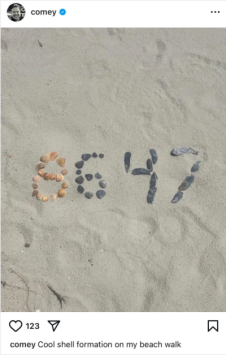
In May 2025, while walking on the beach in North Carolina, Comey said he came across shells arranged to spell out “86 47” — Donald Trump is the 47th president — and he shared the image on Instagram.
According to the online Merriam-Webster dictionary, “eighty-six” is a slang term most commonly used to mean “to throw out,” “to get rid of” or “to refuse service to.” More recently, though, and sparsely, Merriam-Webster says, it has also come to mean “to kill.” And that’s the definition the Department of Justice relies upon.
According to a two-page indictment announced on April 28, Comey “did knowingly and willfully make a threat to take the life of, and to inflict bodily harm upon, the President of the United States” by posting the image of the shells that “a reasonable recipient who is familiar with the circumstances would interpret as a serious expression of an intent to do harm to the President of the United States.”
The indictment includes two charges: threatening the president and “transmitting a threat in interstate commerce” (via Instagram). Combined, the charges carry a maximum penalty of 10 years in prison.
“Threatening the life of the president of the United States will never be tolerated by the Department of Justice,” acting Attorney General Todd Blanche said at a press conference announcing the indictment.
“James Comey disgracefully encouraged a threat on President Trump’s life and posted it on Instagram for the world to see,” FBI Director Kash Patel said in a press release. In the press conference, Patel said the grand jury was presented with the fact that “shortly after posting that threat, he deleted that threat and then issued an apology.”
It’s true that the same day he posted the photo to Instagram, Comey took it down. But he did not apologize.
“I posted earlier a picture of some shells I saw today on a beach walk, which I assumed were a political message,” Comey wrote in a new Instagram message on May 15, 2025. “I didn’t realize some folks associate those numbers with violence. It never occurred to me but I oppose violence of any kind so I took the post down.”
In an interview on MSNBC on May 20, 2025, Comey insisted there was “no dark intention on my part” and that while he regretted the controversy around his post, “it’s hard to have regret about something that, even in hindsight, looks to me to be totally innocent.”
Comey said he thought it was just “a silly picture of shells that I thought was a clever way to express a political viewpoint. And actually I still think it is. I don’t see it the way some people are still saying it is, but again, I don’t want any part of any violence. I’ve never been associated with violence, and so that’s why I took it down.”
Trump wasn’t buying it.
“He knew exactly what that meant. A child knows what that meant,” Trump said on Fox News on May 16, 2025. “If you’re the FBI director, and you don’t know what that meant, that meant assassination, and it says it loud and clear.”
After the indictment, Trump commented on April 29, “If anybody knows anything about crime, they know 86. … It’s a mob term for kill him. You know, you ever see the movies? ’86’ the mobster says to one of his wonderful associates. ’86 him.’ That means kill him. … People think of it as something having to do with disappearing, but the mob uses that term to say when they want to kill somebody, they say, ’86 the son of a gun.'”
As we said, the Merriam-Webster dictionary says the term “eighty-six” is “slang meaning ‘to throw out,’ ‘to get rid’ of, or ‘to refuse service to.’ It comes from 1930s soda-counter slang meaning that an item was sold out. There is varying anecdotal evidence about why the term eighty-six was used, but the most common theory is that it is rhyming slang for nix.”
“In the 1950s the word underwent some functional shift, and began to be used as a verb,” Merriam-Webster says. “The initial meaning as a verb was ‘to refuse to serve a customer,’ and later took on the slightly extended meaning of ‘to get rid of; to throw out.’ The word was especially used in reference to refusing further bar service to inebriates.”
Merriam-Webster notes, “Among the most recent senses adopted is a logical extension of the previous ones, with the meaning of ‘to kill.’ We do not enter this sense, due to its relative recency and sparseness of use.”
The Oxford English Dictionary also says of the U.S. slang term, “In restaurants and bars, an expression indicating that the supply of an item is exhausted, or that a customer is not to be served.” The OED doesn’t include a definition meaning “to kill.”
When the controversy over Comey’s post first erupted last year, Jesse Sheidlower, adjunct assistant professor in Columbia University’s writing program and formerly editor at large for the Oxford English Dictionary, told the Associated Press, “The original sense is, we are out of an item. But there are a bunch of obvious metaphorical extensions for this. 86 is something that’s not there, something that shouldn’t be there like an undesirable customer. Then it’s a verb, meaning to throw someone out. These are fairly obvious and clear semantic development from the idea of being out of something.”
There are some uses of the phrase as a euphemism for killing someone, he said, but that usage is more rare.
“Yes, it can mean ‘to murder,’” Sheidlower told the New York Times last year. “But without any very specific indication that that’s the intended meaning, you’d never assume that. The notion that Comey was suggesting this is completely preposterous.”
Some legal experts say prosecutors will have a hard time proving Comey “knowingly and willfully” posted the photo as a violent threat.
“Posting numbers constitute a threat? I just don’t accept that,” Jimmy Gurulé, a University of Notre Dame law professor and former federal prosecutor, told the Washington Post. “They are going to have to prove that to a jury — beyond a reasonable doubt. … I don’t think they are going to be able to satisfy that legal threshold.”
“I think this indictment is deeply flawed. I think it’s probably fatally flawed. And here’s why,” CNN legal analyst Elie Honig said on April 28. “The law that Justice Department prosecutors have chosen to charge here requires an intent to kill or physically injure the president of the United States. And I think if you look at this communication, these seashells, it’s just way too ambiguous.
“What does 86 mean? Yes, there have been instances in pop culture and elsewhere where people have used 86 to mean kill, but there have been plenty of other instances, apparently far more instances where it simply means to remove or to cross off a list,” Honig said. “And that ambiguity is going to be a major problem for prosecutors because I will tell you, ambiguity is always the enemy of the prosecutors because you have to prove your case not just by 51% or 75%, you have to prove your case beyond a reasonable doubt. And I don’t see any realistic way prosecutors are going to be able to do that here.”
John Keller, a former senior Justice Department official who led a task force to prosecute violent threats against election workers, told the AP that he agreed the term “86” posted by Comey was “ambiguous — it doesn’t necessarily threaten violence and the fact that it was the FBI Director posting this openly and notoriously on a public social media site suggests that he didn’t intend to convey a threat of violence.”
Fox News legal analyst Jonathan Turley wrote in an opinion piece that despite being “one of Comey’s most vocal and consistent critics,” he believes the indictment is “facially unconstitutional absent some unknown new facts.” In order to convict Comey, he said, “the Justice Department will have to show that his adolescent picture was a ‘true threat'” according to the law. “It is not,” Turley wrote.
At the indictment press conference, Blanche was asked how he intended to prove intent when Comey has said he did not associate “86” with doing physical harm.
Blanche said that over the last year, the Department of Justice has done “a tremendous amount of investigation. And how do you prove intent in any case? You prove intent with witnesses, with documents, with the defendant himself, to the extent is appropriate, and that’s how we’ll prove intent in this case.”
This is the second time Trump’s Justice Department has sought criminal charges against Comey. In September, Comey was indicted on two criminal counts alleging he made a false statement to Congress in 2020 and obstructed a congressional proceeding. In November, a federal judge threw out the case, ruling that Lindsey Halligan, the prosecutor who secured the indictment, was unlawfully appointed to her role. The Justice Department has appealed.
On April 28, Comey released a video message on Substack responding to the latest indictment: “Well, they’re back. This time about a picture of seashells on a North Carolina beach a year ago. And this won’t be the end of it. But nothing has changed with me. I’m still innocent. I’m still not afraid, and I still believe in the independent federal judiciary. So let’s go.”
Editor’s note: FactCheck.org does not accept advertising. We rely on grants and individual donations from people like you. Please consider a donation. Credit card donations may be made through our “Donate” page. If you prefer to give by check, send to: FactCheck.org, Annenberg Public Policy Center, P.O. Box 58100, Philadelphia, PA 19102.