




President Donald Trump has said over the last year that money brought in from his increased tariffs would pay for at least half a dozen initiatives — from reducing the national debt to providing dividend checks to “moderate income patriots” — but the revenue raised so far can’t deliver all of them.
In fact, that revenue would be able to cover only a fraction of what the president has proposed. Trump recently highlighted three initiatives that he claimed would be “easily” paid for because of the tariff revenue: an increase in the defense budget, dividend checks for Americans and paying down the debt. It would take several years for the estimated revenue from Trump’s tariffs to cover the cost of those first two proposals, if the tariff rates remain in effect.
“Tariffs fall very short of funding all the priorities the President has suggested they can pay for,” Erica York, vice president of federal tax policy at the Tax Foundation, told us.
“While tariffs are tax increases that raise more revenue for the federal government, the revenue coming in is not enough to cover all the spending the President envisions,” she said.
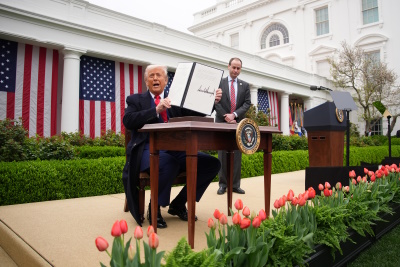
During Trump’s first year in office, from January through December, the U.S. collected $264 billion from tariffs, according to the Treasury Department’s monthly statements. That is more than three times what tariffs brought in during the previous 12-month period, which was about $79 billion.
But many of the president’s new tariffs didn’t go into effect until the second half of the year, and the $264 billion includes already existing tariffs that the U.S. had regularly been collecting.
Projections from the Congressional Budget Office and the Tax Policy Center estimate that revenues from Trump’s new tariffs would average about $230 billion annually over the next decade, with somewhat higher returns in the near future and lower returns in later years as consumers shift away from buying imports.
But just the three policy priorities that Trump recently outlined would total at least $1 trillion, conservatively.
In a Jan. 7 post on Truth Social, Trump proposed a 50% increase to the military budget, bringing it to a total of $1.5 trillion, and said that the tariffs could “easily” pay for that while, at the same time, paying down the national debt and paying for “a substantial Dividend to moderate income Patriots within our Country!”
A breakdown of cost estimates for those three initiatives shows:
Military budget — As described by Trump, an increase from $1 trillion to $1.5 trillion would cost $500 billion.
National debt — The president hasn’t specified how much he would pay down the debt, but the current total debt is more than $38 trillion and rising quickly.
Dividend checks — Trump hasn’t presented details on the checks, and when we asked the White House for information, we didn’t get a response. But he previously said they would be $2,000 checks to be “paid to everyone” except “high income people.” Based on that, an analysis from Yale University estimated the total cost would be $450 billion, if the income limit were $100,000.
So, the total amount collected from tariffs in 2025 would cover only about half of the cost of either the military spending increase or the dividend checks, and it would cover less than 1% of the national debt.
Those three initiatives aren’t the only ones the president has said would be funded by tariff revenue, either. He has also said tariffs would cover military bonus payments and aid to farmers and might even raise enough revenue to one day eliminate income taxes.
We asked the White House for an explanation of how tariff revenue would cover the cost of all these proposals, but we didn’t receive a response.
Further complicating Trump’s claims that tariffs will pay for government programs and make the U.S. “so rich, you’re not going to know where to spend all that money,” is that he’s described conflicting goals. He has said both that tariffs are meant to “bring in tremendous amounts of money” — a goal that depends on a high volume of imports — and also that they are meant to encourage growth in U.S. manufacturing, reducing imported goods and, therefore, the taxes collected on them.
The president has used two primary avenues for imposing his increased tariffs — section 232 of the Trade Expansion Act and the International Emergency Economic Powers Act, or IEEPA, which has never before been used to implement tariffs like this, according to legal experts.
So far, in the fiscal year that started in October — which also captures the time period during which most of the new tariffs were in effect — collections from the IEEPA tariffs have made up 67% of the total tariff revenue collected, according to data from U.S. Customs and Border Protection.
The question as to whether or not Trump can use the IEEPA to impose tariffs is before the U.S. Supreme Court, which is expected to rule soon.
During oral arguments for that case, the lawyer for the administration, Solicitor General D. John Sauer, argued that the tariffs under the IEEPA are legitimate because they are a negotiating tool rather than a means of raising tax revenue. “These are regulatory tariffs. They are not revenue-raising tariffs,” he said. “The fact that they raise revenue is only incidental. The tariffs would be most effective, so to speak, if no person ever paid them.”
Using the example of the national emergency regarding the trade deficit that Trump declared on April 2, Sauer explained further, “If you look at the trade deficit emergency, if nobody ever pays the tariffs and instead Americans direct their consumption towards American producers and stimulate the rebuilding of our hollowed-out manufacturing base, then the policy is by far the most effective.”
York pointed to this argument in saying, “The President has made many contradictory statements about his rationale for imposing tariffs. For tariffs to continue generating revenue, we need to continue importing goods into the United States. But if, as the administration argued before the Supreme Court, revenue is not the rationale and ideally the tariffs would generate no revenue, then the President should not plan to fund his expenditure plans with tariffs.”
Here’s a breakdown of six initiatives Trump has said tariff revenues would fund.
Replacing the Federal Income Tax
Trump has repeatedly said that tariff revenue could potentially replace the federal income tax.
He said in the spring, “And it’s possible we’ll do a complete tax cut. Because I think the tariffs will be enough to cut all of the income tax.”
And he repeated the idea in the fall, saying, “And over the next couple of years, I think we’ll substantially be cutting — and maybe cutting out completely — but we’ll be cutting income tax, could be almost completely cutting it because the money we’re taking in is going to be so large,” referring to tariffs and trade deals.
As we’ve written before, there is a yawning gap between the revenues raised from personal income taxes versus those raised from tariffs. In fiscal year 2024, tariffs on imports accounted for less than 2% of the more than $4.9 trillion in federal receipts.
Using the most recent monthly Treasury report, the U.S. brought in a total of $484 billion during the month of December. Half of that — $242 billion — came from individual income taxes. Tariffs, however, made up about 6% of the total revenues — $28 billion.
“It is literally impossible for tariffs to fully replace income taxes,” Kimberly Clausing and Maurice Obstfeld, economists with the Peterson Institute for International Economics, wrote last year. “Tariff rates would have to be implausibly high on such a small base of imports to replace the income tax, and as tax rates rose, the base itself would shrink as imports fall, making Trump’s $2 trillion goal unattainable.”
Reducing or Eliminating the National Debt
The president frequently says that he will use tariff revenues to pay down the national debt, as he did in November, saying, “We’re going to be lowering our debt, which is a national security thing.”
The total national debt, including money the federal government owes to itself, is $38 trillion, as of this month.
As we said, the total amount brought in by tariffs in 2025 was $264 billion, which is less than 1% of the national debt.
Trump hasn’t said how much of the tariff revenue he would use to try to pay down the debt, but it’s worth noting that some of his policies are projected to further increase yearly deficits — and ultimately, the total debt. For example, the One Big Beautiful Bill Act, which extended parts of the Tax Cuts and Jobs Act from his first term and introduced other new tax cuts, is projected by the nonpartisan Congressional Budget Office to increase budget deficits by $3.4 trillion from 2025 to 2034.
For comparison, the CBO has estimated that new tariff rates enacted from Jan. 6 to Nov. 15, 2025, will bring in about $2.5 trillion over 11 years, if those tariffs remain the same. The deficit reduction would be $3 trillion, including the impact on debt interest. So, the total tariff revenues aren’t even expected to cover the cost of a policy Trump has already enacted.
Increasing the Military Budget
The budget for the Department of Defense in fiscal year 2026 is about $900 billion.
In his Jan. 7 Truth Social post, Trump proposed raising that total budget by about 50%.
“I have determined that, for the Good of our Country, especially in these very troubled and dangerous times, our Military Budget for the year 2027 should not be $1 Trillion Dollars, but rather $1.5 Trillion Dollars,” he wrote.
“[B]ecause of Tariffs, and the tremendous Income that they bring … we are able to easily hit the $1.5 Trillion Dollar number,” Trump said.
The Committee for a Responsible Federal Budget has estimated that this proposed increase would total $5 trillion through 2035 and add $5.8 trillion to the national debt, including interest.
“In reality, the military spending increase would be about twice as large as expected tariff revenue,” the CRFB said.
‘Warrior Dividends’
“We’ve taken in hundreds of billions of dollars in tariffs. We gave the military, the entire military … $1,776 dollars, that’s not bad,” Trump said on Dec. 31, referring to so-called “warrior dividend” bonus checks sent to military personnel in December.
When he announced the program on Dec. 17, the president said the bonuses were made possible by revenue from tariffs and the One Big Beautiful Bill Act.
They were actually entirely funded by a $2.9 billion appropriation in the One Big Beautiful Bill Act, which passed in July – a reallocation of funds initially earmarked for an increased housing allowance.
The $1,776 checks were sent to about 1.5 million active-duty and reserve military members, according to a post from the U.S. Army. That would put the total cost at about $2.6 billion.
Dividend Checks
The president has also promised tariff-revenue dividend checks to most Americans.
On Nov. 9, Trump posted on Truth Social, “A dividend of at least $2000 a person (not including high income people!) will be paid to everyone.”
He reiterated that pledge in his Jan. 7 post, but hasn’t offered any further details.
A Yale University analysis estimated that, based on the expectation that the program would provide $2,000 checks for those making under $100,000, it would cost $450 billion.
For reference, the last round of COVID-19 economic stimulus checks — which provided $1,400 to those making less than $75,000 and $1,400 per dependent — went to about 176 million people and cost just under $410 billion, according to the Government Accountability Office.
Farmer Bailout
After China slashed its purchase of American soybeans in 2025 following Trump’s imposition of additional tariffs, the administration announced a $12 billion aid payment for farmers.
“The Soybean Farmers of our Country are being hurt because China is, for ‘negotiating’ reasons only, not buying. We’ve made so much money on Tariffs, that we are going to take a small portion of that money, and help our Farmers,” Trump posted on Truth Social on Oct. 1.
During the official announcement on Dec. 8, he repeated the claim that the bailout would be funded by tariffs, saying, “because of the tariffs, this is possible.”
But the bailout is being paid for by the Commodity Credit Corporation, which provides funding for agricultural programs and gets regular appropriations from Congress, according to a press release from the U.S. Department of Agriculture.
Editor’s note: FactCheck.org does not accept advertising. We rely on grants and individual donations from people like you. Please consider a donation. Credit card donations may be made through our “Donate” page. If you prefer to give by check, send to: FactCheck.org, Annenberg Public Policy Center, P.O. Box 58100, Philadelphia, PA 19102.