




President Donald Trump has threatened to invoke the Insurrection Act to send federal military forces to Minneapolis in response to protests against Immigration and Customs Enforcement actions in the city. We’ll explain what the law says about the president’s authority to do so.
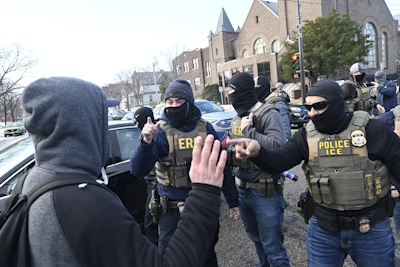
Trump cited the act in a Jan. 15 social media post, eight days after an ICE officer fatally shot Renee Nicole Good during a protest confrontation. The shooting sparked more protests in Minneapolis and the Trump administration’s deployment of hundreds more immigration officers to join 2,000 Department of Homeland Security agents sent to the Minneapolis-St. Paul area as of early this month, according to DHS. The department has called it “Operation Metro Surge.”
“If the corrupt politicians of Minnesota don’t obey the law and stop the professional agitators and insurrectionists from attacking the Patriots of I.C.E., who are only trying to do their job, I will institute the INSURRECTION ACT,” Trump wrote on Truth Social.
On Jan. 12, Minnesota and the Twin Cities filed a lawsuit against DHS, asking the courts to end the surge of immigration officers, calling it “unconstitutional and unlawful.” The suit says that the “agents’ reckless tactics endanger the public safety, health, and welfare of all Minnesotans.”
Minneapolis Mayor Jacob Frey said on Jan. 15 that the city’s police force was “approximately 600,” while there were “approximately 3,000 ICE agents in the area.” The latter figure, which includes other DHS officers, not solely ICE, amounts to “nearly one agent for every 1,000 of the Twin Cities’ 3.2 million residents,” the Minnesota Star Tribune reported.
Last fall, Trump similarly said he could invoke the Insurrection Act to override the objections of the Illinois and Oregon governors to Trump’s National Guard troop deployments in those states. (Those deployments have been blocked by the courts while litigation proceeds.) Here, we’ll repeat much of what we wrote about the law in an Oct. 17 article about the issue then.
What’s the Insurrection Act?
Under the Posse Comitatus Act of 1878, federal military forces can’t perform civilian law enforcement tasks. However, the Insurrection Act provides an exception to this.
Under the Insurrection Act, which dates back to 1792, a state legislature or governor could request that the president send federal military forces to suppress an insurrection, or the president could invoke the act himself “[w]henever the President considers that unlawful obstructions, combinations, or assemblages, or rebellion against the authority of the United States, make it impracticable to enforce the laws of the United States in any State by the ordinary course of judicial proceedings,” the statute says.
The president also can invoke the act to suppress “any insurrection, domestic violence, unlawful combination, or conspiracy” in two scenarios: if it “hinders the execution” of state and federal laws and deprives people’s constitutional rights or protections and state authorities “are unable, fail, or refuse to protect that right, privilege, or immunity”; or if the insurrection/violence “opposes or obstructs the execution of the laws of the United States or impedes the course of justice under those laws.”
Joseph Nunn, a counsel in the Brennan Center for Justice’s liberty and national security program, wrote in an explainer on the Insurrection Act that, in theory, it “should be used only in a crisis that is truly beyond the capacity of civilian authorities to manage,” but the statute “fails to adequately define or limit when it may be used.” Nunn, who has written about limiting the use of the military for law enforcement purposes, said the statute is “dangerously overbroad and ripe for abuse.”
In his Jan. 15 social media post, Trump said that “many” presidents have used the act, and a week prior, he said that “48 percent of the presidents have used it.”
Eighteen of 45 presidents, or 40%, have invoked the act for crises such as rebellions, labor disputes and enforcing civil rights federal court orders. Most of these crises occurred prior to 1900. The most recent use of the act was in 1992, when the California governor asked President George H.W. Bush to do so in order to send federal troops to assist with civil unrest that erupted in Los Angeles following the acquittal of white police officers charged for beating Rodney King, a Black motorist.
The Brennan Center for Justice has a list of all times the Insurrection Act has been used for 30 crises, dating back to 1794 under President George Washington. Troops have not always been deployed. “Sometimes the mere threat of military intervention has been enough to resolve a crisis,” the Brennan Center said.
William Banks, a professor at Syracuse University College of Law, and Mark P. Nevitt, an associate professor at Emory University School of Law, wrote in a piece for Just Security that “the last time the National Guard was federalized over a governor’s objection was in 1965, when President Lyndon B. Johnson deployed the Guard to Selma, Alabama to protect civil rights demonstrators.” Johnson invoked the Insurrection Act.
In 1989, Bush invoked the act to send troops to the Virgin Islands to quell lawlessness following the destruction caused by Hurricane Hugo. The Brennan Center says there’s a dispute over whether the territorial governor of the islands requested the federal deployment.
There’s “little case law” on the act, Nevitt told us last fall. Nevitt said in an email that the “leading case is from the War of 1812 (Martin v. Mott), where the Supreme Court suggested that the president has broad discretion in interpreting the act’s statutory language.”
Nevitt said there’s no judicial review in the statute and “courts have been reluctant to second-guess presidential authority in using the military,” but the courts are addressing such authority in the cases in California, Oregon and Illinois involving federalization of the National Guard over governors’ objections. “A court challenge is likely,” if Trump uses the Insurrection Act, “but it remains to be seen whether a federal judge will find the case justiciable,” Nevitt said.
Nunn wrote that the high court “has suggested that courts may step in if the president acts in bad faith, exceeds ‘a permitted range of honest judgment,’ makes an obvious mistake, or acts in a way manifestly unauthorized by law” and “that courts may still review the lawfulness of the military’s actions once deployed.”
In an Oct. 12 ABC News interview, former New Jersey Gov. Chris Christie, who is also a former U.S. attorney, said that if Trump invokes the Insurrection Act, “you can’t stop him if you’re the governor.” But the governor “could always bring a court action and then the courts could decide whether the facts are there to support his [Trump’s] invocation of the Insurrection Act,” Christie said.
Editor’s note: FactCheck.org does not accept advertising. We rely on grants and individual donations from people like you. Please consider a donation. Credit card donations may be made through our “Donate” page. If you prefer to give by check, send to: FactCheck.org, Annenberg Public Policy Center, P.O. Box 58100, Philadelphia, PA 19102.