




Q: Is it true that ICE agents are financially rewarded for the number of people taken into custody?
A: The Department of Homeland Security has said there is no such policy, and an immigration think tank told us it is unaware of any payments per arrest. The Wall Street Journal reported that agents “are rewarded for making arrests” but didn’t say how they are rewarded. Immigration and Customs Enforcement quickly scrapped a proposed program to pay bonuses to speed up deportations.
FULL ANSWER
We’ve received several questions from readers about whether Immigration and Customs Enforcement agents get a bonus for each person they arrest. One reader asked if agents are paid $1,500 for each immigrant they arrest. Versions of this claim have circulated on social media, with some posts pointing to a Wall Street Journal article that said ICE officers were “under pressure” to meet a daily nationwide arrest goal and were “rewarded for making arrests.” Some have interpreted this to mean a financial bonus.
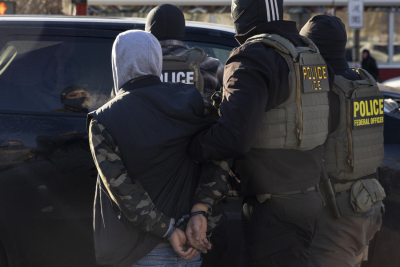
The Department of Homeland Security and ICE didn’t respond to our multiple inquiries asking whether agents receive a bonus payment for each arrest. However, a DHS spokesperson told Snopes, which wrote about these claims, that “this policy has never and never was in effect.”
The Migration Policy Institute, a nonpartisan think tank, also told us it wasn’t aware of any per-arrest bonus structure. Michelle Mittelstadt, MPI’s director of communications and public affairs, said, “We do not believe these claims regarding bonuses for arrests are accurate. ICE and its parent agency, DHS, have never indicated that they would set up a bonus payment structure rewarding personnel per arrest.”
In August, the New York Times reported on an ICE proposal to pay bonuses for quicker deportations — but it was canceled before it started and didn’t pertain to arrests. According to the Times, an internal ICE email proposed “cash bonuses to agents for deporting people quickly, an incentive meant to motivate the staff to speed up President Trump’s mass deportation campaign. Less than four hours later, the agency abruptly canceled what was supposed to be a 30-day pilot program.”
The Times reported that documents it reviewed called for $100 and $200 bonuses for each immigrant deported within one or two weeks of arrest. But a subsequent email to ICE field offices from Liana J. Castano, an ICE field operations official, told staff to “PLEASE DISREGARD” the program, the newspaper reported.
As we said, some social media posts about arrest bonuses have pointed to a Jan. 17 Wall Street Journal article. The article about immigration enforcement in Minneapolis said that “officers here and elsewhere are under pressure from daily arrest quotas that leadership has set at 3,000 a day across the country—the number it would take to reach one million arrests in a year, according to ICE officials familiar with the matter. Though ICE has never come close to meeting that daily goal, officers are rewarded for making arrests, even if the immigrants they take in are later released.”
The administration has publicly acknowledged the 3,000 arrest goal. In May, senior White House adviser Stephen Miller said on Fox News that the administration was “looking to set a goal of a minimum of 3,000 arrests for ICE every day and President Trump is going to keep pushing to get that number up higher each and every single day.”
It’s unclear from the Wall Street Journal article how officers are “rewarded for making arrests”; the story says nothing about financial payments and doesn’t offer any more explanation about these rewards. We reached out to the Journal reporters for clarification, but we did not receive a response.
We also didn’t get a response from DHS or ICE when we asked for comment on the Journal’s article.
Some, including Minnesota Democratic Sen. Amy Klobuchar, posted that ICE was “rewarding” agents, an accurate summary of that article. Others interpreted this as a “bonus.” For instance, David J. Bier, the director of immigration studies at the libertarian Cato Institute, posted part of the article on X and said, “ICE agents get bonuses when they make wrongful arrests of US citizens.” Democratic Sen. Ruben Gallego, of Arizona, shared Bier’s post and said, “Mistakenly arrest a US citizen? You get a big fat bonus.”
Beyond these interpretations of the Journal’s article, we were unable to find evidence regarding claims about per-arrest bonuses. Bier told us the Journal story was the only information he had. Gallego’s office hasn’t responded to our inquiry.
Snopes reported that some of its readers appeared to misconstrue the daily 3,000 arrest goal with a “$3,000 bonus for each arrest,” as some readers asked about.
According to DHS press releases, there is a signing bonus of up to $50,000 for new ICE hires. But that’s a recruitment and retention incentive, and there’s no indication it is tied to the number of arrests, or deportations for that matter, that an agent performs.
The Republicans’ 2025 budget bill, called the One Big Beautiful Bill Act, provided $858 million for the signing bonuses, which, the legislation says, would be for new agents, officers or attorneys who agree to serve for five years or those already working for ICE who agree to stay with the agency for two more years.
Last year, DHS announced incentive funding to state and local law enforcement agencies that partner with ICE to arrest immigrants living in the country illegally. Beginning Oct. 1, DHS said that participating agencies would receive reimbursement for trained officers’ salaries and benefits along with quarterly performance-based bonuses. These monetary awards range from $500 to $1,000 per “eligible task force officer,” depending on “the successful location of illegal aliens provided by ICE and overall assistance to further ICE’s mission to Defend the Homeland.”
But that quarterly bonus program is for state and local police that cooperate with ICE, not a payment per arrest for ICE officers.
Editor’s note: FactCheck.org does not accept advertising. We rely on grants and individual donations from people like you. Please consider a donation. Credit card donations may be made through our “Donate” page. If you prefer to give by check, send to: FactCheck.org, Annenberg Public Policy Center, P.O. Box 58100, Philadelphia, PA 19102.