




Is the U.S. at “war” with Iran? Americans are getting conflicting messages from the Trump administration and congressional leaders.
“We are not at war. We have no intention of being at war,” House Speaker Mike Johnson said at a press conference on March 5, hours after Republicans in the House blocked a war powers resolution that would have required congressional approval for any further military action against Iran. Instead, Johnson called the military action a “limited operation.”
But in remarks to reporters on March 7 — and on other occasions — “war” is exactly how President Donald Trump has described it.
“We’re winning the war by a lot,” Trump told reporters on March 7. “The war itself is going unbelievably. It’s as good as it can be.”
While there are varying definitions of war even among academics who study such things, the war-or-not political debate is mostly about the legal definition of war according to the Constitution, and the implications that come with such a designation.
While Article II of the U.S. Constitution designates the president as “Commander in Chief of the Army and Navy,” Article I, Section 8 of the Constitution gives Congress — and only Congress — the power “To declare War.” In other words, the president is obligated to seek authorization from Congress before he initiates a war.
But Congress hasn’t formally declared a war since World War II. And it didn’t happen with the military attack initiated by Trump in Iran. Rather, in accordance with the 1973 War Powers Resolution, Trump provided a report to Congress on March 2 about the administration’s justification for the U.S.-Israeli joint strikes against Iran initiated on Feb. 28.
“So currently, if political leaders were to say that this is a war, they would also be acknowledging that the administration’s actions were unconstitutional,” Stephanie Savell, director of Brown University’s Costs of War project, told us.
In a March 1 post for his Substack, Foreign Exchanges, journalist Derek Davison wrote that Trump had “made a little verbal slip” when referring to the military operation as a war.
“You’re not supposed to refer to these sorts of things as ‘wars’ when you’re the president of the United States, at least not at their outset, because by law wars have to be declared by Congress,” Davison wrote. “Presidents have leeway to engage in military action prior to a congressional vote but only in self-defense, which was plainly not the case here even if one were to stretch that term beyond all comprehension.”
But Trump numerous times has referred to the situation with Iran as a war.
“We have unlimited middle and upper ammunition, which is really what we’re using in this war,” Trump said in remarks on March 3.
“We’re doing very well on the war front, to put it mildly, I would say,” Trump said on March 4.
In his remarks on March 7, when talking about American casualties, Trump commented, “It’s part of war. It’s a sad part of war. It’s the bad part of war.”
Secretary of Defense Pete Hegseth has also repeatedly referred to the armed conflict as war.
“We didn’t start this war, but under President Trump, we are finishing it,” Hegseth said in a press conference on March 2. “We set the terms of this war from start to finish.”
Those characterizations are in stark contrast to the way many Republican members of Congress have described the military conflagration.
“Nobody should classify this as war. It is combat operations,” Republican Rep. Brian Mast said on CNN the day the U.S. and Israel initiated airstrikes on Iran.
In a press conference on March 3, House Minority Leader Hakeem Jeffries pointed to Trump’s own words to argue that the president “has unconstitutionally and illegally chosen to launch a war.”
“He’s describing it as a war,” Jeffries said. Hegseth “is describing it as a war. Other members of the administration are describing it as a war. And it’s a requirement under the Constitution that it’s members of Congress who make the decision as to whether to get us entangled in this kind of armed conflict.”
As we’ve written before, legal experts have told us that under an originalist interpretation of the Constitution, congressional approval for the use of military force against another country is required. But in practice, several presidents have launched military actions in other countries without congressional authorization.
Robert Johnson, director of Oxford University’s Changing Character of War Center, told us via email, “There is a political reason not to call the campaign against Iran a war. The President must consult Congress and gain approval after 60 days. Until that time, he is permitted to take actions which are in self-defense of the United States, a power the POTUS was granted because [of] the Cold War and the speed at which a nuclear armed attack could be launched.”
“Most scholars and lawyers do not use the term war, even when they should,” Johnson said. “The term in use is armed conflict. This is further defined as an armed attack. A pattern has been set in the last three decades of not declaring war and taking military action, that is, using lethal force to obtain political ends and to neutralise an emergent threat, such as a terrorist attack. Legally, the criteria are that it should be a threat which cannot be dealt with reasonably by any other means and it should be ‘imminent’ as a threat.”
Other Definitions of War
The media and academics, of course, use other definitions of war that have nothing to do with the legal or constitutional considerations.
The Associated Press, for example, decided on March 1 to start using the word “war” to refer to the Israeli-U.S. strikes on Iran and Iran’s retaliation.
“This reflects the scope and intensity of the fighting,” the AP wrote.
The AP noted that the Merriam-Webster dictionary defines war broadly as, “A state of usually open and declared armed hostile conflict between states or nations,” or “a state of hostility, conflict, or antagonism.”
“Even though none of the countries have officially declared war, the attacks by the United States and Israel, combined with Iran’s retaliation, meet those criteria,” the AP noted. “The decision by the Trump administration and Israeli leaders to attack and the subsequent destruction and casualties are enough to call the actions, and Iran’s response, a war. Trump himself has used the word war to describe the conflict.”
Johnson, of the Changing Character of War Center, said, “As a phenomenon, war is a contest of organised polities using lethal armed force at scale. Under this definition, the U.S. is ‘at war.'”
Savell, at the Costs of War project, cited the words of Douglas Fry, an anthropologist of war, in his 2007 book “Beyond War: The Human Potential for Peace.” Fry defined war as: “A group activity, carried on by members of one community against members of another community, in which it is the primary purpose to inflict serious injury or death on multiple nonspecified members of that other community, or in which the primary purpose makes it highly likely that serious injury or death will be inflicted on multiple nonspecified members of that community in the accomplishment of that primary purpose.”
“This fits what the US is doing in Iran,” Savell said.
But there are other definitions used in academia as well.
Scott Wolford, a professor of government at the University of Texas at Austin, and Jeff Carter, a professor in the Department of Government and Justice Studies at Appalachian State University, are co-directors of the Correlates of War Project, which provides a “systematic accumulation of scientific knowledge about war” dating back to 1816.
COW defines war as “‘sustained combat’ between belligerents, or what we might call competitive violence used by groups organized for violence against other groups organized for violence,” Wolford and Carter told us via email.
The conflict between the U.S. and Iran meets their definition of “sustained combat,” they said.
“Operationally, though, to enter the COW data as a war (as opposed to lower-level violence) there’s a battle death cutoff of 1000, above which a conflict enters the data as a war,” they said.
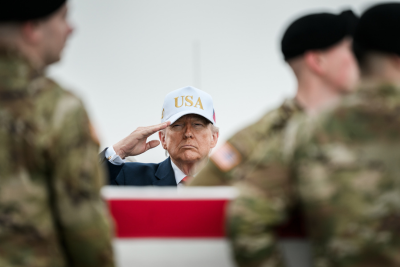
Seven American troops have been killed in the military conflict so far, and retaliatory Iranian strikes have also killed nearly two dozen others in the Middle East region, according to a March 8 New York Times report. Iran’s U.N. ambassador said on March 6 that more than 1,300 Iranian civilians have been killed in the conflict.
Those figures from Iran have not been verified, however, and Carter noted that COW’s 1,000 threshold “applies to members of the combatants’ armed forces,” not civilians.
If the military conflict leads to 1,000 battle deaths, it would be categorized as a war in the COW database, regardless of what either Iranian or U.S. leaders call it. (Iran’s foreign minister, Abbas Araghchi, did call the conflict a “war,” telling PBS News on March 9, “This is a war imposed on us.”)
“The virtue of those definitions is that they’re independent of what governments *say* about whether or not they’re at war,” Wolford and Carter wrote.
“But that’s distinct from the political-legal question of whether this is a war,” they said. “Declarations of war are pretty rare, though Congressional authorizations for the use of force aren’t, and the fact that this conflict began and continues with neither is probably what’s at issue in the public argument over the definition.”
But experts told us the political classification of the conflict could change over time, if the number of American casualties rose, if ground troops were deployed, or if the military action continues for a protracted amount of time.
“If there was a specific and limited set of armed attacks, of short duration, the Administration could sustain the argument that they are not yet at war,” Johnson said. “However, the scale, extent, and possibly duration of [counter] attacks would take us beyond purely legal definitions.”
In remarks on March 11, Trump referred to the military action in Iran as “a little excursion.”
A reporter asked, “You just said, ‘It is a little excursion,’ and you said, ‘It is a war.’ So which one is it?”
“Well, it’s both,” Trump said. “It’s both.”
Editor’s note: FactCheck.org does not accept advertising. We rely on grants and individual donations from people like you. Please consider a donation. Credit card donations may be made through our “Donate” page. If you prefer to give by check, send to: FactCheck.org, Annenberg Public Policy Center, P.O. Box 58100, Philadelphia, PA 19102.