




Q: Has President Trump asked for a billion dollars for the ballroom?
A: Since the White House announced plans in July for a ballroom, the president has promised to fund its construction without using public money. But in May congressional Republicans proposed $1 billion in federal funding for “security adjustments and upgrades” including at the White House and the ballroom site.
FULL ANSWER
President Donald Trump has claimed that the new White House ballroom would be privately funded, using “not one dime of government money.” But Republicans in Congress have proposed $1 billion in public funds for “security” features, prompting criticism from Democrats that this means taxpayers are paying for the ballroom.
The White House has said the congressional proposal is strictly for security elements, not the ballroom itself.
When Trump first began touting the project shortly after he took office in 2025, he said he would foot the bill himself. When it was officially announced on July 31 at an estimated cost of $200 million, the president answered a question from a reporter about the source of the funding, saying, “It’s a private thing, yeah, I’ll do it, and we’ll probably have some donors or whatever.”
The press release for the project said, “President Trump, and other patriot donors, have generously committed to donating the funds necessary to build this approximately $200 million dollar structure. The United States Secret Service will provide the necessary security enhancements and modifications.”
As recently as late March, when the estimated cost had doubled to $400 million, the president maintained that it would be donor-funded, saying, “This is taxpayer-free. We have no taxpayer putting up 10 cents.”
But following the April 25 shooting during the White House Correspondents’ Association dinner, some congressional Republicans cited security concerns and proposed public funding for the project, arguing that the White House needs to have a secure facility for hosting large events.
“If this is not a wake-up call, what would be?” Sen. Lindsey Graham said on April 27, referring to the shooting, while announcing legislation that would authorize $400 million to build the ballroom and fund a military installation below it. (More on that later.)
A week later, Sen. Chuck Grassley, chairman of the Judiciary Committee, announced a proposed $1 billion for the Secret Service to provide “security adjustments and upgrades, including within the perimeter fence of the White House Compound to support enhancements … relating to the East Wing Modernization Project, including above-ground and below-ground security features.” The ballroom is replacing the East Wing.
The funding was part of a $72 billion plan to fund the Border Patrol and Immigration and Customs Enforcement through 2029 without Democratic support. It followed a record-breaking partial shutdown of the Department of Homeland Security that hinged on Democrats’ demands for changes to immigration enforcement policies after agents killed two U.S. citizens — Renee Good and Alex Pretti — in Minneapolis earlier this year.
Democrats panned the proposal, with Rep. Jared Huffman of California saying, “They’re sending Trump $1 billion to build a gilded room for their balls,” and Rep. Susie Lee of Nevada saying, “The economy in NV is tanking, gas prices are going through the roof … and Republicans are throwing down $1 Billion for Trump’s ballroom.” Rep. Jamie Raskin of Maryland wrote on X on May 5, “Trump said, ‘Not one penny is being used from the federal government’ to fund his ballroom boondoggle. True, in the sense that $1 billion is a lot more than one penny!”
In a meeting on May 12, the Secret Service chief reportedly told Republican lawmakers that only $220 million of the $1 billion proposal would be used to fortify the ballroom with bulletproof glass, drone detection equipment, chemical filtration systems and other security elements. The rest would be used for training and security measures elsewhere, as a DHS spokesperson also told us in a statement.
Both the White House and Grassley’s office have responded to the criticism by pointing to language specifying that the $1 billion allocation would cover only “security”-related features. “None of the funds made available under this section may be used for non-security elements of the East Wing Modernization Project,” the legislation reads. We asked Grassley’s office for further details on what might qualify as a security feature, but we didn’t get an answer to that question.
Instead, we were provided a statement attributable to a Senate Judiciary Committee spokesperson that said, “The reconciliation text speaks for itself, providing funds for critical security enhancements to ensure Secret Service can fulfill their duties of securing the White House, protecting the President, members of the administration and White House visitors, and supporting broader public safety for designated events like America 250 and the World Cup.”
Likewise, a White House spokesman said, “The Ballroom will still be paid for with the private funds raised. The reconciliation package introduced was funds for DHS and USSS to better secure the WH complex.”
Here’s what we know so far about the project.
The Ballroom
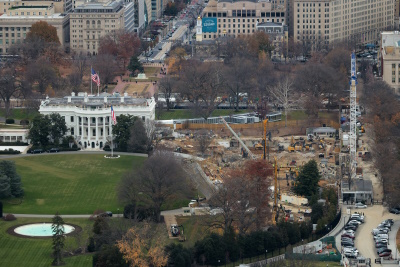
The Trump administration began demolition of the East Wing of the White House in October to make way for what it has described as a 90,000 square-foot ballroom that can seat 650 people, although the president has said that it will have a capacity of 999.
The move drew condemnation from some architectural and historical organizations, prompting a lawsuit from the National Trust for Historic Preservation. In March, the federal judge handling that case ordered that construction of the ballroom should stop until plans receive authorization from Congress, although he allowed for the continuation of construction “necessary to ensure the safety and security of the White House.” The administration has appealed.
Another lawsuit brought against the administration revealed in April the funding agreement for the project. The agreement cited a comprehensive design plan for the White House complex that the National Park Service published in 2000 after about a decade of research, planning and public comment.
That design plan “identified the need for expanded event space to address growing visitor demand and provide a venue suitable for significant events,” the funding agreement said.
That’s true, but nowhere in the plan does it suggest a ballroom to replace the East Wing of the White House. Rather, it emphasized the importance of maintaining the existing structure of the White House complex and recommended expanding space underground, including a new meeting and conference space near the West Wing that could accommodate up to 200 people. It also recommended building a special events plaza in the ellipse on the south side of the White House.
As for the donors who have contributed to the fund to build the ballroom, a reporter asked on May 7 for a list and Trump responded, “I have no problem with it. You’re not supposed to because it’s done under a way where you don’t have to do that, but I have no problem. They’re unbelievable people. These are great patriots.”
In October, the White House released a list that included both companies — such as Amazon and Meta — and individuals — such as the Winklevoss twins, who had accused Mark Zuckerberg of stealing their idea to build Facebook and now run a cryptocurrency exchange, and Stephen A. Schwarzman, CEO of alternative investment firm Blackstone. The list didn’t include any dollar amounts for donations to the ballroom. Trump, himself, was not listed among the donors.
The Bunker
In March, Trump began speaking more about the military’s involvement in the project.
“The military wanted it more than anybody,” Trump said during a Cabinet meeting on March 26.
Three days later, he said, “There’s not one dime of government money going into the ballroom,” but he immediately added that “the military’s building a massive complex under the ballroom, and that’s under construction and we’re doing very well.” He described the ballroom as a “shed” over the subterranean military installation. “Everything’s drone-proof and bulletproof.”
There isn’t much publicly available information about plans for the new installation or the former bunker under the East Wing, which was built during World War II and has been updated over the years. “Known as the Presidential Emergency Operations Center (PEOC), it can become a command center for the president as needed,” the White House Historical Association wrote in a 2024 social media post. “For example, after the September 11, 2001, terrorist attacks, President George W. Bush and his team spent time in the PEOC.”
Trump was also taken to the bunker during his first term, amid protests following the death of George Floyd in 2020. He described the visit as an “inspection.”
The cost of construction for the new bunker and other security elements — which Trump has said would include “bomb shelters” and “very major medical facilities” — is also unclear.
But Trump said on May 7 that the $400 million he’s promised to collect in donations will pay for “the ballroom section of the ballroom,” while the $1 billion proposed in the reconciliation bill is “for projects having to do with safety … in a certain section of the White House grounds. That’s not all for the ballroom.”
We asked both the Defense Department and the Department of Homeland Security, which oversees the Secret Service, if they were paying for any of the construction. The Defense Department didn’t respond.
A DHS spokesperson provided this statement: “The $1 billion in funding included in the reconciliation bill will assist the United States Secret Service in delivering critical security upgrades at the White House to minimize threats, including, but not limited to, the security components of the East Wing Modernization Project, which will afford needed protection for the President, his family, and visitors, along with additional security functions. This hardening of the White House complex is long overdue, especially in today’s heightened threat environment. A majority of the money provided by the bill will fund other core critical missions for the USSS such as training, money for the Special Operations Division, and increased security measures to ensure safety at multiple upcoming events of national significance.”
Update, May 18: The Senate parliamentarian — a nonpartisan professional position that assists in applying legislative rules — found that the $1 billion in funding couldn’t be included in a budget reconciliation bill, Democrats announced on May 16. Reconciliation bills can be passed with only a simple majority. But a spokesman for Senate Majority Leader John Thune indicated in a social media post that Republicans would redraft that provision.
Update, June 10: Senate Republicans removed the $1 billion in security funding from the immigration enforcement legislation. Both chambers of Congress passed the bill with no Democratic support. Trump signed it into law on June 10.
Editor’s note: FactCheck.org does not accept advertising. We rely on grants and individual donations from people like you. Please consider a donation. Credit card donations may be made through our “Donate” page. If you prefer to give by check, send to: FactCheck.org, Annenberg Public Policy Center, P.O. Box 58100, Philadelphia, PA 19102.