




In the midst of a court battle over whether to continue to allow access by mail to the medication abortion pill mifepristone, Republican lawmakers have claimed that 10% or more of women who take the drug have serious side effects. A 2025 report from an anti-abortion group that put forward the figure has been criticized by reproductive health researchers for methodological issues and a lack of transparency about its data source.
Peer-reviewed studies show a far lower rate of serious problems.
Republicans cited the statistic last week while discussing court rulings on medication abortion. The Louisiana-based 5th U.S. Circuit Court of Appeals halted access to mifepristone by mail on May 1, but the Supreme Court temporarily restored access on May 4 for a week. On May 11, the court extended its order through May 14.
Update, May 15: The Supreme Court on May 14 extended its pause on the lower court’s decision, allowing continued access to the drug by mail while the court case proceeds.

“Mifepristone sends 1 in 10 women who use it to the emergency room with life threatening conditions,” Sen. Josh Hawley of Missouri wrote in a May 4 post on X, calling on Congress to ban the drug when used for abortion.
Rep. Riley Moore of West Virginia in an X post that same day called the drug “extremely dangerous” while referring to a thread from a year prior that claimed “1 in 10 women had dangerous complications like sepsis or hemorrhaging,” based on an April 2025 report from the Ethics and Public Policy Center, a conservative nonprofit that opposes abortion.
“Eleven percent of these women will have side effects so bad within the first 45 days that you can cause sepsis or internal bleeding, hemorrhage, things like that,” Rep. Diana Harshbarger from Tennessee said during a May 6 interview with Tony Perkins, who is president of the Family Research Council, a Christian think tank that also opposes abortion. Harshbarger shared a clip of the interview on X.
Harshbarger’s communications director, Max Mallhi, confirmed to us that Harshbarger was talking about the EPPC report. Hawley’s office did not reply to an email asking for the source of the senator’s similar statistic.
The 2025 report, which was also cited by plaintiffs in the case now before the Supreme Court, claimed that 10.93% of women prescribed mifepristone abortions went on to have serious adverse events within 45 days, based on a review of health insurance claims data on more than 865,000 women from an undisclosed source.
Adverse events are health issues that arise after using a drug, but they aren’t necessarily caused by the drug. Serious adverse events are those that are life-threatening or lead to hospitalization, permanent damage or death.
A May 6 amicus brief from 360 reproductive health researchers filed with the Supreme Court said that the EPPC report, which was not published in a peer-reviewed scientific journal, was “riddled with methodological flaws that render its conclusions unreliable.” This conclusion echoed an August 2025 letter by an overlapping group of researchers.
The EPPC report authors “clearly misconstrued and used deceptive methods to erroneously inflate the rate of serious adverse events after an abortion,” Ushma Upadhyay, a public health scientist at the University of California, San Francisco, and an author on both the 2025 letter and the amicus brief, told us last fall.
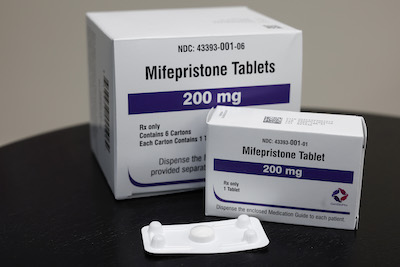
Mifepristone is approved by the Food and Drug Administration for medication abortion through week 10 of pregnancy and is given alongside another drug, misoprostol. During the pandemic, the FDA eased enforcement of requirements that the drug be dispensed in person and in 2023 formally allowed it to be prescribed via virtual telehealth appointments and sent by mail. That year, 63% of abortions in the U.S. were medication abortions, according to the Guttmacher Institute, a research organization that supports reproductive rights.
The case currently being considered by the Supreme Court was brought by the state of Louisiana, which said the FDA’s 2023 decision violated law on proper administrative procedures and was illegal under an 1873 anti-obscenity law. Louisiana claimed the FDA’s actions had injured the state in various ways, such as by interfering with its sovereign ability to ban abortion and costing it Medicaid dollars for treatment for those who had used the drug.
The May 6 amicus brief from reproductive health researchers said that EPPC had failed to disclose key information on where the claims data underlying the study came from or how it was analyzed. We explained before that it is standard when doing research using health insurance claims data to disclose these details, and that researchers experienced in using such data said they had not heard of a dataset that matched EPPC’s description.
“This fundamental lack of transparency precludes any independent verification or reproducibility—fatal deficiencies for any scientific analysis,” the reproductive health researchers wrote in the amicus brief.
In a Feb. 12 amicus brief, EPPC said that it had “entered into a confidentiality agreement with the particular vendor of the database that it is using, in order to protect the vendor from political backlash,” adding that “substantially similar databases are widely available.” The brief also said the report “was internally reviewed and adjudicated by a panel of board-certified obstetricians and gynecologists, who carefully evaluated the clinical classifications, coding, and outcome assessments to ensure medical accuracy and consistency.”
The EPPC report incorrectly counted situations in which someone needed further treatment to complete the abortion as serious adverse events, the reproductive researchers’ amicus brief said, and otherwise “inflated its serious adverse event figures.” For example, the researchers wrote, the EPPC report “inadequately” defined hemorrhage. “Because a successful medication abortion always involves bleeding, EPPC more likely than not misclassified cases of normal, expected bleeding as serious adverse events,” they continued.
Multiple other sources of data on the safety of mifepristone show a far lower rate of serious adverse events. The rate of serious adverse events shown on the drug’s label from the FDA is less than 0.5%, based on data from 10 clinical trials.
Mallhi, the spokesperson for Harshbarger, said the EPPC report’s strength was in using claims data instead.
“FDA’s current label claims are based largely on controlled clinical trials,” Mallhi said in an email. “This study uses real-world claims data, and that is precisely why it matters. When findings this significant emerge, they should be treated as a serious safety signal warranting transparency, full adverse-event reporting, and a thorough FDA review.”
However, published studies using real-world data have corroborated the low rate of serious adverse events reported on the FDA label. For example, one study of Medicaid claims data identified a serious adverse event rate of 0.23%.
(Mallhi went on to say that an FDA review “is especially urgent because, in 2016, the Obama FDA stopped requiring prescribers to report all serious adverse health events associated with chemical abortion pills, leaving deaths as the only adverse-event reporting requirement.” As we’ve written before, in 2016 the FDA relaxed extra reporting requirements for physicians for mifepristone. The standard reporting expected for FDA-approved drugs remained, such as having manufacturers report adverse events, Greer Donley, an abortion law expert at the University of Pittsburgh School of Law, told us.)
Studies of telehealth abortions have not found a safety difference when drugs are dispensed by mail versus in person. In deciding to allow mail access to mifepristone, the FDA consulted relevant peer-reviewed studies and reviews of FDA adverse events monitoring data from the period when in-person requirements were initially relaxed.
In contrast, the EPPC report was not able to shed light on the safety of medication abortion via mail specifically because it did not break down its data by mail versus in-person dispensing, the reproductive researchers who wrote the May 6 amicus brief said.
In its Feb. 12 amicus brief, EPPC referred to a new analysis the group performed, which compared serious adverse events before and after the in-person dispensing requirements were first relaxed in 2020. The analysis, also released in a March 10 fact sheet, claimed that serious adverse events rose from affecting 10.15% of users between 2017 and mid-2020 to 11.5% from mid-2020 through 2023. However, EPPC noted that the group lacked “firm data” on the proportion of prescriptions that were dispensed by mail.
The May 6 amicus brief from the reproductive health researchers said that few by-mail instances were likely included in EPPC’s insurance claims data, because during this period the “vast majority” of medication abortion prescriptions by telehealth were not covered by insurance. “Telehealth is likely not the cause of any such increase,” the researchers wrote.
Editor’s note: FactCheck.org does not accept advertising. We rely on grants and individual donations from people like you. Please consider a donation. Credit card donations may be made through our “Donate” page. If you prefer to give by check, send to: FactCheck.org, Annenberg Public Policy Center, P.O. Box 58100, Philadelphia, PA 19102.