




The head of the Food and Drug Administration’s vaccine division claimed in a leaked email that “at least 10 children” died from COVID-19 vaccination, using that to justify major vaccine regulatory changes. Experts, however, say too little information was provided to verify the claim.

Studies and safety assessments in the U.S. and other countries have repeatedly shown that the COVID-19 vaccines are remarkably safe, including for children, and do not increase mortality risk. While serious side effects can occur, they are rare.
Dr. Vinay Prasad, the official who penned the memo, used the alleged deaths to announce a variety of ways in which the agency would be more stringent in approving future vaccines, which some experts say are unnecessary and impractical and could reduce access to shots.
In a perspective published Dec. 3 in the New England Journal of Medicine, a dozen former FDA commissioners assailed the memo, saying Prasad’s proposals would “impede the ability to update vaccines” and “suppress innovation and competition,” ultimately “disadvantag[ing]” the American people. They added that deaths reported to the CDC and FDA previously “had been carefully reviewed by FDA staff, who drew different conclusions.”
Prasad was installed as the director of the Center for Biologics Evaluation and Research, which oversees vaccines, in May after his predecessor said Health and Human Services Secretary Robert F. Kennedy Jr. forced him to resign.
The email was sent to all CBER staff on Nov. 28 and obtained by multiple news outlets the same day.
“I am writing to report that OBPV career staff have found that at least 10 children have died after and because of receiving COVID-19 vaccination. These deaths are related to vaccination (likely/probable/possible attribution made by staff),” Prasad opened the lengthy email, referring to CBER’s Office of Biostatistics and Pharmacovigilance. “This safety signal has far reaching implications for Americans, the US pandemic response, and the agency itself.”
Prasad went on to explain that Dr. Tracy Beth Høeg, a physical medicine and rehabilitation physician and then-FDA adviser, started investigating reports of death in children from the Vaccine Adverse Event Reporting System, or VAERS, over the summer. By late summer, she had determined “there were in fact deaths,” he said. (On Dec. 3, the FDA announced that Høeg had been appointed acting director of the FDA’s drug evaluation center.)
VAERS is an early warning system that accepts unvetted reports of health problems from anyone following vaccination. The reports do not necessarily mean a vaccine caused a problem, as many events are coincidental. Government websites for VAERS repeatedly caution that it is usually not possible to determine from VAERS data alone whether a vaccine caused an event.
Prasad said he then asked OBPV to analyze deaths reported to VAERS and that the resulting “initial analysis of 96 deaths between 2021 and 2024″ found “no fewer than 10 are related” to vaccination. He added that the coding was conservative and the “real number is higher.”
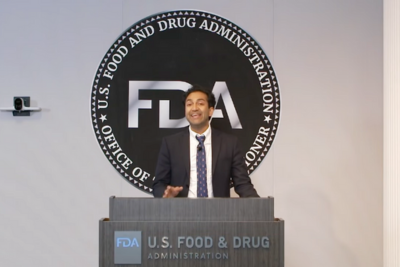
“This is a profound revelation,” he continued. “For the first time, the US FDA will acknowledge that COVID-19 vaccines have killed American children.”
In closing the email, Prasad said he remained “open to vigorous discussions and debate” but that staff who did not agree with his “core principles and operating principles” should resign.
Prasad did not include details on any of the 10 cases, including age, cause of death or which vaccine had been administered. While he referred to myocarditis in the email, he did not specifically say that the deaths were related to the condition.
Myocarditis, or inflammation of the heart muscle, is a known side effect of the COVID-19 vaccines. It is, however, rare, and while it can be serious, is typically mild and less severe than the myocarditis that is caused by other viral infections, including the coronavirus.
Experts told us and other news outlets that given the lack of information, it was unclear how reliable the assessments were. Some also objected to other claims in the email.
“The memo [is] factually incorrect, misleading and disingenuous,” Dr. Anna Durbin, a vaccine researcher at the Johns Hopkins Bloomberg School of Public Health, told us. Prasad “has not provided any evidence to support his conclusion that the vaccine caused the deaths yet asserts he knows the vaccine caused them,” she said, adding that the deaths should be independently investigated.
The FDA did not reply to our inquiry asking for more information, but told the biotech news outlet Endpoints News on Dec. 3 that the agency intended to “make a report publicly available by the end of this month.”
Alleged Deaths
Given the lack of detail, experts said it was difficult to evaluate Prasad’s claim of “at least 10” vaccine-related deaths in children.
“It is impossible to tell from the comments of Prasad any details of the cases and whether they have been comprehensively reviewed and other causes of death have been excluded,” Dr. Kathryn Edwards, a now-retired Vanderbilt University vaccinologist and pediatrician who served on both the CDC and FDA’s vaccine advisory panels, told us in an email. “All deaths reported to VAERS are investigated more fully, but some of the reports do not have comprehensive tests for other causes or autopsies to assess multiple organs.” She added that it is “conceivable” that there were some vaccine-related deaths in kids, “but we have not seen the science to confirm this.”
In previous administrations, Durbin said, reports of VAERS investigations would include how the review of deaths was done, who did the review, and how they came to their conclusions. “We do not have any of this for these. Until we do, it is difficult to assess how rigorous the review was,” she said. “Were those staffers qualified to do the review? I don’t know because none of that information was provided.”
By Prasad’s description, however, it appears that the count includes cases that were deemed only possibly related to vaccination.

One “can never prove with 100% certainty that the vaccine did NOT contribute to the death, so one might question what they meant by ‘possible,’” Susan S. Ellenberg, a biostatistician at the University of Pennsylvania’s Perelman School of Medicine who oversaw VAERS at the FDA between 1993 and 2004, told us in an email. She said it would be interesting to know which types of deaths were considered possible and which were not, as well as how many of the 10 were likely or probable versus possible.
Durbin said it would be “very unusual” to consider cases vaccine-related if there is another possible or probable cause.
Typically, vaccine safety investigations begin but do not end in VAERS. As we’ve explained previously, and a CDC website notes, the system is good at detecting potential safety issues, but such signals are then investigated through other vaccine safety surveillance systems, such as the Vaccine Safety Datalink, which draws information from U.S. health care organizations.
Such investigations have revealed that myocarditis is a side effect of vaccination, but there is no evidence that the vaccines increase the risk of death.
During a safety update presentation before the vaccine advisory panel in June, a CDC staffer reviewed the existing data, noting that the agency is “confident” that “there’s no increased risk of mortality” after COVID-19 vaccination.
Vaccine-related myocarditis is most common — albeit still rare — in teen and young adult males after a second dose. It is very rare in children below the age of 12 and virtually nonexistent in children below the age of 5, according to the presentation. In recent years, too, the risk of developing myocarditis after COVID-19 vaccination has fallen.
A CDC follow-up study of around 500 12- to 29-year-olds experiencing myocarditis after vaccination found that 83% were fully or probably fully recovered after three months, with the rate rising to more than 90% after at least one year. There were no known deaths or cardiac transplants.
It is nevertheless possible that vaccination could be fatal in extremely rare circumstances. There have been isolated reports in the scientific literature of lethal instances of myocarditis that occurred after vaccination, including two cases in teen boys in the U.S. The risk, however, is very low. One 2023 Korean study identified 21 deaths from vaccine-related myocarditis among 44 million people who were vaccinated with at least one dose.
While COVID-19 is usually mild in children, it has caused deaths and many cases of severe disease.
“The number of confirmed covid deaths in children is certainly higher than 10,” Jeffrey Morris, director of the division of biostatistics at the University of Pennsylvania, told us in an email, adding that the risks go beyond death to hospitalizations, ICU stays, and serious inflammatory syndromes and long COVID.
For a while, although death remained rare, COVID-19 was the eighth leading cause of death in people 19 years of age and younger, and the leading cause of infectious disease deaths.
CDC data show that around 2,000 children have died from COVID-19, including 90 confirmed cases between July 2024 and July 2025, which the agency said is likely an undercount.
Regulatory Changes
Using the alleged VAERS deaths as a rationale, Prasad then proposed broad changes to how the FDA approves vaccines, stating the agency would no longer allow antibody data to be used as a proxy for efficacy when evaluating a new vaccine or extending an existing vaccine to a new population. The method is sometimes called immunobridging.
He also said the FDA would “revise” the framework for approving seasonal influenza vaccines — which he said was “an evidence-based catastrophe” — and would reassess how the agency evaluates the safety of vaccines given at the same time.
In their NEJM piece, the former FDA commissioners explained that immunobridging studies have long been accepted by the agency and are important for updating vaccines against pathogens that rapidly evolve.
“The proposed measures will slow the replacement of older products with better ones and will create potentially prohibitive expenses for new market entrants,” they wrote, adding that the changes would also reduce competition and increase prices. “Moreover, insisting on long, expensive outcomes studies for every updated formulation would delay the arrival of better-matched vaccines when new outbreaks emerge or when additional groups of patients could benefit.”
We previously explained the validity of immunobridging when addressing claims from Makary and Høeg in 2022 about the COVID-19 vaccine approvals in children, which were approved based on the method.
“As a former chair of the vaccine advisory committee, VRBPAC, I can say that vaccines are carefully and meticulously assessed for effectiveness and safety and the reviewers at the FDA are experts,” Edwards said, when asked about Prasad’s policy changes. “These comments do not consider any of the adverse events caused by the diseases that the vaccines prevent. None of the benefits of vaccines are acknowledged and none of the rich history and experience of vaccinologists is being called on.”
Other Claims
Experts took issue with several of Prasad’s other claims, including the suggestion that the Biden administration mandated COVID-19 vaccines in schools — the federal government does not have that power — and the idea that there is not “reliable” data on the benefits of COVID-19 vaccination in children.
The FDA commissioners called the latter assertion incorrect. “Reasonable scientists should engage in open debate about how best to shape recommendations for children at lower risk for Covid-19,” they wrote, “but substantial evidence shows that vaccination can reduce the risk of severe disease and hospitalization in many children and adolescents.”
Prasad also implied that the U.S. should have first identified myocarditis as a rare side effect of vaccination instead of Israel. But as Durbin pointed out, Israel began vaccinating earlier and also had the benefit of a universal health care system, which makes it much easier to detect safety signals.
Prasad said that he has seen “no evidence that COVID-19 vaccines, which do not halt transmission, benefit third parties.” Morris told us that his comments misrepresent the evidence. Before the arrival of the omicron variant in 2021, the vaccines were quite effective in preventing infection and thereby reducing transmission. That has since changed significantly, but even now, there is evidence that vaccination helps prevent spread of the virus to at least some degree for a period of time. The main benefit of the vaccines, however, is to prevent severe disease and death.
Editor’s note: FactCheck.org does not accept advertising. We rely on grants and individual donations from people like you. Please consider a donation. Credit card donations may be made through our “Donate” page. If you prefer to give by check, send to: FactCheck.org, Annenberg Public Policy Center, P.O. Box 58100, Philadelphia, PA 19102.