




President Donald Trump said one reason that the U.S. will “run” Venezuela and “indefinitely” control its oil sales is because “years ago” Venezuela “took our oil away from us” and “stole our assets.” That’s an oversimplification of what happened when Venezuela assumed greater control of its energy sector.
In 2007, under then President Hugo Chávez, Venezuela continued the nationalization of its oil industry that began in 1976. The Chavez administration required the foreign oil companies still operating in the country to enter into new contracts giving Venezuela’s state-owned oil and gas company majority control of their oil projects.
The companies that did not agree to those conditions were expropriated, meaning their oil-related assets were seized by the Venezuelan government.
“They did change the terms of the deals that they had with the companies that were operating in Venezuela,” Roxanna Vigil, an international affairs fellow at the Council on Foreign Relations, told us in an interview. But Vigil said the assets belonged to the private companies, not the U.S. government.
Furthermore, the oil in the ground always belonged to Venezuela.
Samantha Gross, director of the energy security and climate initiative at the Brookings Institution, told CBS News that “the oil itself was never ‘our oil,'” as Trump said. Gross clarified that Venezuela has ownership of its oil reserves, which are the largest of any nation.
Two U.S.-based oil companies, Exxon Mobil and ConocoPhillips, did not agree to Chávez’s conditions and left the country. Chevron, another American company, did agree to the terms and continues to produce oil in the country.
But in Trump’s eyes, Venezuela “stole” from the U.S.
“We built [the] Venezuela oil industry with American talent, drive and skill, and the socialist regime stole it from us,” Trump said in a Jan. 3 press conference, in which he talked about the U.S. military operation that led to the capture of Venezuelan President Nicolás Maduro and his wife, Cilia Flores.
The following day, while on Air Force One, Trump told reporters, “It was the greatest theft in the history of America. Nobody has ever stolen our property like they have. They took our oil away from us.”
When we inquired about the president’s claims, a White House official pointed to the nationalization of Venezuela’s oil industry to support what Trump said.
Nationalization in Venezuela
In 1975, Carlos Andrés Pérez, then the president of Venezuela, signed a bill nationalizing the country’s oil industry and creating a state-run company, Petróleos de Venezuela S.A., or PDVSA, to completely control oil production in the country.
A New York Times article from that year said that the new law ended “more than half a century of dominance by foreign oil companies” in Venezuela, including U.S. companies such as Exxon, Mobil and Gulf Oil, which previously had been granted concessions contracts to extract Venezuela’s oil in exchange for at least half of the profits that companies made from oil sales.
Before nationalization, “the contracts that these companies had,” which were set to expire in 1983, “basically authorized them to produce oil and pay royalties and taxes to the Venezuelan government,” Francisco Monaldi, director of the Latin America Energy Program at Rice University, told NPR in a podcast interview published on Jan. 8.
In 1977, a year after nationalization went into effect, the Times reported that about 20 foreign oil companies affected by the takeover ended up being paid about $1 billion in compensation from the Venezuelan government, and some negotiated contracts to continue providing marketing and technological support in the country.
Monaldi said that the arrangement “was not controversial at all with the oil companies.”
In the 1990s, Venezuela implemented a policy that allowed foreign oil companies back into the country specifically for the purpose of increasing oil production, particularly in the Orinoco Belt region, where most of the country’s oil reserves are located. However, things went differently in 2007, when the Chávez regime enacted another nationalization plan that saw PDVSA take a minimum 60% stake in foreign oil projects in the Orinoco Belt.
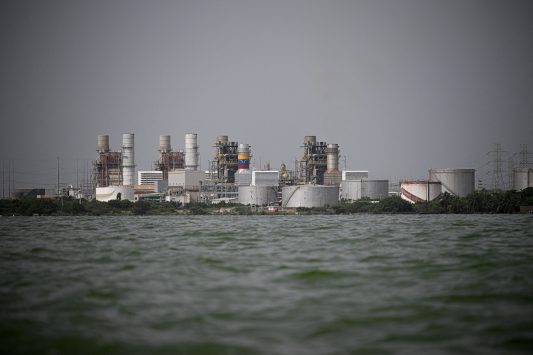
At least four major international oil companies, including Chevron in the U.S., agreed to the terms of new contracts that allowed them to continue their oil operations there. “And in fact, Chevron has been able to make money after they were partially expropriated,” Monaldi said on the podcast.
Two other U.S. companies, Exxon Mobil and ConocoPhillips, did not agree to Chávez’s demands, and withdrew from the country, abandoning their oil projects and equipment. Petro-Canada, which had partnered with Exxon Mobil on an oil project in the country, also opted to pull out of Venezuela.
At the time, news outlets quoted then U.S. State Department spokesman Tom Casey as saying, “The government of Venezuela, like any other government, has the right to make these kinds of decisions to change ownership rules.” But he said he hoped to “see them meet their international commitments in terms of providing fair and just compensation” to the companies.
Exxon Mobil and ConocoPhillips ended up having to go through international arbitration to get compensated by Venezuela for the expropriation of their oil assets.
It wasn’t until 2012 that the International Chamber of Commerce said that Exxon Mobil should receive $908 million in compensation and then awarded $2 billion for ConocoPhillips in 2018. Meanwhile, the World Bank’s International Centre for Settlement of Investment Disputes ordered Venezuela to pay $1.6 billion to Exxon Mobil in 2014 and $8.7 billion to ConocoPhillips in 2019.
The companies say they have been paid only a fraction of the billions of dollars they’re owed.
Future Investments Questionable
Exxon Mobil’s past experience with Venezuela is one of the reasons the company says it is taking a wait-and-see approach to reinvesting in oil ventures in the country – even though Trump has said that U.S. oil companies will now “spend billions of dollars” to fix the country’s “badly broken infrastructure.”
To reenter Venezuela a “third time would require some pretty significant changes from what we’ve historically seen here and what is currently the state,” Darren Woods, Exxon Mobil’s chairman and CEO, said at a Jan. 9 meeting of oil company executives at the White House. “If we look at the legal and commercial constructs and frameworks in place today in Venezuela, today it’s uninvestable.”
Energy experts also have said that improvements would be necessary to secure future investments.
“Foreign companies are looking for an improvement in governance, the restoration of the rule of law, and an easing of US oil sanctions,” including ones levied against Venezuela during the first Trump administration, Luisa Palacios, an adjunct senior research scholar at the Center on Global Energy Policy, said in a Jan. 4 blog post.
She said if the Venezuelan government can “commit to these reforms in a serious way,” leading the U.S. to remove sanctions, it’s “plausible” that in two years, oil production in Venezuela could increase by as much as 1 million barrels per day. As of November, production in the country was about 860,000 barrels per day, according to an International Energy Administration oil market report.
Jorge León, senior vice president and head of geopolitical analysis for Rystad Energy, told ABC News in Australia that it would take 15 years and investments of more than $180 billion for Venezuela to return to its pre-Chavez production rate of 3 million barrels per day.
In the meantime, Secretary of State Marco Rubio said that the U.S. will take from Venezuela “between 30 and 50 million barrels of oil” that have already been produced and packaged, and “sell it in the marketplace.” Purchased at market value, the oil could raise between $1.65 billion and $2.75 billion in revenue for the U.S. government, according to CNN.
Energy Secretary Chris Wright told CNBC that any oil revenue would first be used to help “stabilize the economy in Venezuela.” He said that repaying the U.S. oil companies that Venezuela still owes money is a “longer term issue.”
Editor’s note: FactCheck.org does not accept advertising. We rely on grants and individual donations from people like you. Please consider a donation. Credit card donations may be made through our “Donate” page. If you prefer to give by check, send to: FactCheck.org, Annenberg Public Policy Center, P.O. Box 58100, Philadelphia, PA 19102.