




President Donald Trump wasted no time in responding to the deaths of two U.S. citizens last month during protests against an immigration crackdown in Minneapolis. Trump and other top administration officials made inaccurate or unsupported statements within hours of the incidents, a departure from how previous presidents responded in similar situations, experts told us.
Hours after an Immigration and Customs Enforcement agent shot and killed Renee Good on Jan. 7, Trump claimed that Good was “very disorderly, obstructing and resisting, who then violently, willfully, and viciously ran over the ICE Officer, who seems to have shot her in self defense.” The president included a video clip of the shooting, captured from a distance, but closer video showed the agent wasn’t run over.
Then, hours after federal agents shot and killed Alex Pretti on Jan. 24, Trump posted a picture of a handgun and wrote, “This is the gunman’s gun, loaded (with two additional full magazines!), and ready to go – What is that all about? Where are the local Police? Why weren’t they allowed to protect ICE Officers? The Mayor and the Governor called them off? It is stated that many of these Police were not allowed to do their job, that ICE had to protect themselves — Not an easy thing to do!”
Department of Homeland Security officials also made statements that Pretti “approached” officers with a handgun, “violently resisted” an attempt to “disarm” him, and “wanted to do maximum damage and massacre law enforcement.” As we’ve explained, in the immediate aftermath of a shooting, it’s difficult to know exactly what happened, but bystander videos contradicted DHS’ account. They don’t show Pretti holding the gun or threatening officers with it.
The president, himself, softened his remarks, saying the next day, “We’re reviewing everything and will come out with a determination” on whether the federal agent’s actions were justified. And the civil rights division of the Justice Department is now investigating the Pretti killing.
All four of the experts we spoke to — a group that included political communications researchers and historians — said that Trump’s remarks following these deaths marked a shift from previous presidents, and even from some of his own rhetoric during his first term.
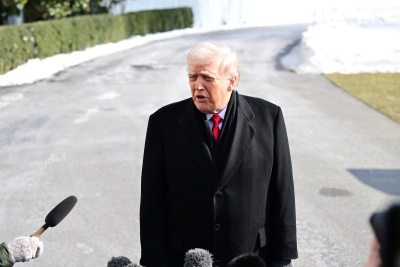
“As with so much else Trump, yes — he’s extremely different,” Matt Dallek, a political historian and professor at George Washington University’s Graduate School of Political Management, told us in an interview.
“He’s much more extreme and far more untethered from facts and the reality on the ground,” Dallek said, noting that, importantly, it’s not just the president, but also his officials who have taken this tack.
Others we spoke to made the same point.
“Without question,” there has been a shift, Roderick Hart, a professor emeritus of communication at the University of Texas at Austin with expertise in politics and the mass media, told us. “And it has very little to do with this particular situation in Minneapolis. He’s a rhetoric-first guy. … And he’s chosen his people who have exactly the same instincts,” Hart said.
Presidents are normally judicious, particularly when reacting to an event, Hart said. But, “Trump talks before the event is even finished.”
The Minnesota fatal shootings, however, involved federal agents, while examples from past presidencies concern state or local officers.
For example, former President Barack Obama — who was in office at a moment when the ubiquity of camera phones and the rise of social media converged to shine light on the killings of unarmed Black men and boys — took more time before publicly expressing his thoughts.
One of the first illustrations of this moment didn’t actually feature an officer, but rather a neighborhood watch volunteer in central Florida, who shot and killed 17-year-old Trayvon Martin on Feb. 26, 2012. About a month after that, in response to a reporter’s question, Obama said, in part, “Well, I’m the head of the executive branch, and the attorney general reports to me, so I’ve got to be careful about my statements to make sure that we’re not impairing any investigation that’s taking place right now. But obviously, this is a tragedy. I can only imagine what these parents are going through. And when I think about this boy, I think about my own kids. And I think every parent in America should be able to understand why it is absolutely imperative that we investigate every aspect of this and that everybody pulls together — federal, state, and local — to figure out exactly how this tragedy happened.”
Obama continued: “But my main message is to the parents of Trayvon Martin. If I had a son, he’d look like Trayvon. And I think they are right to expect that all of us as Americans are going to take this with the seriousness it deserves and that we’re going to get to the bottom of exactly what happened.”
In 2014, a year that saw several high-profile police killings, Obama waited three days to publicly respond to the Aug. 9 death of 18-year-old Michael Brown, who was shot and killed by a local police officer in Ferguson, Missouri, sparking widespread protests.
Then, Obama said in a statement: “The death of Michael Brown is heartbreaking, and Michelle and I send our deepest condolences to his family and his community at this very difficult time. As Attorney General Holder has indicated, the Department of Justice is investigating the situation along with local officials, and they will continue to direct resources to the case as needed. I know the events of the past few days have prompted strong passions, but as details unfold, I urge everyone in Ferguson, Missouri, and across the country, to remember this young man through reflection and understanding. We should comfort each other and talk with one another in a way that heals, not in a way that wounds. Along with our prayers, that’s what Michael and his family, and our broader American community, deserve.”
The former president waited three weeks — when he was asked about it in an interview — to comment on the shooting death that year of 12-year-old Tamir Rice in Cleveland. In a lengthy answer to a question about how responsible he felt his administration was for addressing police shootings, Obama said, “Well, I think an enormous amount. Not just because, as president, you’re always responsible for what happens in this country and you’ve got to be part of the solution, not part of the problem, but because of my particular experiences that I bring to this office.”
And Obama took more than four months to make remarks on the July 17, 2014, death of Eric Garner in New York — the former president had waited until a grand jury decided not to indict the police officer who had choked Garner. In December 2014, Obama said, in part, “My tradition is not to remark on cases where there may still be an investigation. But I want everybody to understand that this week, in the wake of Ferguson, we initiated a Task Force whose job it is to come back to me with specific recommendations about how we strengthen the relationship between law enforcement and communities of color and minority communities that feel that bias is taking place; that we are going to take specific steps to improve the training and the work with State and local governments when it comes to policing in communities of color; that we are going to be scrupulous in investigating cases where we are concerned about the impartiality and accountability that’s taking place.”
Before the era of the camera phone, the Rodney King case in 1991 grabbed national attention when a man in a nearby apartment videotaped Los Angeles police beating King during a traffic stop.
Then-President George H.W. Bush waited almost three weeks before commenting. Then, in a prepared statement on March 21, 1991, he said, in part, “We’ve all seen those shocking videotapes and have seen transcripts of the incident in Los Angeles. And without getting into the specifics of the case, those terrible scenes stir us all to demand an end to gratuitous violence and brutality. Law enforcement officials cannot place themselves above the law that they are sworn to defend. This administration will investigate possible breaches of federal law aggressively and will prosecute violators to the full extent of the law. … I was shocked by what I saw in that tape–that violence. And to the degree there’s a federal role here, I’m confident we will go the extra mile to see that that is fulfilled.”
Going back even further, to the 1970s, Dallek said, “Even Nixon’s comments in the wake of the Kent State killings were far more restrained and measured than anything Trump has offered the American people.”
On May 4, 1970, the same day that the National Guard shot and killed four students during a protest of the Vietnam War at Kent State University in Ohio, then-President Richard Nixon issued a statement that said, “This should remind us all once again that when dissent turns to violence, it invites tragedy. It is my hope that this tragic and unfortunate incident will strengthen the determination of all the Nation’s campuses–administrators, faculty, and students alike–to stand firmly for the right which exists in this country of peaceful dissent and just as strongly against the resort to violence as a means of such expression.”
When he was asked about the proper role of the National Guard — which, in this case, had been called in by the state’s governor — at a press conference four days later, Nixon said, “I want to know what the facts are. I have asked for the facts. When I get them, I will have something to say about it. But I do know when you do have a situation of a crowd throwing rocks and the National Guard is called in, that there is always the chance that it will escalate into the kind of a tragedy that happened at Kent State. If there is one thing I am personally committed to, it is this: I saw the pictures of those four youngsters in the Evening Star the day after that tragedy, and I vowed then that we were going to find methods that would be more effective to deal with these problems of violence, methods that would deal with those who would use force and violence and endanger others, but, at the same time, would not take the lives of innocent people.”
“There are some echoes, I think,” Dallek said, comparing Trump’s recent statements with Nixon’s. But Nixon was much more measured in the aftermath, Dallek said, adding that “he never branded [the students] as traitors or domestic terrorists.” (After the Good killing, DHS Secretary Kristi Noem called Good’s actions “domestic terrorism,” and Noem used the same phrase to describe Pretti’s actions.)
Minneapolis Cases Involved Federal Agents
One distinction between these previous examples and the current situation is that agents deployed in Minneapolis are federal, rather than state or local, Barbara Perry, a professor of governance at the University of Virginia’s Miller Center, which focuses on the American presidency, told us in an interview.
Since most previous cases of officer-involved shootings implicated state or local police, presidents could distance themselves, she said, and say that the Justice Department would investigate.
“So they could keep at arms length the legal process while expressing their sorrow,” Perry said.
Similarly, Guian A. McKee, a professor of public affairs at the Miller Center, told us in an email, “Trump administration statements about the recent killings in Minneapolis have been immediate, they have been political, and they have had little regard for facts or willingness to wait until evidence is clear.”
He went on to explain that one reason for this may be that “the recent killings have been done by federal agents acting as instruments of the president’s own policies and the tactics chosen to implement them. This has not been the case in most other law enforcement-involved deaths, where the officers were state or local. So the actions and their consequences fall much closer to the president.”
Near the end of his first term, Trump made conciliatory remarks about a high-profile case that involved local police officers, not federal agents.
Two days after the May 25, 2020, killing of George Floyd, whose death under the knee of a Minneapolis police officer led to widespread protests, Trump wrote on Twitter, “At my request, the FBI and the Department of Justice are already well into an investigation as to the very sad and tragic death in Minnesota of George Floyd.”
And, two days after that, on May 29, he said at the start of an event for business leaders, “I want to express our nation’s deepest condolences and most heartfelt sympathies to the family of George Floyd. A terrible event. Terrible, terrible thing that happened. I’ve asked that the Department of Justice expedite the federal investigation into his death and do it immediately, do it as quickly as absolutely possible. … It should never be allowed to happen, a thing like that.”
Editor’s note: FactCheck.org does not accept advertising. We rely on grants and individual donations from people like you. Please consider a donation. Credit card donations may be made through our “Donate” page. If you prefer to give by check, send to: FactCheck.org, Annenberg Public Policy Center, P.O. Box 58100, Philadelphia, PA 19102.