




President Donald Trump claimed that Iran essentially shutting down the Strait of Hormuz “doesn’t really affect” the United States the way it does “other countries.” It’s true that a small share of U.S. oil imports comes from the Persian Gulf. But the U.S. has been affected by the global increase in the price of oil.
Since the waterway has been effectively closed – significantly reducing crude oil exports from the Persian Gulf region – oil prices have increased by double-digit percentages, which has contributed to a 50-cent-plus spike in the average price of a gallon of gasoline in the U.S.
“The US is definitely affected,” Mark Finley, the nonresident fellow in energy and global oil at Rice University’s Baker Institute, told us in an email. Because it’s a global oil market, “if something goes wrong anywhere, the price goes up everywhere,” he said.
Iran has blocked the flow of oil and other goods through the strait in retaliation for joint U.S. and Israeli airstrikes that began on Feb. 28. Iran has threatened to shoot or bomb vessels that attempt to pass through the narrow body of water that separates Iran from Oman and connects the Persian Gulf with the Gulf of Oman and the Arabian Sea.
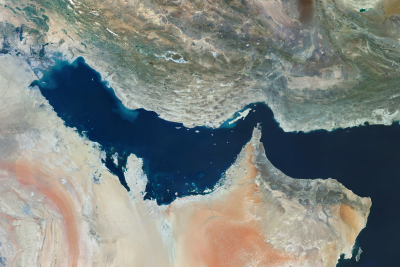
About 20 million barrels per day of crude and other oil products were transported through the strait in 2025. That has slowed “to a trickle” since the U.S.-Israeli conflict with Iran began, according to the International Energy Agency.
In a March 9 press conference, Trump talked about offering “risk insurance” to oil tankers operating in the region, possibly by having U.S. Navy ships escort the tankers, “because you have to keep the straits flowing.”
But then he said, “With all of that, it affects other countries much more than it does the United States. It doesn’t really affect us. We have so much oil. We have tremendous oil and gas, much more than we need.” And he added, “I mean, we’re doing this for the other parts of the world, including countries like China. They get a lot of their oil through the straits. So, we’re doing this.”
Compared with some other nations, the U.S. does get just a fraction of its crude oil from Middle Eastern countries for whom the strait is the primary route of exporting oil products.
Last year, the U.S. imported approximately 490,000 barrels of crude oil per day from countries in the Persian Gulf, which include Bahrain, Iran, Iraq, Kuwait, Qatar, Saudi Arabia and the United Arab Emirates. That was about 8% of the almost 6.2 million barrels per day the U.S. imported in total, according to the U.S. Energy Information Administration. (Canada and Mexico were the source of roughly 70% of U.S. crude imports last year, with Canada alone accounting for a little more than 63%.)
Meanwhile, “About 80% of oil and oil products transiting the Strait in 2025 was destined for Asia,” the IEA has reported – with China, India and Japan being the main importers in the region. China, which Trump mentioned by name, receives between 45% and 50% of its imports through the strait, according to the Center on Global Energy Policy.
But it’s not accurate to claim that Iran’s blockade on the strait “doesn’t really affect” Americans, as Trump claimed. The fact that the U.S. is the world’s leading producer of crude oil, and relatively little of its imports come from the Persian Gulf, doesn’t mean that Americans won’t feel any pain.
“It insulates us in the sense that we’re not going to have a hard time finding supply, but the prices are global, so prices go up anyway,” Abhi Rajendran, director of Oil Markets Research at Energy Intelligence, told us in an interview.
As we’ve reported, the U.S. still relies on some imports because much of the crude oil produced domestically is lighter, or less dense, while many refineries in the U.S. were long ago configured to use the heavier crude oils produced in other parts of the world, such as Canada. That’s also why the U.S. exports a lot of the oil produced in the States.
Trump wrote on social media that higher oil prices are actually a positive thing. “The United States is the largest Oil Producer in the World, by far, so when oil prices go up, we make a lot of money,” the president said.
In his email, Finley told us that “US oil companies, their employees, and the states where they operate benefit from higher prices.” As for consumers, including households and businesses, he said they “bear the burden of higher prices at the pump” as well as on “everything that uses oil.”
He noted that the price of gasoline, diesel fuel and other petroleum products in the U.S. “have gone up sharply” since the U.S. and Israel attacked Iran.
In a February update, the IEA said, “With around 25% of the world’s seaborne oil trade transiting the Strait, and options to bypass it being limited, any disruption to flows through the Strait would have huge consequences for world oil markets.” It warned that a prolonged disruption of shipments would lead to oil supply shortages and make price increases inevitable.
As we’ve written, most of the cost of gasoline is determined by the price of crude oil, which refiners use to make gasoline and other petroleum products. The price of crude oil is set internationally and is largely based on supply and demand factors around the world.
Since the airstrikes on Iran began, the price of West Texas Intermediate crude, the U.S. benchmark, has increased about 41% to almost $95 a barrel, and the price of Brent crude, the international standard, rose about 32% to just over $94 a barrel, according to the Energy Information Administration. As a result, as of the week ending March 9, the average U.S. price for regular grade gasoline had increased to $3.50 per gallon – up by about 56 cents, or roughly 19%, since the week ending Feb. 23, which was five days before the fighting with Iran began, EIA data show.
On March 11, “to address disruptions in oil markets stemming from the war in the Middle East,” the 32 nations that are members of the International Energy Agency — which include the U.S. — announced that they collectively would make 400 million barrels from their oil reserves available for purchase “over a timeframe that is appropriate” for each country.
For the U.S., the Department of Energy said that Trump had authorized the release of 172 million barrels from the Strategic Petroleum Reserve over several weeks.
Experts have said that whether the releases help stabilize oil markets and lower prices depends on how fast the crude can be shipped and how much longer the fighting lasts.
“I think it will help,” Rajendran told us about the planned releases. But he added this caveat: “as long as the conflict doesn’t drag on past early to mid-April.”
Beyond that point, he said, countries would likely have to keep drawing more from their oil reserves or start making other adjustments to address demand.
Editor’s note: FactCheck.org does not accept advertising. We rely on grants and individual donations from people like you. Please consider a donation. Credit card donations may be made through our “Donate” page. If you prefer to give by check, send to: FactCheck.org, Annenberg Public Policy Center, P.O. Box 58100, Philadelphia, PA 19102.