




President Donald Trump on multiple occasions has assured the public that high gasoline prices will “rapidly” or “quickly” decline “as soon as” the war with Iran ends. Energy experts told us that prices will start to fall when the conflict is resolved, but it could take many months before the national average price is back to where it was before the conflict began.
“For pre-war prices to show up, it could take beyond a year,” Patrick De Haan, head of petroleum analysis for the fuel-price tracking service GasBuddy, said in an interview. But he told us that there are “a lot of different potential” outcomes depending on what happens when the war ends.
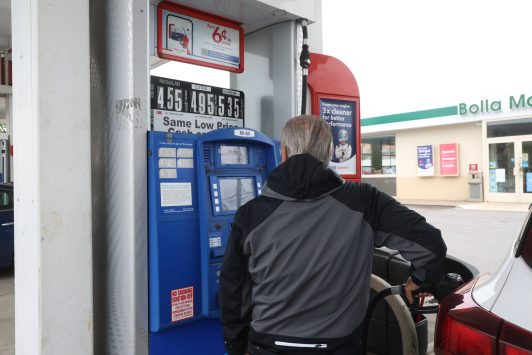
The average U.S. price for regular grade gasoline was $4.50 per gallon as of the week ending May 11, according to the Energy Information Administration. That was up $1.56, or 53%, from the average price of $2.94 during the week ending Feb. 23 – which was five days before the U.S. and Israel launched airstrikes on Iran.
Gasoline prices spiked after Iran responded to the joint attack by blocking the Strait of Hormuz – a vital waterway in the Middle East for trade – stopping the vast majority of crude oil exports from the Persian Gulf region. About 20 million barrels of oil and oil products were exported through the strait per day in 2025, which was about one-quarter of global seaborne oil trade, according to the International Energy Agency.
The reduced supply caused oil prices to increase, and that led to the rise in gasoline prices, since the cost of oil makes up about half of what drivers pay at the pump. Because it’s a global oil market, “if something goes wrong anywhere, the price goes up everywhere,” Mark Finley, a nonresident fellow in energy and global oil at Rice University’s Baker Institute for Public Policy, told us in March.
But Trump has said repeatedly that gasoline prices will fall fast when the war concludes.
“As soon as it’s over, you’re going to see gasoline and oil drop like a rock,” Trump told reporters in the Oval Office on May 11.
About a week before that, on May 1, during a Florida event for seniors, Trump said that “it’s going to come down lower than it was,” referring to the price of gasoline. “When all of that stuff comes out,” he said, mentioning “pent up” oil in the Strait of Hormuz, “you’re going to see prices dropping on gasoline like you’ve never seen.”
The same day, at another event in Florida, the president said the price of gasoline will “snap back” in the end. “I believe it will snap back very, very quickly,” he said.
And Trump isn’t the only person in his administration to make such a claim.
On May 4, in an interview with Fox News, Treasury Secretary Scott Bessent said he is “also confident” that gasoline prices are “going to come down very quickly” at the end of the conflict with Iran. “This gasoline — this temporary aberration — will be over in a matter of weeks or a month,” he said.
Experts told us it’s difficult to predict exactly what will happen in the long run. But they said it could be months, plural, before motorists see substantial price relief at the pump. Getting back to pre-war prices would take longer than Trump’s and Bessent’s remarks suggest, they said.
Expert Analysis
“When the strait opens in a meaningful way, it would likely have a fairly quick impact to start pushing prices down,” De Haan said, adding that price decreases will depend on how quickly oil tankers resume transporting shipments through the strait to increase the global supply.
“It’s very contingent on how much oil starts getting through the strait, whether it’s all or nothing,” he said. “But it’s going to take several weeks for those ships to reach destinations once it becomes open. So, at best, it’s probably going to still be two to three weeks before the flows of oil can normalize. So, at least several weeks, and potentially beyond that.”
“If the strait were to reopen today,” he said, “it would probably be early June until ships started going in and out,” and “it could be until July for some of those cargoes to start getting to the market.”
De Haan told us he was reluctant to make specific price predictions because of the uncertainty of the situation. But he did say that a return to average gasoline prices at less than $3 per gallon in the immediate future seems doubtful.
“Beyond the big drop, the initial big drop, it could take quite a bit longer for gas prices to more noticeably get back to like pre-war levels,” he said. “That’s going to take quite a bit of time, and the longer the situation goes on, the more time that could end up taking.”
Abhi Rajendran, a nonresident fellow at Rice University’s Baker Institute of Public Policy and the director of Oil Markets Research at Energy Intelligence, largely agreed.
“Should the conflict actually find some path to resolution, then I think prices could come down,” he said. But how fast that happens is another matter.
“I don’t know if it’s going to be quick and look like before-the-conflict prices were,” Rajendran said. He said he doesn’t see $3 per gallon gasoline “anytime soon,” even if the conflict ends, because “there’s still damage that’s been done to the supply side and to inventory, and that’s going to be felt for a little while.”
After a while, Rajendran said, he could see gasoline prices settling at between $3.25 a gallon and $3.50 a gallon, which is “higher than they were before the conflict.”
Meanwhile, Tom Kloza, chief energy adviser for Gulf Oil, predicted that prices in many states could be “back in the $3-$3.50/gal neighborhood” in the final 100 days of the calendar year, when he said “gasoline prices almost always drop” because “demand slumps and the formula for motor fuel changes.”
However, that projection could change, he said in an email to us, if the blockade on the Strait of Hormuz continues, or if a strong hurricane hits the Gulf of Mexico, which would “lengthen the $4-$4.75/gal pricing backdrop.”
“What happens between now and Labor Day is tougher” to forecast, he said.
Other Projections
Back on April 16, in an interview with CNN, Energy Secretary Chris Wright said prices would “certainly” decline after the conflict with Iran ends. But he was less sure about when the average price would again be below $3 a gallon.
“That could happen later this year,” or “that might not happen until next year,” he told CNN’s Jake Tapper.
But one day before that, in an April 15 press briefing from the White House, Bessent, Wright’s fellow Cabinet secretary, said he was “optimistic” that “we can have $3 gas again” this year, between June 20 and Sept. 20.
Skip York, another nonresident fellow in energy and global oil at Rice’s Baker Institute, told us that, like Wright, he believes $3 gasoline may not happen until next year.
“[R]eturning to $3/gal gas looks like more [of] a 2027 resolution,” he said in an email, in which he listed several reasons prices often “[go] up like a rocket, but down like a feather.”
York said when wholesale gasoline prices rise, “retailers raise pump prices immediately to cover the expected cost of replacing inventory.” When wholesale prices come down, however, “retailers may still be selling higher‑cost inventory and wait for cheaper supplies before cutting prices.”
In addition, he said, “Retailers often wait for a sustained downward trend before reducing prices because a quick cut could force them to raise prices again if wholesale costs rebound.”
Market behavior and competition is also a factor. “Drivers tend to more actively shop when prices rise but less as they fall; that reduces competitive pressure to cut prices quickly,” he said.
Finally, York added, abrupt supply shocks, such as geopolitical events and refinery outages, “cause fast price increases driven by consumer fears of shortages,” while easing those risks and rebuilding inventories “takes time, so declines are more gradual.”
Federal Gasoline Tax Holiday?
As of May 14, the war with Iran had gone on for 75 days, which is much longer than the “four to five weeks” that Trump initially said he intended for it to last.
With the U.S. so far being unable to reach a deal with Iran to end the conflict, and having a ceasefire agreement with Iran that is on “massive life support,” as Trump said on May 11, the president has proposed temporarily suspending the federal tax on gasoline.
That would reduce gasoline prices by about 18.4 cents per gallon and prices for diesel by about 24.4 cents per gallon. But that plan would also require approval from Congress, and it is not yet clear if there is enough bipartisan support to make that a law.
Furthermore, the experts said, eliminating the gasoline tax, even temporarily, could help keep prices more elevated than they otherwise would be.
“While relieving the gasoline tax would lower pump prices, that lower price also would encourage more consumption, meaning it would take longer to rebuild inventory,” York said. “If a policy doesn’t improve supply availability, it doesn’t really help restore physical fundamentals back to pre-conflict levels.”
De Haan also said that the plan for a federal gasoline tax holiday “could actually stimulate demand,” which would add to the imbalance between demand and supply and “could send prices higher.”
In a May 11 floor speech criticizing Trump on Iran, Senate Minority Leader Chuck Schumer said that “Senate Democrats will support real action to lower costs.” But he said a decrease of 18 cents per gallon is hardly enough.
“Eighteen cents isn’t a dollar fifty, which is how much the price of gas has gone up since this war started,” he said. “Americans don’t need just a few cents back.” He said the “best way to lower costs” was to end the war.
Schumer said, “Trump could end this war tomorrow and prices would plummet by far more than 18 cents a gallon.”
But, as we explained, while experts have said that the price of gasoline will likely start going down not long after the war ends, it is less likely that the price will “plummet” as quickly as Schumer suggested.
In its Short-Term Energy Outlook for May, the EIA projected that the average retail price for gasoline will be $3.88 for 2026 and $3.62 for 2027. That’s up from the average prices the agency projected in early February – before the war began — which were $2.91 in 2026 and $2.93 in 2027.
In its May analysis, the EIA said its most recent price projections assume that the Strait of Hormuz “will remain effectively closed through late May, with flows slowly starting to resume in late May or early June.” If that happens, the agency said it expects it will take “until late 2026 or early 2027 for most pre-conflict production and trade patterns to resume.”
Editor’s note: FactCheck.org does not accept advertising. We rely on grants and individual donations from people like you. Please consider a donation. Credit card donations may be made through our “Donate” page. If you prefer to give by check, send to: FactCheck.org, Annenberg Public Policy Center, P.O. Box 58100, Philadelphia, PA 19102.