




Legislative efforts to make daylight saving time permanent year round got a boost with support from President Donald Trump, who criticized the twice-yearly clock switching as cost-prohibitive.
But there is no strong evidence that Trump’s solution — switching permanently to daylight saving time — would provide the economic boost Trump suggests it would.
The Sunshine Protection Act, which would make daylight saving time permanent year round unless states opt out, was folded into a motor vehicle safety bill that passed out of the House Energy and Commerce Committee on May 21 with a 48-1 vote.
Shortly after, Trump posted his support on Truth Social.
“This is so important in that Hundreds of Millions of Dollars are spent every year by people, Cities, and States, being forced to change their Clocks. Many of these Clocks are located in Towers, and the cost of renting, or using, Heavy Equipment to do this twice a year is prohibitive!” Trump wrote.
“I am going to work very hard to see The Sunshine Protection Act signed into Law,” Trump added. “It’s time that people can stop worrying about the ‘Clock,’ not to mention all of the work and money that is spent on this ridiculous, twice yearly production. It will also be a very nice WIN for the Republican Party. Take it! We are going with the far more popular alternative, Saving Daylight, which gives you a longer, brighter Day — And who can be against that — This is an easy one!”
We should note that while Trump framed the legislation as a potential “WIN for the Republican Party,” the bill has bipartisan support (and bipartisan opposition, as well). But it would still need support from the House and then the Senate, plus the president’s signature, in order to pass. Similar past efforts in Congress have stalled.
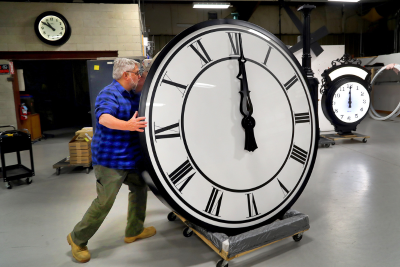
We could find no credible analysis of the cost of using heavy equipment to physically change municipal clocks located in towers, as the president mentioned. In fact, David Prerau, author of the 2005 book “Seize the Daylight: The Curious and Contentious Story of Daylight Saving Time,” told us that in the decades he has spent researching and speaking publicly about daylight saving time, “no one has mentioned that particular point.” While there may be a cost to changing such municipal clocks, he said, it’s also “very rare” and the cost is negligible in the larger scheme of the topic.
A “back-of-the-envelope” calculation by an economist with the Independent Institute updated in 2013 by the American Enterprise Institute estimated the “opportunity cost” of daylight saving time at about $2 billion per year. The estimate assumed people spent 10 minutes twice a year changing their clocks, and it assigned a lost wages figure to that time. (We would note that many digital clocks nowadays automatically make the time shift, so the lost-time argument has dissipated over time.)
More commonly, though, economists have attempted to estimate the cost of switching back and forth between standard and daylight saving time related to impacts on health, driving and work. (Most of the country moves the clock forward by an hour on the second Sunday in March, and back an hour the first Sunday in November.)
For example, an analysis by Chmura Economics & Analytics, a labor market research firm, updated in 2024, looked at evidence of economic loss from peer-reviewed journals — increased heart attacks, strokes, workplace accidents and traffic accidents attributed to switching times — and concluded daylight saving time costs about $672 million annually in all U.S. metropolitan statistical areas.
Although extending daylight saving time is often touted as an energy-saver, a Department of Energy analysis in 2008 concluded, “The electricity savings are small compared to the national total for the year, representing about 0.03 percent of the total national electricity consumption.” Some other studies have also found a small electricity savings.
But still other studies have found the opposite. Research published in 2011 looked into the effect of daylight saving time in Indiana and concluded that “if anything, the policy seems to have the opposite of its intended effect” and that electricity demand increased about 1%.
Nevertheless, the authors wrote, “there are other arguments made in favor of DST. These range from increased opportunities for leisure, enhanced public health and safety, and economic growth.”
There’s another facet to the daylight saving debate: If you do away with switching back and forth, do you go with standard time or daylight saving time?
Weighing the Options
Trump himself appears to have been conflicted on which route is best.
On Dec. 13, 2024, he posted to Truth Social, “The Republican Party will use its best efforts to eliminate Daylight Saving Time, which has a small but strong constituency, but shouldn’t! Daylight Saving Time is inconvenient, and very costly to our Nation.”
But shortly after taking office for a second term, Trump was asked on March 6, 2025, when he’d be getting rid of daylight saving time.
“This should be the easiest one of all, but it’s a 50/50 issue,” Trump said. “And if something’s a 50/50 issue, it’s hard to get excited about it. I assume people would like to have more light later, but some people want to have more light earlier because they don’t want to take their kids to school in the dark. … But a lot of people like it one way, a lot of people like it the other way. It’s very even. And usually I find when that’s the case, what else do we have to do?”
By the following month, though, Trump seemed to have picked a side.
“The House and Senate should push hard for more Daylight at the end of a day,” Trump posted on Truth Social on April 11, 2025. “Very popular and, most importantly, no more changing of the clocks, a big inconvenience and, for our government, A VERY COSTLY EVENT!!!”
Trump is correct that switching permanently to daylight saving time is the “more popular alternative.” In a 2022 poll by CBS News, 46% of Americans said they’d like daylight saving time all year around, while 33% preferred standard time all year around. Just 21% said they would like to keep switching back and forth. A Monmouth University poll that same year similarly found 44% of Americans favored year-round daylight saving time, while 13% favored year-round standard time and 35% said they’d like to keep changing the clocks twice a year.
Currently, 19 states have enacted legislation to switch to year-round daylight saving time, if Congress votes to allow it, according to the National Conference of State Legislatures. Two states — Hawaii and most of Arizona — and several U.S. territories already observe permanent standard time.
Effects on Health, Traffic, Work
Dr. Beth Malow, a professor of neurology and pediatrics in the Vanderbilt Sleep Division who testified before the House in 2022 in favor of a permanent switch to standard time, told us via email, “Moving permanently to DST would not be a cost savings and in fact, is associated with decreased productivity” due to disruption of sleep cycles. It also “increases healthcare costs,” she said. And, she noted, energy cost analyses are less relevant now that “energy use with computers etc is 24/7” than “when we were focused on electrical lighting, as we were in the 1900s.”
Groups such as the American Medical Association and the American Academy of Sleep Medicine also prefer switching permanently to standard time.
“Although the chronic effects of remaining year-round in daylight saving time (which shifts daylight hours later in the evening) have not been well studied, sleep experts say that standard time (which shifts daylight hours earlier in the morning) aligns best with human circadian biology,” the AMA wrote in 2022. “Data show that the sudden change from standard time to daylight saving time in March is associated with significant public health and safety risks, including increased risk of adverse cardiovascular events, mood disorders, and motor vehicle crashes. Some studies suggest that the body clock does not adjust to daylight saving time even after a few months.”
“Eliminating the time changes in March and November would be a welcome change. But research shows permanent daylight saving time overlooks potential health risks that can be avoided by establishing permanent standard time instead,” AMA Trustee Alexander Ding said at the time. “Sleep experts are alarmed. Issues other than patient health are driving this debate. It’s time that we wake up to the health implications of clock setting.”
In a 2024 position statement, the American Academy of Sleep Medicine wrote: “[T]he United States should eliminate seasonal time changes in favor of permanent standard time (ST), which aligns best with human circadian biology. Evidence supports the distinct benefits of ST for health and safety, while also underscoring the potential harms that result from seasonal time changes to and from daylight saving time (DST).”
Legislators Weigh In
There is far from a consensus in Congress.
At a House Energy and Commerce Committee markup on May 21, Republican Rep. Gus Bilirakis of Florida lobbied for a permanent switch to daylight saving time.
“Like clockwork twice a year, I hear from my constituents — I know you do too — on their dread of having to change the clocks,” Bilirakis said. “For decades, Americans have long criticized this switch as disruptive to families, businesses, schools, and public health. Studies have also shown that the economic productivity increases with more evening daylight, while reducing traffic accidents and improving overall quality of life.”
Democratic Rep. Nanette Diaz Barragán of California provided the counterpoint.
“Like many Americans, I too am tired of changing our clocks twice a year,” Barragán said. “Parents hate it, workers hate it, our bodies hate it. But making daylight saving time permanent poses health and safety issues. Doctors, neurologists, sleep scientists, and major medical organizations have warned Congress that permanent daylight saving time would hurt public health and public safety. … Why? Because our bodies are built to wake up with morning light. When sunrise gets pushed later into the morning, especially in winter, it turns off our sleep, our mood, our concentration, and even our health, our heart health. Sleep experts have linked the shift to daylight saving time with higher risk of heart attacks, strokes, depression, and car crashes, and for millions of Americans, permanent daylight saving would mean going to school and work in darkness for months. It would put sunrise in many states past 8am for over three months.”
The country tried year-round daylight saving time in the early 1970s, and it didn’t go well.
In 1973, Congress passed — and then President Richard Nixon signed — the Emergency Daylight Saving Time Energy Conservation Act — which made daylight saving time year-round as a response to the ongoing fuel crisis at the time. It was supposed to last for two years. But just a few months into it, widespread public support for the switch collapsed, and Congress pulled the plug.
“The experiment … ran afoul of public opinion—parents became concerned about traffic accidents involving their children, who were going to school in the predawn darkness on winter mornings,” the New York Times reported at the time.
Republican Sen. Tom Cotton cited that history lesson in an Oct. 28, 2025, speech from the Senate floor, opposing a plan to switch permanently to daylight saving time.
“In January of 1974, millions of Americans traveled to work and school in darkness. Commuter trains were delayed. Schoolchildren carried flashlights. Tragically, some of these kids were struck by cars and killed while walking to school in the dark,” Cotton said. (Indeed, Time reported in February 1974 that eight children died in pre-dawn traffic accidents that winter in Florida alone.)
“It’s said that those who don’t learn from history are doomed to repeat it,” Cotton said. “If permanent daylight savings time becomes the law of the land, it will again make winter a dark and dismal time for millions of Americans.”
In a June 1 article, economist William Shughart, a senior fellow at the Independent Institute and professor at the Jon M. Huntsman School of Business at Utah State University, argued for year-round standard time, writing: “Few, if any, general benefits of DST have been identified. But physiologists, sleep medicine specialists, and other experts have emphasized the human costs of springing time forward by an hour in March, only to set it back again eight months later. Misaligning body clocks (circadian rhythms) with sunlight has been associated with brain fog, strokes, heart attacks, and more workplace and road accidents. The adverse effects are especially troublesome for older people, who take longer than their younger compatriots to adjust to the time shocks. … Permanent daylight saving time holds a false promise of energy savings, bustling stores, and enhanced social welfare.”
There is, of course, a third camp in this debate — those who argue to just leave things as they are.
Prerau, the daylight saving time expert, told us that while there are undeniable social benefits to daylight saving time in the spring, summer and fall, the effects are intolerable in the winter. During the summer, sunrise gets pushed an hour from, say, 4:30 a.m. to 5:30 a.m., and so most people don’t even notice it. But in the winter, it can push sunrise until after 8:30 a.m or even 9 a.m. “Everyone gets up in the dark,” he said. “Adults drive to work in the dark. Kids go to school in the dark.” Switching the clocks may be disruptive, Prerau said, but it’s worth that price to enjoy daylight saving for eight months.
“In my opinion, stick with the way it is now,” he said. “Once a year you lose an hour of sleep. But that’s worth the benefit of having daylight saving for eight months out of the year.”
Daylight Saving Time Does Not Provide ‘Longer, Brighter Day’
As for Trump’s statement that switching permanently to daylight saving time “gives you a longer, brighter Day — And who can be against that,” that is, of course, not accurate. The president has more clearly said on other occasions that the switch would mean “more Daylight at the end of a day.”
“Clocks merely advance an hour, shifting sunlight from the morning to the evening,” Shughart wrote. “The length of the day doesn’t change a single nanosecond.”
The term “daylight saving time” is “a misnomer if there ever was one, given that daylight isn’t saved, it’s just moved from morning to evening,” Jon Nese, a teaching professor of meteorology at Penn State University, explained in 2022.
“The length of day (ie, the length of daylight) doesn’t change whether you’re on Daylight Saving Time or Standard Time – it’s just that an hour of daylight is moved from the beginning to end of the day,” Nese told us this week via email.
Editor’s note: FactCheck.org does not accept advertising. We rely on grants and individual donations from people like you. Please consider a donation. Credit card donations may be made through our “Donate” page. If you prefer to give by check, send to: FactCheck.org, Annenberg Public Policy Center, P.O. Box 58100, Philadelphia, PA 19102.