




Several Democrats have claimed that the Trump administration’s Jan. 3 military operation that led to the capture of Venezuelan President Nicolás Maduro and his wife, Cilia Flores, was “illegal,” violating both domestic and international law.
Experts we consulted told us that the operation runs afoul of the United Nations Charter that prohibits unjustified uses of military force by one country against another. Experts also previously told us that the U.S. Constitution, according to an originalist interpretation, requires congressional approval for such use of force abroad. In practice, however, multiple presidents — like President Donald Trump in this instance — have unilaterally ordered military action without input from lawmakers.
In this story, we’ll review some of the legal arguments that have been made.
International Law
Several Democrats have claimed that the Trump administration’s military actions in Venezuela violated international law.
“It’s clearly illegal under international law, right?” Rep. Jim Himes, the top Democrat on the House Intelligence Committee, said on CBS’ “Face the Nation” on Jan. 4. “Full stop. U.N. charter. No question there.”
In an interview on CNN on Jan. 5, Rep. Adam Smith, the ranking Democrat on the House Armed Services Committee, called the military action “blatantly illegal.”
“We’ve signed on to a U.N. charter that says you can’t violate sovereign territory in this way, even to arrest somebody who has a indictment against them,” Smith said. “The U.N. Charter is clear. We signed on to the U.N. Charter, so therefore we were clearly breaking the law and doing a regime change operation. That’s not even debatable. And President Trump’s contempt for that law does undermine any sort of legal action going forward. Across the globe, we increasingly send the message the law is just a matter of convenience. Do what you want.”
Numerous experts in international law agree with them.
Specifically, Article 2 (4) of the U.N. Charter states that members “shall refrain in their international relations from the threat or use of force against the territorial integrity or political independence of any state.”
In a Jan. 5 statement, U.N. Secretary-General Antonio Guterres said that he was “deeply concerned that rules of international law have not been respected” and warned about “the precedent it may set for how relations between and among states are conducted.”
There are 193 members of the U.N., including Venezuela, which has been a member since 1945.
University of Pennsylvania Carey Law School professor Bill Burke-White, an expert on international law, told us via email that the military action in Venezuela was “illegal under international law in every imaginable way.”
“Under international law and pursuant to articles 2(4) and 51 of the UN Charter, the use of force is only justified in two circumstances: authorization by the UN Security Council or an act of self defense in response to an armed attack,” Burke-White said. “Neither applies here.”
“In addition,” Burke-White said, “Maduro (while a despicable individual) was the sovereign leader of Venezuela. He therefore enjoys sovereign immunity, which means a foreign government can not arrest or prosecute him.”
Secretary of State Marco Rubio and other Trump administration officials have called Maduro an “illegitimate” leader. (World leaders widely disputed Maduro’s supposed 2024 election.) And therefore, the administration’s argument goes, he can be criminally prosecuted in the United States.
That is an issue “the American courts are going to have to weigh in on,” Oona Hathaway, a professor at Yale Law School and the director of its Center for Global Legal Challenges, said in an interview with the New Yorker.
The problem, Hathaway said, “is that merely saying that he’s not head of state doesn’t then justify the use of military force in Venezuela.”
In a Jan. 5 article for Just Security, international law experts Michael Schmitt, Ryan Goodman and Tess Bridgeman agreed.
“The bottom line is, unlike the boat strikes the U.S. military has carried out to date that have occurred in international waters against stateless vessels, this operation, striking Venezuela and abducting its president, is clearly a violation of the prohibition on the use of force in Article 2(4) of the UN Charter,” the three wrote. “That prohibition is the bedrock rule of the international system that separates the rule of law from anarchy, safeguards small States from their more powerful neighbors, and protects civilians from the devastation of war.”
Echoing Burke-White’s comments, they wrote that the only exceptions are with authorization from the U.N. Security Council or “in self-defense against armed attack.” Given there was no U.N. Security Council authorization, “the sole possible legal basis for the operation would be self-defense,” they wrote.
And that is what Trump administration officials are arguing.
Trump Administration Defense
In an interview with Fox News on Jan. 4, U.N. Ambassador Mike Waltz dismissed the “hand-wringing” about Article 2 of the U.N. Charter, adding that Article 51 of the charter permits “a nation’s inherent right to self-defense.”
Article 51 of the U.N. charter states, “Nothing in the present Charter shall impair the inherent right of individual or collective self-defence if an armed attack occurs against a Member of the United Nations, until the Security Council has taken the measures necessary to maintain international peace and security.”
“So, in this case, you have a drug kingpin, an illegitimate leader indicted in the United States coordinating with the likes of China, Russia, Iran, terrorist groups like Hezbollah, pumping drugs, thugs and weapons into the United States of America, threatening to invade its neighbors,” Waltz said. “And at the end of the day, was the United States, was President Trump just going to let that status quo continue? Absolutely not.”
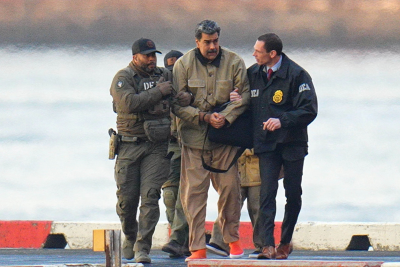
Maduro and his wife were brought to New York and indicted on cocaine-trafficking conspiracy charges.
On NBC’s “Meet the Press” on Jan. 4, Rubio echoed the defense argument.
“We can’t have a country where the people in charge of its military and in charge of its police department are openly cooperating with drug trafficking organizations. We can’t. We’re not going to allow that,” Rubio said. “These things are direct threats to the United States.”
John Bellinger, adjunct senior fellow in international and national security law at the Council on Foreign Relations, said the defense exceptions in the U.N. Charter “do not apply here.”
“President Trump has claimed that President Maduro had sent criminal gangs, including Tren de Aragua, ‘to terrorize American communities nationwide’ but there is no factual support for this statement,” said Bellinger, quoting the president’s Jan. 3 press conference on the military action. Bellinger, who served as the legal adviser for the Department of State and the National Security Council in the George W. Bush administration, noted that the administration’s own National Intelligence Council concluded in an April 7 intelligence assessment that the Maduro regime “probably does not have a policy of cooperating with [Tren de Aragua] and is not directing TDA movement to and operations in the United States.”
“The action violated international law,” Tom Dannenbaum, a professor at Stanford Law School with expertise in international law relating to armed conflict, told us via email. “This analysis does not turn on an assessment of the Maduro regime. It depends instead on the strict prohibition of the resort to military force in international relations, except in narrow and specific circumstances, none of which obtains in this case. Serious legal objections to Maduro’s regime do not eliminate the need for a legal basis to use military force in Venezuela. Under international law, the use of force on another state’s territory is presumptively unlawful.”
While the Trump administration has argued the U.S. was defending itself against drug traffickers, Hathaway told the New Yorker that argument “really doesn’t work under international law.”
“There is a right of self-defense under the United Nations charter, which allows states to use force in self-defense against an armed attack,” Hathaway said. “But it’s never been used for something like drug trafficking. And so all of these boat strikes that have been taking place over the past couple of months, which have been justified as self-defense, don’t fall within anything that anyone would recognize as self-defense under international law. Self-defense generally requires that there’s actually an armed attack.”
Dannenbaum similarly disagreed with the argument that Venezuela drug trafficking met the threshold of an armed attack on the U.S.
“Venezuela has not engaged in an armed attack against the United States or any other state on whose behalf the US could claim to be acting,” Dannenbaum said. “Nor is there any reason to believe such an attack was imminent. The concept of ‘armed attack’ captures the ‘most grave’ forms of the use of armed force. This is widely understood to entail direct injurious or destructive action. Even assuming it can be attributed to the state, drug trafficking does not satisfy that threshold and it has never been recognized as doing so, in part because the harm associated with drug use involves multiple points of intervening agency and is too far attenuated from the act of trafficking itself. The fact that drug trafficking is a serious crime does not entail an authorization to use military force against another state, even if that state’s officials are suspected of being involved in the criminal activity.”
The Barr Memo
CNN national security correspondent Natasha Bertrand reported on Jan. 3 that “Trump administration officials are internally pointing to a 1989 legal opinion and the subsequent US invasion of Panama as precedent to justify the operation that was carried out in Venezuela.”
That opinion, written by Bill Barr, then an assistant attorney general in the Office of Legal Counsel — who later served as U.S. attorney general in Trump’s first term — argues that the president “has the inherent constitutional authority to deploy the FBI to investigate and arrest individuals for violating United States law, even if those actions contravene customary international law.”
In an article for Just Security, Goodman, founding co-editor-in-chief of Just Security and a law professor at New York University School of Law, argued that the Barr memo is “flawed” and that it reaches “a radical conclusion that cannot withstand serious scrutiny.”
As for a comparison to the U.S. military action to capture General Manuel Noriega in Panama in 1989, the authors of the earlier Just Security article noted several significant differences in that case.
“The United States claimed to be acting by invitation of the rightful Head of State,” the authors wrote. And, they said, “the United States acted after the Panamanian National Assembly declared a state of war against the United States, and after forces under Noriega’s command” had — as noted by President George H.W. Bush at the time– “killed an unarmed American serviceman; wounded another; arrested and brutally beat a third American serviceman; and then brutally interrogated his wife, threatening her with sexual abuse.”
Regardless, experts told us the U.S. veto power would block any potential United Nations consequences, such as sanctions. There are, nonetheless, political implications.
“The United States was one of the principal drafters of the UN Charter and is one of five permanent members of the Security Council, entrusted with ensuring international peace and security,” Bellinger told us. “When the United States blatantly violates the UN Charter, it destroys the global respect it has built over many decades as a nation committed to the rule of law and a force for good and encourages other rogue states like Russia and China to ignore the UN Charter. The United States loses its global credibility to criticize the Russian invasion of Ukraine or a potential Chinese invasion of Taiwan when it uses force in violation of the UN Charter based on false justifications.”
Congressional Authorization Required?
Several Democratic lawmakers have also claimed that the operation in Venezuela, without congressional approval, violated domestic law.
“Maduro is a horrible, horrible person, but you don’t treat lawlessness with other lawlessness, and that’s what’s happened here,” Senate Minority Leader Chuck Schumer told ABC’s George Stephanopoulos in a Jan. 4 interview. “They went inside Venezuela, bombed civilian as well as military places, and it’s a violation of the law to do what they did without getting the authorization of Congress.”
Rep. James P. McGovern, the ranking member of the House Rules Committee, made essentially the same argument in a Jan. 3 statement.
“President Trump did not seek congressional authorization for this use of force, and Congress did not grant it. Under our Constitution and the law, that makes this action illegal,” he said.
Hathaway, the director of Yale’s Center for Global Legal Challenges, told the New Yorker that U.S. constitutional law “requires the President to go to Congress to seek authorization before using force against another country.”
Republicans in the Trump administration and in Congress have argued that no congressional authorization was needed.
“This is an operation that did not require prior consent of Congress, prior authorization of Congress,” House Speaker Mike Johnson said in a Jan. 5 press conference. “It required notification of Congress. It’s well within Article II” of the U.S. Constitution.
Johnson said that he spoke to the president and the secretaries of state and defense “within hours” after the mission commenced. “The first call was from Marco Rubio at about 4 a.m., so they’ve done everything that they were supposed to do. This was an appropriate action,” he said.
The day prior to Johnson’s press conference, on NBC’s “Meet the Press,” Rubio himself defended acting without getting the go-ahead from Congress.
“This was not an action that required congressional approval,” Rubio said to the show’s host, Kristen Welker. “In fact, it couldn’t require congressional approval because this was not an invasion. This is not an extended military operation. This was a very precise operation that involved a couple of hours of action. It was a very delicate operation too. It was one that required all these conditions to be in place at the right time in the right place.”
Rubio said going to Congress beforehand could have led to “leaks” that “would have endangered the mission and gotten people killed.”
Going forward, he said, “we will seek congressional approval for actions that require congressional approval … otherwise they will get congressional notification.”
As we’ve written, Article I, Section 8 of the U.S. Constitution assigns the power “To declare War” to Congress. Meanwhile, Article II, Section 2 of the Constitution says that the president is the commander in chief of the armed forces.
For our June story, which was about whether Trump’s decision to bomb Iranian nuclear facilities was legal, Peter Shane, a constitutional law scholar and adjunct professor at New York University School of Law, told us that “there is so much disagreement about how the Constitution should be interpreted with regard to the unilateral presidential deployment of military force.”
He said in an email, “Under the most persuasive reading of the Founding era, the Constitution does not authorize Presidents to deploy military force abroad without advance congressional authorization.” Yet, he said, it has “long been the position” of the Justice Department’s Office of Legal Counsel “that history has ratified unilateral presidential deployments of military force as long as (1) the deployment serves ‘sufficiently important national interests,’ as judged by the President, and (2) the deployment does not portend a ‘prolonged and substantial military engagement, typically involving exposure of U.S. military personnel to significant risk over a substantial period.'”
Kermit Roosevelt, a constitutional expert and professor at the University of Pennsylvania Carey Law School, had a similar interpretation.
“The Constitution says that Congress has the power to declare war, and the records of the Constitutional Convention are pretty clear that the drafters did not want to give one person the power to take the United States into war,” Roosevelt told us for the same story. “However, presidents have done things that count as acts of war under international law without congressional authorization, like the Libya bombings [under then-President Barack Obama], and no one has stopped them, so our practice has departed from the text and original understanding.”
As for notifying Congress of military action, the 1973 War Powers Resolution passed by Congress requires presidents within 48 hours “to report to Congress any introduction of U.S. forces into hostilities or imminent hostilities,” as the Congressional Research Service has explained.
Once the military action is reported, the resolution “requires that the use of forces must be terminated within 60 to 90 days unless Congress authorizes such use or extends the time period.” It also “requires that the ‘President in every possible instance shall consult with Congress before introducing’ U.S. Armed Forces into hostilities or imminent hostilities.’”
Roosevelt previously told us that the resolution doesn’t mean the president “can do what he wants for 48 hours before notifying Congress, or for 60 days even if Congress doesn’t” give its approval. He said, “That’s not consistent with the Constitution and it’s not consistent with the purpose and policy section of the WPA, which says that the intent is to make sure that the President’s power to engage in military action is exercised ‘only pursuant to (1) a declaration of war, (2) specific statutory authorization, or (3) a national emergency created by attack upon the United States, its territories or possessions, or its armed forces.'”
He explained that the “48 hour and 60 day windows are supposed to be relevant to presidential responses to attacks, and the President is not supposed to be able to initiate wars at all.”
But the Trump administration says that the U.S. is not at war with Venezuela.
“As Secretary Rubio has said, there is no war against Venezuela or its people,” Waltz, the U.S. representative to the United Nations, said in a U.N. Security Council briefing on Jan. 5. “We are not occupying a country. This was a law enforcement operation in furtherance of lawful indictments that have existed for decades. The United States arrested a narcotrafficker who is now going to stand trial in the United States in accordance with the rule of law for the crimes he’s committed against our people for 15 years.”
However, Trump, who also has said “we’re not” at war with Venezuela, has not ruled out sending troops back into the country.
Legal Debate Is ‘Largely Meaningless’
In the end, Jack Goldsmith, a Harvard Law School professor and a nonresident senior fellow at the American Enterprise Institute, argued that the debate about the legality of unilateral presidential uses of force has little significance.
“Immediately after these operations happen, every time this happens – Libya, Kosovo, Iran, all of these unilateral uses of force without congressional authorization – we immediately jump to the law and commentators immediately say this is illegal, depending on whether they like the war or not, or they defend it as being lawful, and we have this debate about whether it’s lawful or not, and I frankly think it’s kind of a meaningless debate in almost every circumstance,” he said in a Jan. 5 discussion with Bob Bauer, a legal scholar and New York University School of Law professor of practice.
“The issue is, why has Congress given the president this massive military force without constraints? Why does it continue to acquiesce in the president’s use of force? Why isn’t Congress exercising its constitutional prerogatives and constitutional responsibilities to check these things?” Goldsmith asked. “The lawyers tend to flee to the legal arguments. I think the legal arguments in this context are not terribly meaningful and that the focus should be on the politics of this. And the politics are that Congress has let the president get away with it knowingly across administrations, left and right, Democrat and Republican. And the Democrats tend to complain about Republican uses of force and vice versa. But all of this stuff takes place in the rhetoric of law that I think is largely meaningless.”
He said that unilateral use of force by the president is not an issue that has been adjudicated by the courts and he doubts that it will be.
“So, there’s no judicial force to stop that,” he told Bauer. “Only Congress exercising its political prerogatives, perhaps making legal arguments, can check that.”
Schumer said that he and fellow Democratic Sens. Tim Kaine and Adam Schiff, as well as Sen. Rand Paul, a Republican, will force a Senate vote this week on a war powers resolution that would require congressional approval for further military action in Venezuela.
Editor’s note: FactCheck.org does not accept advertising. We rely on grants and individual donations from people like you. Please consider a donation. Credit card donations may be made through our “Donate” page. If you prefer to give by check, send to: FactCheck.org, Annenberg Public Policy Center, P.O. Box 58100, Philadelphia, PA 19102.