




In a July 16 prime-time speech that warned of “shocking vulnerabilities in our election infrastructure,” President Donald Trump cast doubt on the country’s ability to hold “free and fair elections” but offered no evidence that widespread fraud had occurred.
He made one reference to never watching “a stolen election again,” but otherwise suggested, rather than outright claimed, that the 2020 election, which he lost, had been “rigged,” as he has often said and has never backed up.
Trump’s own Cybersecurity and Infrastructure Security Agency concluded in 2020 that the election that year “was the most secure in American history,” a line the president mocked in his speech last night.
The White House released a trove of documents that Trump said showed the intelligence agencies had kept election vulnerabilities and foreign interference a secret, but election experts said there was very little new information revealed in the president’s speech.
“The White House promised a bombshell, and they delivered a dud,” David Becker, the executive director and founder of the Center for Election Innovation & Research, a nonpartisan nonprofit, said in a July 17 press conference. “There was absolutely nothing here that was news, nothing here that even calls into question past elections and certainly not the 2020 election.”
Still, Trump distorted the facts on several issues:
- Trump said the documents he released show that China had acquired “220 million U.S. voter files” starting in the 2020 election cycle, and that this had been kept “secret” by U.S. intelligence officials. But state voter files are mostly publicly available, and an April 2020 intelligence assessment said Chinese officials were analyzing state voter rolls.
- The president said released documents revealed that U.S. election infrastructure is “vulnerable,” “easily compromised” and “people within our government knew that.” But one of the documents Trump cited said the election systems, for several reasons, “would be difficult to manipulate on a wide enough scale to alter the election outcome.”
- Trump said the U.S. election system was “dangerously” exposed to “foreign interference.” It has been publicly known for years that other countries have tried to influence elections. Trump focused on China; it was a “minority view” in an intelligence assessment that China had acted to undermine Trump’s reelection in 2020.
- The president’s speech may have suggested to some listeners that a foreign country changed votes in a U.S. election, but Trump never explicitly claimed that. An adviser to the president said after the speech: “The Intelligence Community has zero evidence that someone, that a foreign power flipped a vote in 2020, ’22 or ’24.”
- Trump claimed that a Department of Homeland Security investigation “identified approximately 278,000 noncitizens who are registered to vote in federal elections.” DHS hasn’t explained its methodology, and experts warn the figure is likely highly inaccurate. Past DHS-derived lists have proven unreliable.
- He cited an alleged instance of fraud from 2020 involving fake voter-registration applications in Michigan. Authorities say no one actually voted improperly as a result of the alleged scam, which stemmed from employees of a voter-registration company trying to defraud their employer and was not a deliberate effort to alter votes.
- The president exaggerated the time it took California to count its votes in its June election and falsely suggested that the long timeline indicates something nefarious occurred.
- Trump said that Congress needed to pass the SAVE America Act, describing its voter ID requirements as “simple.” That’s a matter of opinion. The bill’s ID rules would be stricter than those in most of the 36 states that already have a form of voter ID.
China and Voter Registration Data
Trump said the released documents show that China, beginning during the 2020 election cycle, “carried out what is believed to be the largest compromise of election data in history, resulting in China’s illicit acquisition of 220 million U.S. voter files.” The obtained data included names, home addresses, phone numbers and political party preferences of U.S. voters, he said, calling it an “unprecedented election security nightmare.” But state voter registration files are mostly publicly available, with most states having no restrictions on who can buy them and some states providing them for free.
His use of the word “compromise” implies China was able to change the data, but he presented no evidence of that.
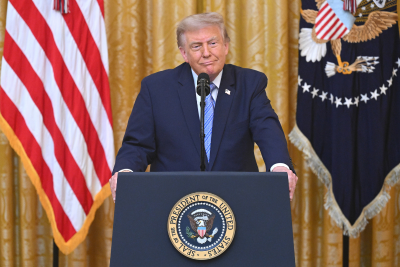
Trump then said the information about voter data in several states being “bought, stolen or hacked by China” had been kept “secret and hidden” by U.S. intelligence officials.
But Becker, of the Center for Election Innovation & Research, said that information was not revelatory.
“It would be a shock if China didn’t have this data, and the idea that, one, they had this data and then it was somehow covered up is relatively laughable,” Becker said on a July 17 press call.
He said it was publicly reported, and has long been known by the Intelligence Community, which has told U.S. presidents, including Trump, “that China has a policy of vacuuming up as much … data on Americans as it can.”
Becker said an April 2020 intelligence assessment that would have been available to Trump as president at the time, had “confirmed China is collecting voter data.” The partially redacted document, which was declassified during the Biden administration in October 2022, says “Chinese intelligence officials analyzed multiple US states’ … election voter registration data … to conduct public opinion analysis on the 2020 US general election.”
It’s unclear if the heavily redacted assessment said how China obtained the voter data, but Becker said it wouldn’t be difficult, as certain voter information is publicly accessible or can be purchased.
Indeed, one of the declassified documents that the White House released on July 16 said that, in early 2022, a Chinese actor had downloaded state voter information from 2013 to 2021 that was available on commercial U.S. websites. That data, “in theory,” could be used for “election influence operations,” the document said, adding that the actual motivation was “unknown.”
In a report updated in October 2020, the U.S. Election Assistance Commission provided data showing that 30 states plus Washington, D.C., had essentially no restrictions on who could purchase their voter registration files. Sixteen states had some restrictions on who could buy their files, and four states completed restricted access for some groups. The prices for the files ranged from $0 (in 11 states) to $37,000 in Alabama.
Becker said, “Just having the data doesn’t give you an ability to access their voter record. You need many, many more private person identifiable information points, things like driver’s license numbers, dates of birth, Social Security numbers, which aren’t in this data, to even begin to think about doing that.”
And if that had happened, he said, the public would likely know about it because it would cause issues for people trying to vote. “Altering records on a voter registration record or deleting a voter registration record would mean voters would go to the polls and have problems, and we’d be hearing reports of hundreds of thousands, if not millions, of American voters having trouble,” he said. “We’ve got no reports of that whatsoever.”
Election Systems
Trump also claimed that the newly released documents show alarming vulnerabilities in U.S. election systems and equipment. But those issues had long been publicized, and a document he quoted from said it was unlikely those weaknesses could be exploited to the degree necessary to change the outcome of an election.
“For many years, Americans were blatantly lied to about the security of our election infrastructure, including electronic voting machines and ballot counting systems,” the president said. “They’re vulnerable and they’re easily compromised and people within our government knew that.”
Trump then quoted a now-declassified January 2020 memorandum from the National Intelligence Council that said at least Russia, China, Iran and North Korea, as well as other non-state groups, “have the capability to compromise US election infrastructure for the 2020 presidential election.” And voter registration databases, pollbooks and official election websites “are most vulnerable to exploitation,” the document said, adding that it could “disrupt election processes” if such systems were accessed.
However, the same memo said those systems “would be difficult to manipulate on a wide enough scale to alter the election outcome.”
For example, it said, “The systems in each voting location are not connected to the Internet or to each other, and many methods for exploiting them rely on physical proximity.” While a foreign actor “could manipulate voting results across multiple jurisdictions and enough states to influence a presidential election,” officials judged that “conducting such a campaign would be difficult and that postelection audits and paper trails very likely would uncover such an effort.”
A similar assessment had been included in a classified Intelligence Community assessment on “foreign threats” to the 2020 election that was given to Trump, as well as administration and congressional leadership, on Jan. 7, 2021. The national director of intelligence at the time was John Ratcliffe, who now serves as CIA director. A declassified version was released in March 2021.
It said, “We assess that it would be difficult for a foreign actor to manipulate election processes at scale without detection by intelligence collection on the actors themselves, through physical and cyber security monitoring around voting systems across the country, or in post-election audits.”
There were also “no indications that any foreign actor attempted to alter any technical aspect of the voting process in the 2020 US elections, including voter registration, casting ballots, vote tabulation, or reporting results,” the assessment said.
Foreign Influence in Elections
The president said that the documents he was declassifying showed that the U.S. election system was “dangerously” exposed to, among other things, “foreign interference.” Later, he said: “China and other countries have been trying to meddle in our elections.” It’s been publicly known for years that other countries have tried to, or wanted to, influence U.S. elections through tactics like social media campaigns — most notably, Russia, a country Trump briefly mentioned once in his speech in a list of adversaries.
There is no evidence that a foreign influence campaign changed votes that were cast in any U.S. election. While Trump’s speech may have suggested to some listeners that this happened, he didn’t explicitly claim that it did. He made one vague reference to a “stolen” election, saying, “We will be working closely to mitigate any harm and we’re taking swift action to ensure that sensitive voter data is better protected so we can never be bought, we can never be hacked, and we can never watch a stolen election again.”
John Solomon, an adviser to the president and a conservative journalist, told reporters outside the White House after Trump’s speech: “The Intelligence Community has zero evidence that someone, that a foreign power flipped a vote in 2020, ’22 or ’24.”
MS Now White House reporter Vaughn Hillyard asked Solomon to confirm that the results of the 2020 election were valid. “I’m still researching,” Solomon responded, saying there was “not yet” any intelligence suggesting otherwise.
As for foreign influence campaigns, the Intelligence Community assessment on “foreign threats” to the 2020 election, which, as we noted, was given to Trump before he left office in January 2021, explained how Russia, Iran and other countries likely sought to influence the election.
“We assess that Russian President Putin authorized, and a range of Russian government organizations conducted, influence operations aimed at denigrating President Biden’s candidacy and the Democratic Party, supporting former President Trump, undermining public confidence in the electoral process, and exacerbating sociopolitical divisions in the US. Unlike in 2016, we did not see persistent Russian cyber efforts to gain access to election infrastructure. We have high confidence in our assessment,” the Intelligence Community report said. Russia’s actions including using online influence actors to “amplify mistrust in the electoral process by denigrating mail-in ballots, highlighting alleged irregularities, and accusing the Democratic Party of voter fraud.”
Iran, meanwhile, “carried out a multi-pronged covert influence campaign intended to undercut former President Trump’s reelection prospects—though without directly promoting his rivals—undermine public confidence in the electoral process and US institutions, and sow division and exacerbate societal tensions in the US. We have high confidence in this assessment,” the report said.
China, the focus of Trump’s speech, “did not deploy interference efforts and considered but did not deploy influence efforts intended to change the outcome of the US Presidential election. We have high confidence in this judgment,” the assessment said, noting that China “did not view either election outcome,” meaning Trump or Biden, “as being advantageous enough for China to risk getting caught meddling.”
There was, however, a “minority view,” held by the national intelligence officer for cyber issues, who assessed that “China took at least some steps to undermine former President Trump’s reelection chances, primarily through social media and official public statements and media,” the report said. It’s this view that Trump emphasized in his speech.
The report said that the national intelligence officer for cyber issues “agrees that we have no information suggesting China tried to interfere with election processes” and had “moderate confidence in these judgments.” This assessment “gives more weight to indications that Beijing preferred former President Trump’s defeat and the election of a more predictable member of the establishment instead.”
Russia’s interference efforts in the 2016 election — involving an online propaganda campaign and a hacking operation targeting Democratic Party committees and Hillary Clinton’s campaign — were documented in the lengthy report by special counsel Robert Mueller, as we’ve explained.
DHS Claims of Noncitizens Registered to Vote
Trump continued to claim without evidence that there are large numbers of noncitizens on voter registration rolls.
“Finally, to reveal just how vulnerable our elections continue to be, we are releasing the results of a stunning investigation by the Department of Homeland Security,” Trump said. “According to the DHS review, state voter rolls and public records, they identified approximately 278,000 noncitizens who are registered to vote in federal elections.”
As part of its data dump, the White House linked to a DHS document claiming that a “review” of “public data files” in four states — California, Pennsylvania, New Jersey and Nevada — found over 250,000 noncitizens illegally registered to vote. The document provided no information about how that estimate was derived, or the methodology used. A DHS press release issued on July 17 said that “preliminary reviews of the four states’ records” revealed there “may be as many as” 190,832 noncitizens registered to vote in California; 35,152 in New Jersey; 15,903 in Nevada; and 14,576 in Pennsylvania. The release also shed no light on how DHS arrived at those figures, and DHS Secretary Markwayne Mullin did not elaborate in a press conference on July 17.
In his July 17 press call, Becker of CEIR said he attended a background White House press briefing the afternoon before Trump’s prime-time speech and “they were not transparent about the methodology whatsoever.”
He said a White House official said only that the comparisons were done with commercial data.
“Commercial data does not allow a comparison to the public voter file in any conceivable way because of common names, because you lack … unique identifiers, like driver’s license numbers or Social Security,” Becker said. “You don’t even have dates of birth in some cases that are accurate to compare between the two because in many cases those are not included, and you’re going to create a lot of false matches because of that. Anyone who works with this data knows that.”
Becker called the 250,000 claim “an irresponsible number to share, given the opaque methodology that they claimed here.” Inevitably, he said, “I predict almost all of them are actually citizens.”
“I know about as much about voter data nationwide as almost anybody,” Becker said. “It is impossible to take a public voter file with very little information that is uniquely identified, like a driver’s license number, and compare it to a commercial database and say for sure the Maria Rodriguez or the John Lee or the Sean O’Hara you have on that is the same person. You just get a huge amount of false positives, and so I suspect that 250,000 number is just their wild highest possible number.”
Nevada Secretary of State Francisco Aguilar provided us a statement, saying, “We can affirm that on its face, we refute these claims. These numbers are wildly speculative at best and the Department of Homeland Security hasn’t shared anything that backs it up.”
“There are numerous safeguards in place to prevent noncitizens, or anyone ineligible to vote, from casting a ballot,” Aguilar said. “The Administration lacks a fundamental understanding of how elections work. They just want to cause chaos and doubt ahead of the midterms.”
Al Schmidt, the Republican secretary of the commonwealth in Pennsylvania, also pushed back on DHS’ claim.
“Pennsylvania follows all state and federal laws when it comes to our elections, and our voter rolls are properly maintained and updated,” Schmidt said in a statement to us via email. “In Pennsylvania, every voter must take steps to verify their identity before they cast a ballot, including providing proper identification every time they register to vote, vote by mail, or vote at a new polling place. All evidence has shown that noncitizen voting is extremely rare across the country, including in Pennsylvania.”
All four of the states in the DHS review declined to share their voting lists to participate in the federal Systematic Alien Verification for Entitlements, or SAVE, program, which the Trump administration has made available to states to help them identify potential noncitizens on state voter rolls.
According to the DHS document, as of June 22, 25 states that have used the SAVE tool have identified potentially 28,000 noncitizens on voter rolls — out of 68 million registration records. Even if that were accurate, that would be about 0.04% of voters. (The 250,000 discussed earlier plus the 28,000 identified through the SAVE program is how Trump arrived at his figure of 278,000.)
But as we have written, when those lists of potential noncitizens identified by the SAVE program were shared with states, county officials found U.S. citizens were among those identified. Some were recently naturalized citizens. In other cases, election officials determined some noncitizens were inadvertently added by county officials to voter lists, and still others were noncitizens who mistakenly checked a box for voter registration even after acknowledging on the same forms that they were noncitizens.
Neither Trump nor DHS claimed that any of those noncitizens who may be on state voter registration rolls have actually voted illegally. Noncitizens convicted of voting in federal elections face fines, jail time and deportation.
According to the conservative Heritage Foundation’s election fraud database, just under 100 noncitizens have been convicted of illegally voting or registering to vote since 1982.
“If his government had actual evidence of noncitizen voting, there would be indictments; Trump has been hounding US attorneys to bring such cases, and the fact that he hasn’t shows that these claims likely have no legs,” Rick Hasen, director of the Safeguarding Democracy Project at UCLA School of Law, wrote for the Election Law Blog. “Claims of noncitizen registration often evaporate upon closer inspection (such as the systems’ failure to catch newly naturalized citizens). And he’s made no claims about noncitizens actually voting.”
Michigan Voter Registration Incident
Trump seized on an incident in which a city clerk in Muskegon, Michigan, received a number of fake voter-registration applications ahead of the 2020 election.
But the applications did not actually result in anyone voting or registering to vote improperly, state officials have said: The clerk’s office quickly flagged the discrepancies and alerted the authorities.
Moreover, investigators concluded that the fraudulent applications were an attempt by low-level employees of a voter-registration organization to get paid for work they hadn’t done — not a deliberate effort to influence the election.
Here’s how Trump described the case in his speech Thursday night:
Trump: Among the disclosures tonight are FBI files detailing evidence of alleged fraud by a large-scale voter registration operation in Michigan. In 2020, Michigan State Police raided a Democrat get-out-the-vote organization, corrupt group, in Muskegon, and were so concerned by what they found … that they contacted the FBI in Detroit. The documents state that some canvassers admitted to FBI agents that they signed voter registration forms in other people’s names, submitted fraudulent registration for people who did not exist, and received gift cards tied to their number of applications that they produced.
This case has been widely reported on by local media in Michigan for years.
In late October 2020, days before the election, local news outlets reported that the Muskegon city clerk’s office had flagged “irregularities” in hundreds of voter registration applications, among several thousand that had been mailed or dropped off as part of an organized registration drive.
City Clerk Ann Meisch told local station WZZM that the vast majority of those forms were valid, but “several hundred” had birthdays, addresses, signatures or other voter information that didn’t match what the state had on file.
She said any such applications were invalidated, and no one was issued a ballot based on one.
State police later determined that around 8,000 to 10,000 applications had been dropped off by someone working for GBI Strategies, as local news outlet Bridge Michigan reported in 2023. Campaign finance records indicate GBI Strategies did work for Democratic campaigns in 2020.
Danny Wimmer, a spokesperson for Michigan Attorney General Dana Nessel, told Bridge Michigan that investigators determined the fraud had “occurred at the lowest levels of the company,” apparently by workers attempting to defraud their employer by claiming to have done work they hadn’t. The evidence did not suggest any intent to affect the election’s outcome.
Wimmer reiterated that there is no evidence anyone voted as a result of the fraudulent applications.
“This attempted fraud was detected because the system worked,” he said.
State officials told Bridge Michigan that they turned their investigation over to the FBI because it was pursuing a national investigation related to GBI Strategies.
Trump, in his speech, accused the Biden administration of a coverup.
“The FBI agents working on the case believe that crimes were committed, yet the Biden Department of Justice slow walked the investigation and killed it,” he said.
Documents released by the White House on Thursday include partially redacted exchanges between federal law enforcement officials about how to proceed with the case at various times, including a November 2021 email from an unidentified FBI agent pushing back on the DOJ’s Public Integrity Section’s decision not to prosecute.
But the records also show that DOJ officials subsequently allowed the investigation to continue, and in 2023 approved a “full field investigation” that included interviews with canvassers.
An FBI document dated September 2025, which was among the records released after Trump’s speech, states that the case was closed “because logical investigation and/or leads have been exhausted, and the investigation to date did not identify a criminal violation or a priority threat to national security.” But it was unclear from the released documents when that decision was made.
California
As he has repeatedly done before, Trump pointed to California’s recent primary election as an example of a problem in the nation’s voting systems.
“As one example of the insanity, California’s recent election for mayor of L.A. and governor was held on June 2 – long time ago. But it was just completed a few days ago on July 10,” he said. “Think of that – much more than one month. Took a month to count the votes. I wonder what they were doing.”
“This is worse than any third world country,” he falsely added. “There’s no third world country that has elections like we have.”
California does take a long time to count its votes, but July 10 is not when the state completed its counting, but rather when it certified its election.
Election certification, as the U.S. Election Assistance Commission explains, is “the process of election officials attesting that the election results are a true and accurate accounting of all votes cast in a particular election.” Beyond just counting, certification involves various audits and tests to ensure that the vote is accurate.
By state law, California county election officials have 30 days to report their results to the secretary of state, who then must certify the results within another eight days. But county officials count and report on the vast majority of ballots within just 13 days, and news organizations are able to confidently call races well before that.
In the case of the June election, the Associated Press called the L.A. mayoral race on June 8 and the gubernatorial race on June 9. Both of those timelines are considered protracted, compared with other states, but Californians have known who will be on their ballots in November for more than a month.
“California wasn’t counting ballots up until last week. California finished counting weeks ago,” Becker of CEIR said. “It was just doing all of that work of auditing and reconciling and checking and double-checking, allowing for legal challenges if there were going to be any, before certifying.”
Becker said California has “one of the longer” certification periods, but that other states, such as Wisconsin, also have them. “Every state takes weeks to certify,” he said. “That’s normal because you need time to check and double-check and audit and recount and reconcile and do all of the things to make sure transparently that the count was the count that you’re reporting out is correct. You want states to take time with this.”
California’s slow vote-counting does not inherently mean there is an election integrity issue. In fact, some of the time is spent on tasks that increase confidence in the election.
For instance, officials are “required to conduct a public 1% manual tally of the ballots tabulated by the county’s voting system in order to verify the accuracy of the automated count,” California’s secretary of state webpage says. The state also requires signature verification for mail-in ballots.
As we’ve explained before, the main reason why California is so slow is because the state sends mail-in ballots to all of its more than 23 million registered voters and 80% or more of votes are typically cast via mail.
Dealing with mail ballots is more time-consuming, as the ballots, which must be postmarked by the election day, are counted as long as they are received within a week and because the state allows voters to resolve any signature verification issues up to eight days before counties certify their results.
“The California primary went off very well. Fairly high turnout. The results stood,” Becker said, despite what he called Trump and his administration’s “slander of California election officials.”
“There are no notable legal challenges that I’m aware of with regard to the results of the primary. The people who got the most votes are advancing to the general election,” he said. “Everything actually went well. It’s just the bluster and the rhetoric that creates an image of chaos.”
SAVE America Act
Trump pushed Congress to pass the SAVE America Act, saying that the bill “requires that all voters must show photo voter ID. How simple is that?” The bill requires proof of citizenship when registering to vote, he added. But it may not be that simple for some voters. Election experts say the bill would make it difficult for some to register and cast a vote.
As we’ve explained before, 36 states already have some form of voter ID requirements, but most accept a wider range of IDs than the SAVE America Act would. The National Conference of State Legislatures, which tracks state legislation, has said that the bill’s voter ID requirements “are stricter than those most states use.”
Acceptable IDs in those 36 states “often” include student IDs, or hunting and fishing licenses, NCSL said. Some states accept non-photo identification, such as a bank statement. The SAVE America Act limits acceptable identification for voting to: a state-issued driver’s license or ID card issued by the motor vehicle agency that includes a photo and expiration date, a U.S. passport, a military ID, or a photo ID issued by a tribal government that includes an expiration date. Those voting by mail would need to submit a copy of a photo ID, or the last four digits of their Social Security number and an affidavit saying that they couldn’t obtain a copy of their ID.
Under the bill, Americans would need to prove citizenship when registering to vote or changing their registration. For most people, that would mean presenting, in person to an election official, either only a U.S. passport, or a certified birth certificate along with a driver’s license or other government-issued photo ID. Election experts have raised concerns about millions of Americans not having a passport or ready access to their birth certificates, and the bill creating too many hurdles to cast a vote.
Walter Olson, a senior fellow at the Cato Institute’s Robert A. Levy Center for Constitutional Studies, told us earlier this year that the legislation wouldn’t meet the dictionary definition of “disenfranchise,” which is to “deprive a person of the right to vote.” But it would make registering and voting harder. “That extra hassle and expense would mean that some citizens eligible to register and vote will in practice not complete the needed process even though the bill does not take away their legal right to register or to vote.”
Trump also referred to an amendment to the bill that would eliminate universal voting by mail. “You would have no mail-in ballots except for illness, disability, military deployment, or travel,” he said.
That’s more restrictive than the practice in the majority of states. Eight states and Washington, D.C., conduct their elections mostly by mail, according to the National Conference of State Legislatures. Another 29 states allow “no-excuse” mail-in voting, which means that voters don’t need to provide a reason when requesting a mail-in ballot.
As he often does, Trump made the unfounded claim that mail-in ballots are “inherently corrupt.” Election experts have told us that while fraud is slightly more prevalent with mail-in voting than in-person voting, it is still relatively rare, and there is no evidence to support claims of widespread fraud. Trump himself has voted several times by mail, including once earlier this year.
Editor’s note: FactCheck.org does not accept advertising. We rely on grants and individual donations from people like you. Please consider a donation. Credit card donations may be made through our “Donate” page. If you prefer to give by check, send to: FactCheck.org, Annenberg Public Policy Center, P.O. Box 58100, Philadelphia, PA 19102.