




Prior to announcing on Jan. 21 that he has reached a “framework of a future deal” on Greenland with the secretary general of NATO, President Donald Trump had insisted that the United States needed to acquire Greenland for national security reasons — and at first, he wouldn’t rule out potentially taking the territory over by force.
In a Jan. 21 speech at the World Economic Forum in Davos, Switzerland, Trump said, “I don’t want to use force; I won’t use force.”
Throughout his initial push to claim Greenland for the U.S., Trump made several claims about the island in the Arctic, which is home to about 56,000 people, including statements questioning Denmark’s documented ownership of Greenland and statements suggesting that the U.S. needs “ownership to defend” Greenland. Some of his claims are false.
In this story, we’ll present what the president has said and the facts.
Denmark Owns Greenland
Claim: “Denmark cannot protect that land from Russia or China, and why do they have a ‘right of ownership’ anyway? There are no written documents, it’s only that a boat landed there hundreds of years ago, but we had boats landing there, also.” — in a text message to Norwegian Prime Minister Jonas Gahr Støre
Facts: Trump’s claim that “no written documents” attest to Greenland being a territory owned by Denmark is false.
Denmark has had a claim to Greenland since Denmark and Norway were unified under the same monarchy until the early 19th Century. As part of the 1814 Treaty of Kiel, which ended a conflict between Denmark and Sweden, Denmark ceded Norway to Sweden but kept the Norwegian settlements of Greenland, Iceland and the Faroe Islands.
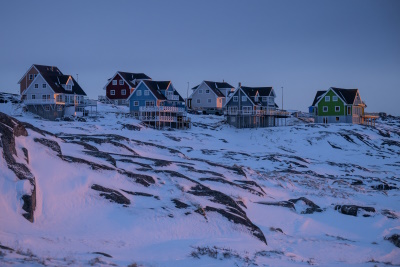
In 1933, during a dispute between Denmark and Norway over territory in the eastern region of Greenland, the Permanent Court of International Justice, as it was formerly known, ruled that Denmark had proven that it “possessed a valid title to the sovereignty over all Greenland,” and cited the Treaty of Kiel as supporting evidence.
Greenland became a county of Denmark, rather than a colony, in 1953, and was granted representation in the Danish Parliament. In 1979, Greenland was granted home rule, a form of increased autonomy, and its own parliament was created. In 2009, through the Self Governance Act, the people of Greenland gained the right to declare independence from Denmark, which has not happened.
Throughout modern history, the U.S. has also recognized Greenland as a territory of Denmark.
For example, upon purchasing the Danish West Indies from Denmark in 1916, the U.S. issued a written declaration that said “the Government of the United States of America will not object to the Danish Government extending their political and economic interests to the whole of Greenland.”
Also, in a 1941 agreement to defend Denmark against Germany during World War II, the U.S. said that it “fully recognized” that Denmark had sovereignty over Greenland.
Ten years later, the U.S. and Denmark, both new members of the NATO alliance formed in 1949, signed an updated defense agreement, which set conditions for U.S. military operations in Greenland. That agreement said that the permissions were granted “[w]ithout prejudice to the sovereignty of the Kingdom of Denmark.”
When that agreement was amended in 2004 during the George W. Bush administration, the U.S. again acknowledged that Greenland is “an equal part of the Kingdom of Denmark.”
U.S. Military Agreement on Greenland
Claim: “And all we’re asking for is to get Greenland, including right, title, and ownership, because you need the ownership to defend it. You can’t defend it on a lease. Number one, legally. It’s not defensible that way, totally. And number two, psychologically, who the hell wants to defend a license agreement or a lease.” — at the World Economic Forum on Jan. 21
Facts: The U.S. currently has an agreement with Denmark that grants broad access to Greenland for military purposes. Some experts have disputed the idea that the U.S. would need “ownership” of the island in order to “defend it.”
The Defense of Greenland agreement was first signed in 1951 and later updated in 2004.
During the Cold War, Greenland served as a foothold for the U.S. as it competed with the Soviet Union in the Arctic, but American presence there declined in the post-Cold War period, according to briefings by European and U.S. government groups.
But, as a July report from the Congressional Research Service explained, “Over the past 10 to 15 years, the emergence of great power competition and a significant increase in Russian military presence and operations in the Arctic has introduced renewed elements of military tension and competition into the Arctic.”
The U.S. now maintains one base in Greenland, the former Thule Air Base that was renamed Pituffik Space Base in 2023. It conducts space surveillance and provides missile warning and defense. Pituffik is the U.S. Department of Defense’s northernmost outpost and is manned by about 130 active-duty servicemembers, as of September.
As Trump’s rhetoric about acquiring Greenland ratcheted up over the last month, Danish officials and foreign policy analysts have pointed to the existing agreement.
“The U.S. has already a wide military access to Greenland,” Danish Minister of Foreign Affairs Lars Løkke Rasmussen said, following a Jan. 14 meeting between U.S., Danish and Greenlandic officials. “Under the 1951 defense agreement, the U.S. can always ask for increasing its presence in Greenland, and therefore, we wish to hear if the U.S. had any further requests to make in this aspect. We would examine any such request constructively.”
Similarly, the day before, Stine Bosse, a Danish member of the European Parliament, said during a question and answer session with NATO Secretary General Mark Rutte, “we have already an agreement. It’s from 1951 — you know that as well — between Denmark, the Kingdom of Denmark and the U.S., allowing the U.S. to deploy all the military forces they want.”
Mikkel Runge Olesen, a researcher at the Danish Institute for International Studies in Copenhagen, told the New York Times, “The U.S. has such a free hand in Greenland that it can pretty much do what it wants.”
We asked the White House if Trump’s “framework of a future deal” concerning Greenland was an extension of the existing agreement, but we didn’t get a response. Instead, we were provided a statement that said, “If this deal goes through, and President Trump is very hopeful it will, the United States will be achieving all of its strategic goals with respect to Greenland, at very little cost, forever. President Trump is proving once again he’s the Dealmaker in Chief. As details are finalized by all parties involved, they will be released accordingly.” (The New York Times reported on Jan. 22, citing anonymous officials, that one point of negotiation is giving the U.S. sovereignty over its military bases in Greenland.)
As for the president’s claim that “you need the ownership to defend” Greenland, some experts have disagreed.
John Bolton, Trump’s former national security adviser in his first term, called that claim “crazy talk.”
Bolton said in a Jan. 21 CNN appearance, “If he really believes that — that you have to own something to defend it — they better take notice in Japan, South Korea, where we have defense facilities — and, by the way, a large number of European countries where we have defense facilities, apparently, under the Trump view, we need to own them, too.”
The U.S. has at least 128 military bases in 51 countries, according to a 2024 Congressional Research Service report. Among the reasons for maintaining these facilities, the report says, is “[a]ssuring allied and partner nations of U.S. security commitments.”
“Merely suggesting that the U.S. can only be secure if it owns Greenland raises fundamental questions about its willingness to defend countries that it doesn’t own,” Ivo Daalder, former U.S. ambassador to NATO under President Barack Obama, told the Wall Street Journal this month.
The Golden Dome
Claim: “So, we’re building a Golden Dome and having Greenland makes it a much more effective Golden Dome.” — in a Jan. 20 interview on NewsNation
Facts: The Golden Dome refers to a defense system that Trump says he wants to build to protect the U.S. from potential missile attacks. Trump got the idea from Israel’s air defense systems, collectively known as the Iron Dome, which can detect and intercept short-range threats, such as rockets, artillery and mortars.
Stephen Biddle, adjunct senior fellow for defense policy at the Council on Foreign Relations, previously told us that the Iron Dome “is not a useful system” for intercepting long-range ballistic missiles that could be fired from U.S. adversaries like China, North Korea or Russia.
But Todd Harrison, a senior fellow who focuses on defense strategy and space policy at the conservative American Enterprise Institute, said that existing operations in Greenland could at least help track certain missiles.
“Greenland is already used by the United States as a key radar tracking site for homeland missile defense,” he told us in an email. “So yes, it would help Golden Dome by continuing to do what we already do there — track missiles with trajectories going through the arctic region.”
However, Harrison said it’s wrong for Trump to suggest that the U.S. couldn’t already do this in Greenland.
“Where the president is way off base is the idea that we don’t already have access to Greenland for missile defense (because we do) and that we need to own Greenland to use it for missile defense (we don’t). His claims about Greenland are detached from reality,” Harrison told us.
NATO Funding
Claim: “We paid for, in my opinion, 100% of NATO because they weren’t paying their bills.” — at the World Economic Forum on Jan. 21
Facts: This is false. The U.S. was not paying for 100% of NATO.
Trump for years has wrongly described what the U.S. willingly spends on its defense budget as funding for NATO. The alliance classifies the amount of money that its 32 member nations independently decide to spend on their own military as indirect spending.
As NATO explained in a December update on its funding: “The volume of US defence expenditure represents approximately two thirds of the defence spending of the Alliance as a whole. However, this is not the amount that the United States contributes to the operational running of NATO, which is shared with all Allies according to the principle of common funding.”
In terms of direct costs, the U.S., since January, pays about 15% of NATO’s “common-funded budgets,” including its civil budget, for its headquarters; its military budget for the NATO Command Structure; and its budget for the NATO Security Investment Programme, which funds certain military capabilities and infrastructure. That percentage is calculated based on a cost-sharing formula that factors in the gross national income of each country.
During Trump’s first term, the U.S. was paying as much as 22% of NATO’s common budgets.
In terms of indirect spending, the alliance in 2025 agreed that countries should spend 5% of their gross domestic product on their individual defense budgets by 2035, up from a prior commitment of 2%. Trump has long complained that several countries have fallen short of the previous spending target.
The president made this claim about NATO funding in saying that the U.S. had gotten “nothing” out of the alliance and “all we’re asking for is to get Greenland.” But the U.S. has received military support from NATO allies. Troops from member countries served in Afghanistan after the Sept. 11, 2001, terrorist attacks on the United States.
Editor’s note: FactCheck.org does not accept advertising. We rely on grants and individual donations from people like you. Please consider a donation. Credit card donations may be made through our “Donate” page. If you prefer to give by check, send to: FactCheck.org, Annenberg Public Policy Center, P.O. Box 58100, Philadelphia, PA 19102.