




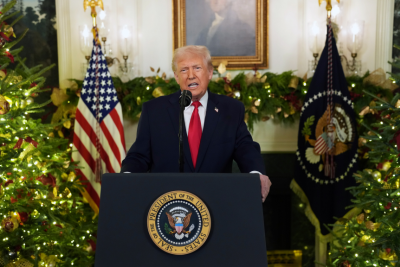
President Donald Trump blitzed through a prime-time address to the nation on Dec. 17, but while short, Trump’s speech contained a number of inaccurate or misleading claims, many of which he has repeated in public speeches for months.
- Trump mentioned several items, such as cars and plane tickets, that he said experienced price increases under former President Joe Biden and price decreases during Trump’s own presidency. We found support for some of Trump’s statistics but not others, such as the price of Thanksgiving turkeys.
- The president made the misleading claim that “for the first time in years, wages are rising much faster than inflation.” Year-over-year wages have been rising faster than inflation since June 2023, according to Bureau of Labor Statistics figures.
- Trump falsely claimed that inflation when he took office was the “worst … in the history of our country” and that inflation had now “stopped.” Inflation was never the “worst” under Biden, and it was 3% for the 12 months ending in January. It rose 2.7% in the 12-month period ending in November.
- He said, “Gasoline is now under $2.50 a gallon, and in much of the country, in some states, it by the way just hit $1.99 a gallon.” The national average price was $2.90 a gallon the week of Dec. 15, and the lowest statewide average was $2.34 in Oklahoma.
- Trump claimed that due to the tax cuts in the One Big Beautiful Bill Act, “many families will be saving between $11,000 and $20,000 a year.” The Tax Policy Center estimated the average tax cut would be $800. Only those in the top 1% of households would see an average tax decrease of the amount Trump claimed.
- Speaking about immigrants, Trump’s estimate that the U.S. was “invaded by an army of 25 million people” is vastly inflated; his claim that many of them came from “prisons and jails and mental institutions and insane asylums” is unsupported, and his claim that the Biden administration allowed in “11,888 murderers” is wrong.
- The president made the mathematically impossible claim that he was able “to slash prices on drugs and pharmaceuticals by as much as 400, 500 and even 600%.”
In his prime-time address, Trump spoke quickly, at twice the rate of his State of the Union address pace, according to a PBS News correspondent. The focus was mainly on the economy and “affordability.”
Prices
The president blamed his predecessor for “driving up prices and everything at levels never seen before,” but Trump said he is “bringing those high prices down and bringing them down very fast.”
“Under the Biden administration,” he said, “car prices rose 22%,” “gasoline rose 30 to 50%,” “hotel rates rose 37%,” and “airfares rose 31%.” He continued, “Now under our leadership, they’re all coming down and coming down fast.” He went on to say that “Democrat politicians also sent the cost of groceries soaring, but we are solving that too.” He added that “the price of a Thanksgiving turkey was down 33% compared to the Biden last year,” and claimed that “the price of eggs is down 82% since March.”

We found support for some of his figures, but none for others.
The White House told us that the price data for cars, hotels, airfares and gasoline came from the Bureau of Labor Statistics, but was not more specific. We checked the bureau’s Consumer Price Index data, the seasonally adjusted numbers, which did show price increases under Biden and mostly price decreases so far under Trump.
The CPI for new vehicles increased about 19% during Biden’s four-year term but has increased only slightly, by 0.2%, under Trump from January to November, according to the most recent BLS figures. Meanwhile, the CPI for airline fares went up almost 32% under Biden and has declined more than 9% under Trump. Also, the CPI for lodging away from home, including hotels and motels, rose over 33% under Biden and has dropped roughly 5% under Trump. Lastly, the CPI for gasoline, including all types, grew by 34.5% under Biden and has decreased about 4.6% under Trump.
The BLS also publishes average monthly price data for unleaded, regular gas and the most recent numbers, which are not seasonally adjusted, show an increase of 38% under Biden (from about $2.33 to $3.21) and a much smaller increase, about 0.6%, under Trump (from $3.21 to nearly $3.23). But those figures are different from the most recent weekly data published by the Energy Information Administration that show the average price of regular grade gas rising almost 31% under Biden (from $2.38 to $3.11 per gallon) and declining almost 7% under Trump (from $3.11 to $2.90, as of Dec. 15).
The source of Trump’s claim that turkey prices were down 33% for Thanksgiving is even less clear, as the White House provided no indication where the president got his figure. In a Nov. 19 news release, the American Farm Bureau Federation said that the average price of a 16-pound frozen turkey was down from the previous year, but only by 16%. The nonprofit advocacy group attributed the price decline to grocery stores offering special Thanksgiving deals, “attempting to draw consumer demand back to turkey, leading to lower retail prices for a holiday bird.” The wholesale prices that retailers paid for fresh turkeys were up from the year prior, the American Farm Bureau Federation said.
As for eggs, as of November, the average retail price for a dozen grade A white eggs was $2.86, down about 42% from $4.95 in January, according to the latest BLS data. Trump was likely referring to wholesale egg prices as of Dec. 12 being down 82% from the high of $8.17 in March, but wholesale prices are not what consumers pay at grocery stores. Egg prices spiked in 2024 after an avian influenza outbreak led to an egg shortage. When bird flu cases began to decline, so did wholesale egg prices, which eventually led to lower retail prices.
Overall, grocery prices, according to the CPI for “food-at-home items,” were up about 1.17% from January to November, and up about 1.9% since November 2024.
Wages
“Real,” meaning inflation-adjusted, wages have gone up since Trump took office in January, and they went down over the entirety of Biden’s tenure. But Trump made the misleading claim that “for the first time in years, wages are rising much faster than inflation.”
Year-over-year wages have been rising faster than inflation since June 2023, according to Bureau of Labor Statistics figures.
As we’ve written before, the average weekly earnings of all private-sector workers rose 16.7% over Biden’s four years, but inflation increased by more. “Real” weekly earnings fell 4%; for rank-and-file production and nonsupervisory workers, the decline was 2%. Inflation hit wage gains the hardest in the first half of Biden’s presidency, particularly in calendar year 2022. For the 12 months ending January 2025, Biden’s last year in office, real average weekly earnings went up 0.6%.
Under Trump, since January, those real average earnings have risen faster; they’re up 1.6%.
“It remains the case that both at the tail end of the Biden administration and the beginning of this Trump administration, real wages have been rising. That is to say, inflation has been rising more slowly than wages have been,” Gary Burtless, a senior fellow emeritus in economic studies at the Brookings Institution, told us in a phone interview. Burtless said that his reading of various wage measures is that “the changes have not been terribly abrupt from the turnover of the Biden administration to the Trump administration.”
Trump referred to a real wage loss under Biden and wage gains in certain industries since January. A White House spokesperson told us that such figures refer to “annualized growth” using BLS real wage data, but we were unable to replicate the figures. For the industries Trump mentioned, since January, real average weekly earnings for the manufacturing and construction industries have both gone up 1.7%; mining and logging saw a 1% increase.
Inflation
At the top of his remarks, Trump said, “11 months ago, I inherited a mess and I’m fixing it. When I took office, inflation was the worst in 48 years and some would say in the history of our country.” He later said, “inflation is stopped.”
Inflation wasn’t “the worst … in the history of our country” when Trump returned to the White House in January. As we previously wrote, during Biden’s term there was a 9.1% increase in the Consumer Price Index in the 12 months ending in June 2022, which the Bureau of Labor Statistics said was the biggest increase in over 40 years. But annual inflation growth moderated to just below 3% in the last six months of 2024. The U.S. suffered its worst inflation increase year-to-year following World War I, when there was a 23.7% rise from June 1919 to June 1920, and it was higher than the peak of Biden’s term during other periods of U.S. history.
Inflation hasn’t “stopped,” as Trump also claimed. The BLS reported on Dec. 18, the morning after Trump’s speech, that the CPI rose 2.7% over the 12-month period ending in November. (BLS didn’t collect data for October during the government shutdown, and didn’t start collecting November’s data until the 14th of that month.)
Gasoline
Returning to one of his favorite measures of economic success, Trump claimed, “Gasoline is now under $2.50 a gallon, and in much of the country, in some states, it by the way just hit $1.99 a gallon.” Retail gasoline prices are lower than the national average of $3.11 for a gallon of regular gasoline when Trump took office, as we’ve written. But Trump exaggerated the average price now. It was $2.90 a gallon the week of Dec. 15, according to the Energy Information Administration.
He also exaggerated when he said “in some states” the price “just hit $1.99 a gallon.” According to data published by AAA, there were no states where the average price was $1.99 a gallon as of Dec. 18. The lowest statewide average was $2.34 in Oklahoma. (We found some individual stations in some states selling gasoline for $1.99 or less using GasBuddy, a site that provides information about prices at more than 150,000 stations.)
OBBBA Tax Cuts
Trump called the One Big Beautiful Bill Act he signed in July “perhaps the most sweeping legislation ever passed in Congress” and touted provisions that include “no tax on tips, no tax on overtime and no tax on Social Security for our great seniors.” (As we have said, fewer seniors would pay taxes on Social Security benefits, but millions of Americans would still have to pay.)
Trump claimed that because of the tax cuts in the law, “many families will be saving between $11,000 and $20,000 a year, and next spring is projected to be the largest tax refund season of all time.” An analysis by the Tax Policy Center found that the average 2025 tax cut from the legislation is $800.
“I don’t know what Trump means by ‘many’ but the only income group that gets an average tax cut that exceeds even $9k are those in the top 1 percent, who make $1.1 million a year or more,” Howard Gleckman, a nonresident fellow at the Urban-Brookings Tax Policy Center, told us via email.
When the White House’s own Council of Economic Advisers analyzed a Senate-proposed version of the bill in June, it estimated that within four years, the potential increase in take-home pay for a typical family with two children would be between $7,600 and $10,900. But as we wrote then, the CEA estimate was based on an assumption that real, or inflation-adjusted, gross domestic product would increase by more than 4% each year, at least for the first four years under the bill. The nonpartisan Committee for a Responsible Federal Budget labeled those “fantasy growth assumptions” that “are many times higher” than the estimates of other independent analysts that have modeled versions of the bill.
Immigrants
Trump repeated several inflated, unsupported or misleading claims about immigrants who came to the U.S. during Biden’s presidency.
“Our border was open and because of this, our country was being invaded by an army of 25 million people, many who came from prisons and jails and mental institutions and insane asylums,” Trump said. “They were drug dealers, gang members, and even 11,888 murderers, more than 50% of whom killed more than one person. This is what the Biden administration allowed to happen to our country and it can never be allowed to happen again.”
Trump’s estimate of 25 million unauthorized immigrants coming into the U.S. during Biden’s presidency is far too high. We calculated in June 2024 that the figure would be about a third of that, including an estimated 2 million “gotaways” who evaded capture by Border Patrol and about 3 million people released with notices to appear in immigration court or report to Immigration and Customs Enforcement in the future, or other classifications, such as parole.
The Pew Research Center estimates that as of 2023 there were 14 million “unauthorized immigrants” residing in the U.S. in total, which includes those with some protection from deportation, such as parole or having applied for asylum. That’s nearly 4 million more than the 10.2 million estimate from the Pew Research Center for 2019.
Trump also repeated — as he does in virtually every speech — his unsupported claim that many of the immigrants who came to the U.S. during the Biden administration were released from “prisons and jails and mental institutions and insane asylums.” Trump has never provided any credible evidence of that.
Finally, Trump’s claim that “11,888 murderers” were “allowed” into the country during the Biden administration is misleading. As we have written, there were about that many noncitizens who had been convicted of murder but were not in ICE custody as of September 2024 — a list known as the agency’s non-detained docket.
But the “vast majority” of them entered the country prior to the Biden administration and had their custody status determined “long before this Administration,” the Department of Homeland Security told us in September 2024, noting that many were in prison. Also, the noncitizens include those who entered the country legally, such as green-card holders. Some of them may also have been deported. We don’t know the source of Trump’s claim that “more than 50%” or those on the list “killed more than one person.”
Drug Prices
Trump made the mathematically impossible claim that he was able “to slash prices on drugs and pharmaceuticals by as much as 400, 500 and even 600%,” by negotiating “with the drug companies and foreign nations, which were taking advantage of our country for many decades.” Of course, such reductions would suggest that drug companies were paying consumers to take their products, instead of the other way around.
In a May press conference on drug prices, Trump made comparisons similar to his 400% to 600% price-drop claims. Then, Trump cherry-picked in saying that drug prices were higher in the U.S. than in other countries sometimes by “a factor of five, six, seven, eight times. … There are even cases of 10 times higher.”
Andrew W. Mulcahy, a senior health economist at RAND, a global policy research organization based in California, told us at the time that it was “broadly correct” to say the U.S. has higher drug prices than other countries, and “you can find examples of 5, 6, 7 or 8 times, or more, higher” for individual drugs. But on average, prices in the U.S. were 2.78 times higher compared with 33 other Organization for Economic Cooperation and Development countries, according to a RAND report based on 2022 data. The average price was 4.22 times higher for brand-name drugs, which account for 10% of the prescriptions filled in the U.S.
Other Repeats
Eight ‘settled’ wars. As he often does, Trump claimed to have “settled eight wars in 10 months.” As we have written, international relations experts said the president has had a significant role in ending fighting in five conflicts, though officials in one country (India) refute Trump’s claim. But some of the international disagreements Trump cites have not been wars, and some clashes have not ended.
Housing. Touting his housing reform plans and criticizing Biden’s immigration policies, Trump also said, “A major factor in driving up housing costs was the colossal border invasion.” Vice President JD Vance made a similar misleading claim about the cause of housing prices rising during Biden’s term, as we’ve written. Immigration does affect housing prices by increasing demand, but economists told us the main causes of higher prices in recent years were low mortgage interest rates that fueled demand, a subsequent rise in interest rates, and a low housing supply dating to the Great Recession in 2007 to 2009. Immigrants in the country illegally are more likely to rent than buy, experts also said.
Electricity. The president said, “Electricity costs surged 30 to 100% under Biden. … On Day One, I declared a national energy emergency.” The cost of electricity did increase by 30% — not 100% — during Biden’s presidency, according to the CPI for electricity. But the cost of electricity continued to tick up under Trump from January to November, rising 6.8%, the BLS data show.
Jobs. Trump again made the claim that “there are more people working today than at any time in American history.” It’s correct, but it doesn’t mean much, as we’ve written. The BLS reported there were nearly 160 million total nonfarm employees as of November, the highest number of workers in history. But the U.S. also has its largest population in history.
“In November, both the labor force participation rate (62.5 percent) and the employment-population ratio (59.6 percent) were little changed from September. These measures showed little or no change over the year,” the BLS reported on Dec. 16. (The labor force participation rate is the percentage of the total population over age 16 that is either employed or actively seeking work.)
Investments. In his prime-time address, Trump said, “Already, I’ve secured a record breaking $18 trillion of investment into the United States” through his tariffs policy. But a White House webpage that purportedly tabulates “Total U.S. and Foreign Investments” made since Trump returned to office reports about half that, $9.6 trillion, taken in so far.
Experts say that even that number is questionable because it includes pledges and planned investments that may not come to fruition.“[T]hey’re just promises — and often vague ones at that,” Scott Lincicome, vice president of general economics at the libertarian Cato Institute, said in an April analysis of Trump’s investment claims.
Editor’s note: FactCheck.org does not accept advertising. We rely on grants and individual donations from people like you. Please consider a donation. Credit card donations may be made through our “Donate” page. If you prefer to give by check, send to: FactCheck.org, Annenberg Public Policy Center, P.O. Box 58100, Philadelphia, PA 19102.