




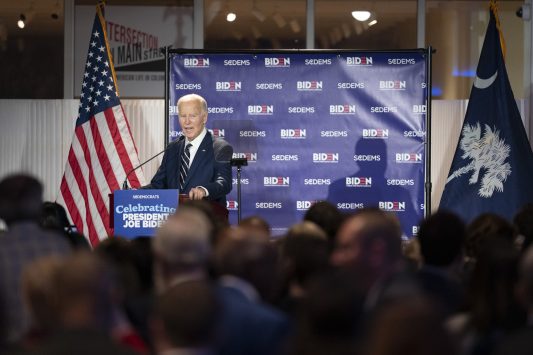
During a speech in South Carolina on Feb. 27, Joe Biden touted his record as president while criticizing his successor, President Donald Trump. But during his remarks, Biden made a number of false, misleading or exaggerated claims.
- The former president claimed that his administration created “2.2 million additional jobs” during his last year in office compared with “185,000 jobs” in the first year of Trump’s second term. But the most recent Bureau of Labor Statistics data show Biden inflated jobs added on his watch and undersold jobs added under Trump.
- He claimed that the economy experienced “record growth” during his administration, which is not supported by data from the Bureau of Economic Analysis. There was higher quarterly and annual economic growth under other presidents.
- He also said that “border crossings” in the U.S. “were lower” the day he left office than when he entered office. Yes, but total apprehensions of people illegally crossing the southern border in Biden’s last year were still more than double the number in the last year of Trump’s first term.
Biden was in South Carolina to celebrate winning the state’s Democratic presidential primary six years earlier. Biden’s win there helped propel him to become the Democratic nominee for president in 2020.
Employment Increases
When Biden compared his jobs record with Trump’s, he exaggerated the figures.
“In fact, [in] just my last year as president of the United States in 2024, we created — just the last year — 2.2 million additional jobs,” he said. “You know how many jobs Trump’s created in his first year as president? 185,000 jobs total. That’s it.”
However, the most recent data from the Bureau of Labor Statistics show that total employment increased by a little more than 1.2 million between January 2024 and January 2025, which covers Biden’s last full year in office. (He left office on Jan. 20, 2025.)
Meanwhile, in the first full year of Trump’s second term, employment increased by 359,000, from January 2025 to January 2026.
For his speech, Biden may have relied on outdated data, or data covering a different period. We reached out to his office about his claims, but we didn’t receive a response.
BLS did report in January 2025 that total employment had increased by 2.2 million in 2024. That covers most of Biden’s final year as president. But that report came out before the BLS made annual data revisions for the 12 months ending in March 2025 that lowered its estimates of the increase in employment during Biden’s time in office. The final revisions were made on Feb. 11.
The latest BLS data also show that total employment in 2025 increased by 181,000, when measured from December 2024 to December 2025. That’s close to the 185,000 figure that Biden used for Trump. But Trump took office on Jan. 20, 2025, and BLS bases its job figures on a monthly survey of households covering the week that contains the 12th day of the month. That means the January 2025 job numbers were under Biden.
We got an increase of 359,000 for Trump by measuring from January 2025 to January 2026, which more closely aligns with the period covering his first full year back in office.
We would also note that the employment for January 2026 is preliminary and subject to be revised. Also, as we’ve said before, presidents shouldn’t receive all the credit, or the blame, for employment figures on their watch.
Economic Growth
Biden also claimed that “the economy grew with record growth” during his presidency. We found no basis for that statement.
Real gross domestic product (meaning it has been adjusted for inflation) grew by 34.9% in the third quarter of 2020 and by 18.9% in all of 1942, which are the quarterly and annual economic growth records, according to Bureau of Economic Analysis estimates. The highest quarterly GDP growth under Biden was 7% in the second and fourth quarters of 2021, when the economy was rebounding from the COVID-19 pandemic, and the highest annual GDP growth during his administration was 6.2% that same year.
Average annual growth during Biden’s four years was 3.6%. That was still lower than the almost 4.5% average during Bill Clinton’s second term, and the average of nearly 5.2% during Lyndon B. Johnson’s full four-year term. There was even average annual growth of about 15.4% in Franklin D. Roosevelt’s third term, during World War II.
Taking out the bounce-back year after GDP plunged as a result of the pandemic, economic growth in the last three years of Biden’s presidency was about 2.7% annually, which is close to the yearly average of about 2.8% annual growth over the last 50 years.
Border Crossings
Biden later turned to the subject of immigration, saying, “The day I left office, border crossings in the United States were lower than the day that I entered an office inherited from Trump.” That’s accurate, but misleading.
Border Patrol made 47,320 apprehensions of people illegally crossing the U.S. border with Mexico in December 2024, Biden’s last full month in office. Then apprehensions at the southern border declined further to 29,105 in January 2025, and Biden left office a little more than halfway through that month.
Those figures were down from 71,141 apprehensions by Border Patrol in December 2020, the last full month of Trump’s first term, and 75,316 in January 2021, when Trump exited the White House.
But in our story “Biden’s Final Numbers,” which looks at various statistical measures during his presidency, we wrote: “Illegal border crossings, as measured by apprehensions at the southwest border, were 107% higher in Biden’s final year in office compared with the last full year before he was sworn in, according to data from U.S. Customs and Border Protection.” We also said “that snapshot undersells the surge in illegal immigration during Biden’s four years in office, because apprehensions dropped dramatically in the second half of 2024 after Biden initiated some emergency policies to curb illegal border crossings.
“Before then, the U.S. was experiencing historically high illegal immigration,” we reported.
We also pointed out that apprehensions were only part of the picture, since the number of people seeking asylum at legal ports of entry remained high under Biden, as his administration began accepting CBP One mobile app applications that allowed immigrants to request asylum or parole and be screened for entry to the U.S. Plus there was an additional surge in immigrants coming to the U.S. via newly created legal methods, such as noncitizens granted parole, which allows them to temporarily live in the U.S. for “urgent humanitarian or significant public benefit reasons.” Biden offered parole to immigrants from countries such as Cuba, Haiti, Nicaragua and Venezuela. (Trump has largely halted those humanitarian programs through executive orders.)
While Biden suggested that the increase in migration earlier in his presidency was due to the pandemic, Julia Gelatt, associate director of the U.S. immigration policy program at the Migration Policy Institute, previously told us that there were several reasons for the surge.
“There were many different drivers in the growth of the unauthorized immigrant population during the Biden presidency: strong labor demand in the U.S. as the country rebounded from the COVID-19 recession, and push factors such as authoritarian governments in Cuba, Nicaragua, and Venezuela and intense gang violence and extortion in countries like Haiti and Ecuador,” she said. “It’s also possible that some people moved in order to take advantage of new pathways created by the Biden administration.”
Correction, March 12: Border Patrol apprehensions for December 2020 and January 2021 were 71,141 and 75,316, respectively, as confirmed by CBP. We had slightly different figures in our original article.
Editor’s note: FactCheck.org does not accept advertising. We rely on grants and individual donations from people like you. Please consider a donation. Credit card donations may be made through our “Donate” page. If you prefer to give by check, send to: FactCheck.org, Annenberg Public Policy Center, P.O. Box 58100, Philadelphia, PA 19102.