




In a disparaging attack on Somalia in which he said he didn’t want people of Somali descent in the United States, President Donald Trump said Somalis “ripped off” Minnesota “every year” for “billions of dollars,” an apparent reference to a fraud investigation, and suggested that “like 88%” of Somalis receive “welfare” benefits. But the White House didn’t provide us with evidence for either of those figures.
Update, Dec. 10: We updated this article to include information the Center for Immigration Studies published on Dec. 10 about 81% of Somali immigrant households in Minnesota receiving “some form of welfare.” We had reached out to CIS for such information prior to the publication of our article but did not receive a response.
Update, Dec. 17: We updated this article to include additional information that Minnesota’s state demographer provided to us showing 84% of individuals reporting Somali ancestry in Minnesota — not just Somali immigrants — benefited from specific public assistance programs, mostly Medicaid.
Trump was at least partly referring to a recent news report that said the vast majority of people federal prosecutors have charged since 2022 with committing three fraud schemes targeting social service programs in Minnesota are members of the state’s Somali community.
Joseph H. Thompson, then the acting U.S. attorney for the District of Minnesota, told a local Minnesota news station in July that the amount of fraud could total over $1 billion when government investigations are complete. He then told another local outlet in September that the amount is “in the billions of dollars,” when counting fraud in other state programs that are under investigation.
However, when we asked that U.S. Attorney’s Office how Thompson came up with his figures, we didn’t receive a response.
The Minnesota Star Tribune reported in a Dec. 7 story that its review of court documents “shows the alleged fraud uncovered to date is closer to $152 million,” although the newspaper said that figure “is expected to grow” as federal and state investigations continue.
In this story, we’ll explain what happened in the fraud cases and what we know about Somalis and welfare.
Fraud Cases
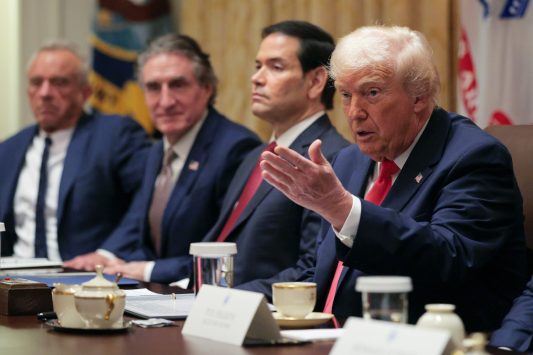
Trump went on a rant against people of Somali heritage at the end of a Dec. 2 Cabinet meeting at the White House, calling them “garbage” and accusing them of stealing large sums of money from Minnesota taxpayers.
“I hear they ripped off, Somalians ripped off that state for billions of dollars, billions,” Trump said. “Every year, billions of dollars. And they contribute nothing. The welfare is like 88%.”
“I don’t want them in our country,” the president said, adding that he didn’t care that some people would call his remarks “not politically correct.”
There are at least three separate fraud cases in Minnesota that are being investigated by federal and state authorities, and there is a connection to the state’s Somali population.
In a Nov. 29 story, the New York Times reported that 78 of the 86 people charged so far for defrauding Minnesota programs are of Somali descent.
First, the Department of Justice began charging dozens of people in 2022 for their roles in a plot exploiting a federally funded nutrition program for children during the COVID-19 pandemic. According to a DOJ press release about the charges, employees of Feeding Our Future, a Minneapolis-based nonprofit organization, enlisted individuals and entities in the scheme to defraud the Department of Agriculture’s Federal Child Nutrition Program, which was administered in the state by the Minnesota Department of Education.
Federal prosecutors said Feeding Our Future was a sponsor participating in the nutrition program when it recruited others to open shell companies to act as program sites feeding children throughout the state. Those fake food sites allegedly produced fabricated paperwork, including invoices and attendance logs, showing millions of meals provided to kids, and Feeding Our Future submitted bogus claims for reimbursement through the federal program.
The Justice Department said that Feeding Our Future opened more than 250 sites statewide and “fraudulently obtained and disbursed more than $240 million” in program funds, some of which officials said was used for personal purchases, such as cars, jewelry and property. (The Star Tribune said that prosecutors “have not produced evidence indicating all of that money was fraudulent.”)
As of November, prosecutors said that 78 individuals had been charged in the scheme, including Feeding Our Future’s founder, Aimee Bock, who denied any wrongdoing but was convicted on wire fraud and bribery charges by a federal jury in March.
Then, in September, federal prosecutors brought wire fraud charges against eight individuals for a scheme to defraud Minnesota’s federally funded Housing Stabilization Services Program, which began in 2020 to help seniors and other people with disabilities find and maintain housing. State officials ended the program in October because of fraud concerns.
Prosecutors said the perpetrators enrolled in the program, which was financed through Medicaid, as providers of various housing services. “Rather than provide such help, the defendants obtained and misappropriated millions of dollars in program funds that were intended as reimbursements for services provided to those people,” prosecutors said in a press release about the charges.
The program’s cost, initially expected to be about $2.6 million annually, ballooned from $21 million in 2021 to $104 million in 2024 — much of it attributed to fraud, according to a federal investigation. Prosecutors said the program’s “low barriers to entry and minimal records requirements for reimbursement” made it “susceptible to fraud.”
Also in September, one person, Asha Farhan Hassan, who is reportedly of Somali ancestry, was federally charged for her alleged participation in a five-year scheme that cheated a Minnesota health care program out of at least $14 million, prosecutors said. That program, the Early Intensive Developmental and Behavioral Intervention Benefit, is also funded through Medicaid, and provides medically necessary services to children and some young adults with autism spectrum disorder or related conditions.
Prosecutors said that through that program a company formed by Hassan, Smart Therapy, filed claims for Medicaid reimbursement that “were fraudulently inflated, were billed without providers’ knowledge, and were for services that were not actually provided.” Hassan allegedly then split the money her company received with her partners, including payments to parents who received kickbacks of up to $1,500 per month for each child they allowed to be enrolled in Smart Therapy for services as part of the scheme.
Hassan, who was also charged in the Feeding Our Future fraud plot, recruited Somali parents and their children for participation, prosecutors said.
Somalis and Welfare
As we said, in addition to not providing support for the claim that Somali people stole “billions” from Minnesota “every year,” the White House also did not provide evidence that “like 88%” of Somalis receive “welfare,” as Trump suggested.
Instead, a White House spokeswoman, Abigail Jackson, said: “President Trump is absolutely right to highlight the problems caused by the radical Somali migrants that the Democrats let invade our country and steal from American taxpayers. For example, Tim Walz has allowed Somali refugees to turn Minnesota into a hub of fraudulent money laundering activity to fund lavish lifestyles overseas at the expense of American taxpayers. While the media feigns outrage, Americans who have suffered at the hands of these schemes will celebrate the President’s comments and strong support for AMERICAN citizens.”
We originally were not able to find information showing the percentage of Somali residents in Minnesota, or the U.S., who benefit from social programs that might be considered “welfare,” which has no universal definition. In 2024, there were nearly 260,000 people of Somali descent living in the U.S. and more than 108,000 of them resided in Minnesota, according to the Census Bureau’s latest American Community Survey estimates.
On Dec. 10, the day after our article was published, the Center for Immigration Studies, an organization that favors low immigration levels, released a report saying that 81% of Somali immigrant households in Minnesota overall, and 89% of Somali immigrant households in the state with children, consume “some form of welfare,” including state or federal cash assistance, Supplemental Nutrition Assistance Program benefits and Medicaid. CIS said its report was based on “the most recent 10 years of data from the American Community Survey, 2014-2023.”
Susan Brower, Minnesota’s state demographer, told us in an email that, while not representative of all types of welfare, from 2019 to 2023, an estimated 8% of people with Somali ancestry living in Minnesota reported receiving certain forms of “public assistance income,” according to the 2019-2023 American Community Survey conducted by the Census Bureau.
She said the public assistance category specifically includes payments from state and federal programs like the Minnesota Family Investment Program, formerly known as Aid to Families with Dependent Children; General Assistance, for low-income individuals and married couples without children; and Supplemental Security Income, which is paid to elderly, blind or disabled persons with low incomes.
Benefits from other programs, such as the Supplemental Nutrition Assistance Program, formerly known as food stamps, were not included.
Due to sampling error, Brower said, the actual percentage of Somali people receiving those forms of income assistance could range from 6.3% to 10.1%. The CIS report said 27% of Somali immigrant households in Minnesota “receive cash welfare,” based on the 2014 to 2023 period, “including Temporary Assistance for Needy Families, Supplement Security Income, and general assistance.”
Brower said because Somalis do have a higher poverty rate than other groups, “it would make sense that they are eligible for more public programs.” She noted that an upcoming report from the Minnesota State Demographic Center estimates that 38% of Somalis in the state live in poverty. A 2023 state report showed that the median income of Somali households in Minnesota was $28,500, in 2020 dollars, the lowest of any cultural group.
After CIS published its report, Brower, at our request, provided to us American Community Survey data showing that, between 2019 and 2023, 84% of the roughly 60,000 estimated individuals reporting Somali ancestry in Minnesota – including people born in and outside the U.S. – received either state or federal assistance income, SNAP, Medicaid, or a combination of those benefits.
She said 8% of people aged 15 or older reporting Somali ancestry reported getting public assistance income, 60% reported receiving SNAP in the previous 12 months and 78% reported having Medicaid as their health insurance. For the latter category, 69% of adults of Somali ancestry reported having Medicaid and 90% of Somali children had such insurance. Brower noted that one limitation of this data is that it “only identifies about 70% of Somali Minnesotans which is a considerable undercount.”
In total, 77.3 million Americans had Medicaid or Children’s Health Insurance Program coverage as of August, the latest data available from the Centers for Medicare & Medicaid Services.
Trump suggested last month that, in general, most immigrants in the U.S. rely on public assistance, writing in a Nov. 27 Truth Social post, “The official United States Foreign population stands at 53 million people (Census), most of which are on welfare, from failed nations, or from prisons, mental institutions, gangs, or drug cartels.”
A 2023 report from CIS did find that, in 2022, 54% of households headed by immigrants — including naturalized citizens, legal permanent residents and people without legal status — “used one or more major welfare program.”
CIS said it counted the following “means-tested anti-poverty programs” as welfare: the Earned Income Tax Credit; Supplemental Security Income; Temporary Assistance to Needy Families; free or reduced-price school meals; the Women, Infants, and Children nutrition program; the Supplemental Nutrition Assistance Program; Medicaid; and subsidized and public housing.
Meanwhile, a February report from the libertarian Cato Institute, using a different methodology, found that “immigrants consumed 21 percent less welfare and entitlement benefits than native-born Americans on a per capita basis in 2022.” That report looked at the percentage of the total dollar amount of spending on benefits for immigrants and U.S.-born residents, and it counted fewer means-tested programs as welfare and also included Social Security and Medicare, which are considered entitlement programs.
But it’s worth noting, Brower said, that 95% of Somalis in Minnesota are citizens of the U.S. and 58% of them were born in the U.S.
Correction, Dec. 9: We originally referred to the Minnesota Star Tribune as the Minneapolis Star Tribune.
Editor’s note: FactCheck.org does not accept advertising. We rely on grants and individual donations from people like you. Please consider a donation. Credit card donations may be made through our “Donate” page. If you prefer to give by check, send to: FactCheck.org, Annenberg Public Policy Center, P.O. Box 58100, Philadelphia, PA 19102.