




Summary
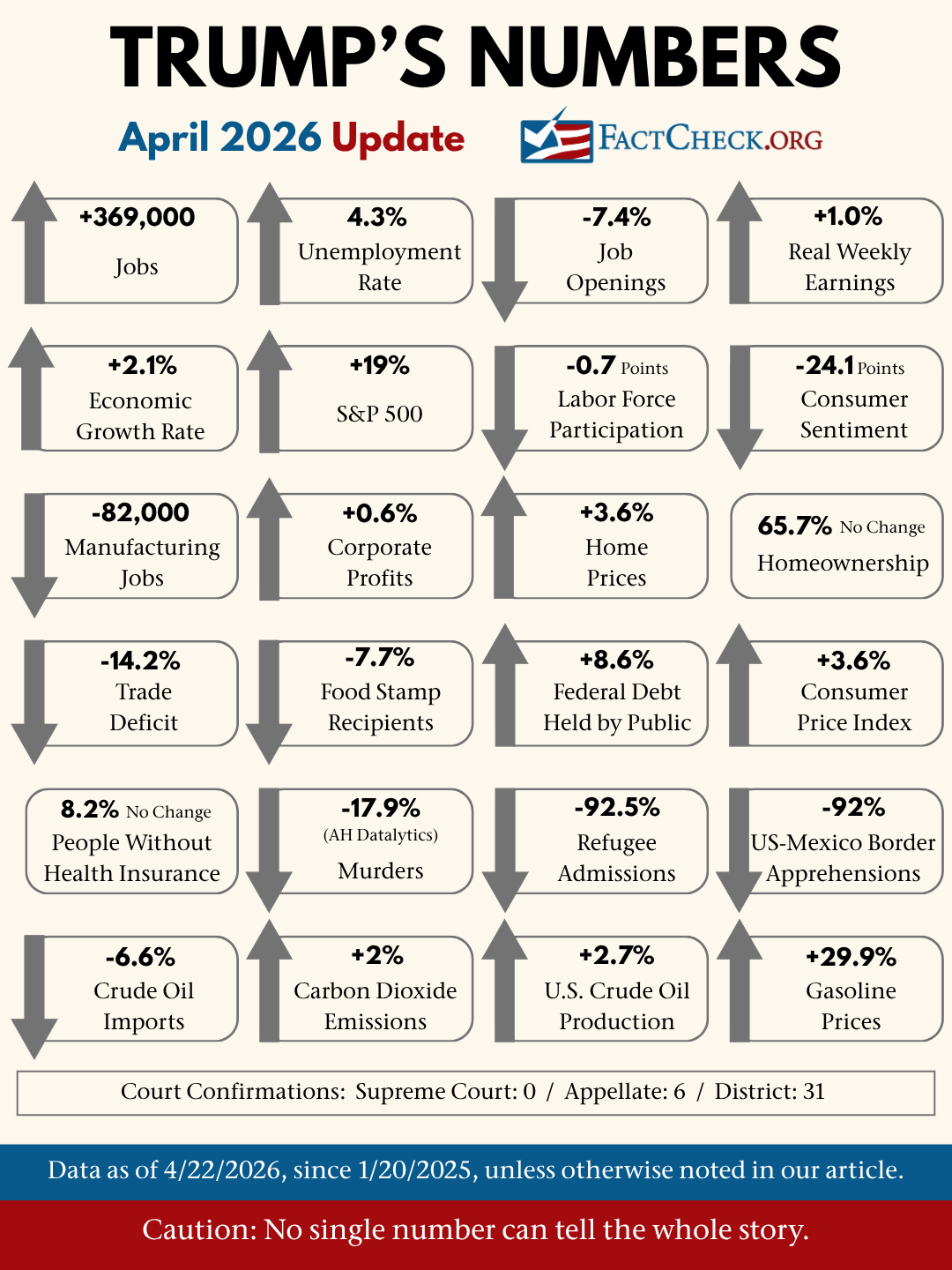
Under President Donald Trump’s second term:
- Job growth slowed, with a total of 369,000 jobs created as of March. The unemployment rate ticked up to 4.3%.
- Inflation worsened a bit, and gasoline prices increased after U.S.-Israeli airstrikes on Iran.
- Average weekly earnings of private-sector workers, adjusted for inflation, rose 1.0%.
- The economy grew 2.1% in 2025.
- Consumer sentiment has now hit a record low.
- The number of apprehensions at the U.S. border with Mexico decreased about 92%, and refugee admissions dropped by the same percentage.
- The percentage of the population lacking health insurance held steady in the first six months of 2025.
- The trade deficit dropped 14% for the most recent 12 months.
- The number of murders nationwide has continued to decline, a trend that began in 2022.
- The stock market fell dramatically after the U.S.-Israeli strikes on Iran, then rebounded and reached new heights.
- Oil production went up 2.7%, and oil imports declined almost 6.6%. Carbon emissions increased slightly.
- About 3 million fewer people are receiving federal food assistance.
- The federal debt held by the public rose about 8.6%.
Analysis
This is the first update in our “Numbers” series for Trump’s second term. Expect additional updates to be published every three months for the remainder of his presidency, as we did for his predecessors, starting with President Barack Obama in 2012.
These are just some of the many economic and social statistics that indicate how the U.S. is faring. We will include a few other data categories, such as household income and the poverty rate, later this year when the newest government figures are available.
We only present the numbers, which, depending on the reader’s perspective, may seem positive, negative or neither. How much credit or blame the president should receive for the statistics is also in the eye of the beholder.
Jobs and Unemployment
Job growth slowed markedly, and unemployment crept up during Trump’s second term. Manufacturing jobs continued to decline despite new tariffs on imports. Job opportunities declined.
Employment — Employment continued growing during Trump’s first 14 months in office, but far more slowly than it had in the previous 14 months.
The most recent figures from the U.S. Bureau of Labor Statistics show an increase of only 369,000 in total nonfarm employment between January 2025 and March 2026. The total went up four times faster before, rising by 1,565,000 during the final 14 months of President Joe Biden’s administration, even after the BLS revised Biden’s figures downward in February as a result of its annual “benchmarking” study.
Much of the sluggishness under Trump is due to the president’s deliberate slashing of the federal workforce. Federal government employment has fallen by 352,000, or 11.7%, since he took office.
Looking only at the private sector — excluding federal, state and local government workers — 609,000 jobs were added during Trump’s term so far. But that’s still far less than the 1,044,000 added in the preceding 14 months.
Last August, after the BLS reported only 73,000 jobs had been gained in July, Trump called the figures “rigged” and “phony” and fired BLS Commissioner Erika McEntarfer. But the numbers have only grown worse since then. The gain for July has been revised downward to 64,000, and the BLS reports that the economy actually lost jobs in August, October, December and February.
Manufacturing Jobs — A year ago, Trump predicted a flood of new factory jobs as he announced sweeping new tariffs on what he called “Liberation Day,” April 2, 2025.
“Jobs and factories will come roaring back into our country,” he said. But so far that hasn’t happened. The economy has continued to lose manufacturing jobs.
During Trump’s first 14 months, the loss was 82,000, following a loss of 186,000 in the preceding 14 months.
Labor Force Participation — The labor force participation rate declined a bit in Trump’s second term, dropping from 62.6% in January 2025 to 61.9% as of March.
The rate is the portion of the population over age 16 that is working or seeking work. It generally has been in a long decline as the population ages and people retire.
Unemployment — The unemployment rate has gone up slightly since Trump took office. It was 4.0% in January 2025, and most recently was 4.3% in March.
But that is still well below the historical norm. The median rate for all months since 1948 is 5.5%.
Job Openings — The number of job openings declined by 549,000 under Trump, to 6.9 million as of the last day of February. It’s a drop of 7.4%.
Meanwhile, the number of people officially listed as unemployed and seeking work rose by 374,000, to 7.2 million as of March. When Trump took office there were more openings than job-seekers. Now it’s the opposite.
Wages and Inflation
CPI — Trump campaigned on a promise to reduce inflation, but since he took office it has worsened a bit.
In the 12 months before Trump took office, the Consumer Price Index, the most commonly cited measure of inflation, rose 3.0%. And in the most recent BLS report, the 12-month increase was 3.3%.
Over Trump’s first 14 months in office, the CPI went up 3.6%, pushed up most recently by the U.S.-Israeli strikes on Iran, which have sent up gasoline prices in particular.
Fuel prices — always volatile — had been a bright spot for Trump before. As of our previous “Trump’s Numbers” report in January, the national average price for regular gasoline at the pump had declined to $2.78 a gallon, down from $3.11 the week he was sworn in for his second term. But as of the week ending April 20, it was up to $4.04, according to the Energy Information Administration. That’s an increase of 29.9% since Trump’s inauguration.
Inflation is still higher than the Federal Reserve would like, and it’s going in the wrong direction as measured by the Fed’s preferred metric, the Personal Consumption Expenditures Index, compiled by the Bureau of Economic Analysis.
The central bank’s target is a 2% annual increase in the PCE. When Trump took office, the 12-month increase in the PCE was 2.5%. But the most recent report put the 12-month increase at 2.8% in February. And that does not reflect the effects of the war on Iran, which began the last day of February. (PCE figures take longer to collect than the CPI, but the Fed prefers the measure because it is more comprehensive and adjusts more quickly to consumers’ buying habits.)
Wages — Wage increases accelerated under Trump, even adjusted for worsening inflation.
The average weekly earnings of all private-sector workers, adjusted for inflation, rose 1.0% during Trump’s first 14 months. They were rising when he took office, but had only gone up 0.4% in the preceding 14 months.
Those figures include professionals, executives and supervisory employees, whose pay is normally higher. But rank-and-file wage earners are seeing gains just as rapid as those of their bosses. For private-sector production and nonsupervisory employees, real average earnings also rose 1.2% under Trump through March, after a 0.8% rise in the preceding 14-month period.
Economic Growth
The U.S. economy resembled a roller coaster last year – with weak first and fourth quarters but strong second and third quarters.
The end result: a respectable, but underachieving 2.1% growth for the year.
“Despite a solid 2.1% expansion for the full year, 2025 will likely be remembered as the year that ‘could have been,’” EY-Parthenon Chief Economist Gregory Daco said in an April 9 analysis. “A rare confluence of supply shocks — tariffs, tighter immigration and elevated policy uncertainty — constrained activity, leaving growth below what strong organic productivity gains and rapid AI adoption would have otherwise supported.”
The nation’s real gross domestic product declined at an annual rate of 0.6% in the first quarter and expanded by only 0.5% in the fourth quarter, according to the Bureau of Economic Analysis. In between, the economy grew at the robust annual rates of 3.8% in the second quarter and 4.4% in the third quarter.
For the full year, the U.S. finished with the weakest GDP since 2020, when the COVID-19 pandemic wrecked the economy. (See the chart below.)
As for this year, economic experts project that the U.S. economy will continue to grow – but they warn that projections carry what S&P Global called “a high degree of unpredictability” because of the Middle East conflict.
In an economic outlook released March 25, S&P Global Ratings projected 2.2% real GDP growth for the U.S. this year, assuming that the war will result in only a “temporary, supply-driven oil shock that recovers inside the year.”
Similarly, Michael Wolf, a senior manager and global economist at Deloitte Touche, wrote in late March that Deloitte economists project U.S. growth at 2.2% – while noting that “conditions remain highly fluid.”
Daco, who is also the president of the National Association for Business Economics, said in a press release that an NABE survey of economic forecasters conducted from March 5 to March 13 found that most of those surveyed expect “recent geopolitical developments to reduce 2026 GDP growth.”
As of April 21, the Federal Reserve Bank of Atlanta’s GDPNow model was projecting growth of 1.2% for the first quarter. The BEA first quarter estimate will be released on April 30.
Consumer Sentiment
When Trump took office, consumers surveyed by the University of Michigan expressed concern that his plan to increase tariffs would increase prices, and that turned out to be true. Consumers now have an added inflationary concern: the joint U.S.-Israeli attack on Iran that started on Feb. 28. Over a nearly two-month period, the war has driven up the cost of oil, gasoline, and other goods and services.
Consumer sentiment, which already has been stubbornly low under Trump, has now hit a record low.
The university’s preliminary Index of Consumer Sentiment for April was 47.6 – the lowest since at least 1978, according to the university’s online database.
“Consumer sentiment sank about 11% this month, extending a decline that began with the start of the Iran conflict,” Joanne W. Hsu, director of the Surveys of Consumers, said in a press release issued this month. “Demographic groups across age, income, and political party all posted setbacks in sentiment, as did every component of the index, reflecting the widespread nature of this month’s fall.”
April’s preliminary number, which could change when it is finalized on April 24, is 24.1 points lower than it was in January 2025, when Trump took the oath of office for a second time.
In its most recent Consumer Confidence Survey, the Conference Board — a research organization with more than 2,000 member companies — reported that consumer confidence “improved modestly” in March for the second straight month. “Nonetheless, the Index has been on a general downward trend since 2021,” Dana M. Peterson, the board’s chief economist, said in a March 31 press release.
The Conference Board’s April report is scheduled to be released April 28.
Home Prices & Homeownership
Homeownership — Homeowner rates have remained largely unchanged under Trump.
The most recent homeownership rate, which the Census Bureau measures as the percentage of “occupied housing units that are owner-occupied,” was 65.7% in the fourth quarter of 2025 — identical to the rate during Biden’s last quarter in office.
Last year’s fourth quarter rate was up slightly from the previous quarter, but the difference was not statistically meaningful, according to a February press release from the bureau.
The homeownership rate remained largely unchanged last year even though the Federal Reserve cut interest rates three times and mortgage rates declined.
Days before Trump took office, the average 30-year fixed rate mortgage was 7.04% for the week ending Jan. 16, 2025, according to Freddie Mac. As of the week ending April 16, the average 30-year fixed rate mortgage was 6.30%.
In a Dec. 12 article, Realtor.com Senior Economic Research Analyst Hannah Jones said homeownership rates continue to be affected by “[p]ersistent affordability challenges and a shortage of reasonably priced homes.”
Home Prices – Home prices have remained fairly stable under Trump.
The national median price of an existing, single-family home sold in March was $412,400, according to the National Association of Realtors. That was only 3.6% higher than it was in January 2025, when Biden left office and the median price was $398,100.
Year-over-year, the median sales price in March was only 1.25% higher – a record high for March, despite a decline in home sales for the month, NAR Chief Economist Lawrence Yun said in a press release. Existing single-family home sales were down 3.5% from February and 0.3% year-over-year, the NAR data show.
“March home sales remained sluggish and below last year’s pace,” Yun said. “Lower consumer confidence and softer job growth continue to hold back buyers.”
“Because inventory remains limited,” he added, “the median home price rose to a new record high for the month of March.”
Existing home sales and prices for April are scheduled for release on May 11.
Immigration
Illegal immigration continues to be historically low since Trump took office for his second term.
While it’s impossible to know how many people successfully cross illegally into the U.S., for the purposes of our Numbers stories going back to Obama, we have calculated the change in border apprehensions as a proxy to measure illegal border crossings. Over the last 12 months under Trump, there were 85,218 immigrants apprehended attempting to illegally cross the southern border. That’s down nearly 92% from the last 12 months under Biden.
Colleen Putzel-Kavanaugh, an associate policy analyst at the Migration Policy Institute, said that one of the biggest drivers of the dramatic drop in illegal immigration was a new policy, which Trump invoked on his first day in office, that “effectively … people were no longer able to apply for asylum” at the border. That was one of the major drivers of immigration during the Biden administration, with hundreds of thousands of migrants crossing the border and “sort of waiting to be intercepted and asking for asylum.”
“So now, without access to that kind of protection, that certainly impacted the number of people who are trying to cross the border,” Putzel-Kavanaugh told us.
In addition, Trump abolished the so-called “catch and release” policy, such that people apprehended at the border are processed for expedited removal or placed in detention, rather than some, such as those seeking asylum, being released into the U.S. pending an immigration hearing.
That is what Trump was apparently referring to in a speech at a Turning Point USA event on April 17, when he said he had taken an “open border and created the most secure border in U.S. history, one of the most secure borders anywhere in the world with zero illegal aliens coming into our country in the past 11 months. Zero.”
But, Putzel-Kavanaugh said, because “people are just immediately processed for removal,” it’s also possible things are returning to the “standard migration pattern” where people are seeking to evade detection.
One other major factor in the decrease in illegal immigration to the U.S. has been the Trump administration’s focus on interior enforcement and deportations, which, Putzel-Kavanaugh told us, “likely has somewhat of a chilling factor for people who maybe were thinking about coming to the US.”
According to publicly available Immigration and Customs Enforcement data, the average daily population of those detained by ICE during the first three months of 2026 is up nearly 300% compared with the last three months under Biden. The Trump administration is also arresting a greater percentage of people who have neither criminal convictions nor pending criminal charges. In the last three months of the Biden administration, 65% of those detained by ICE had criminal convictions and 29% had pending criminal charges. Just 6% had neither. By contrast, in the first three months of 2026, 30% of those detained by ICE had criminal convictions and 31% had pending charges. The percentage of those detained by ICE with neither criminal convictions nor pending charges was 39%.
Refugees
In Trump’s second term, refugee admissions have all but stopped – except for South Africa’s white minority Afrikaners.
As we wrote last year, Trump signed an executive order on his first day back in office that called for an indefinite suspension of all refugee admissions until the program “aligns with the interests of the United States.”
But Trump issued an order on Feb. 7, 2025, making an exception for Afrikaners. When asked about the exception, the president told reporters there was “a genocide that’s taking place” against white farmers in the country – which, as we wrote, distorts the facts.
Since February 2025, the U.S. admitted only 5,005 refugees in Trump’s first full 14 months in office – including 4,838 refugees from South Africa, according to the State Department’s monthly refugee admissions reports.
That’s an average of 357.5 per month, or 92.5% fewer than the monthly average of 4,741 per month under Biden.
For fiscal year 2026, which began Oct. 1, 2025, Trump capped refugee admissions at just 7,500. In the first six months of the current fiscal year, the Trump administration has resettled 4,499 refugees and all but three came from South Africa.
Health Insurance
Data on how health insurance coverage has changed under Trump’s second term is slowly being released. In late January, the National Health Interview Survey published a preliminary report on the first six months of 2025 that found no change in the percentage of the population lacking health insurance, compared with the full-year report for 2024.
For January to June 2025, 8.2% of the U.S. population was uninsured, the same figure as the prior year. In raw numbers, 27.5 million people lacked insurance in the first half of 2025, a figure that “was not significantly different” from the 27.2 million who lacked insurance in 2024, the report said. The NHIS measures the uninsured at the time people are interviewed.
The NHIS, a project of the National Center for Health Statistics at the Centers for Disease Control and Prevention, used to release quarterly preliminary reports, but as of last year, it said it would switch to biannual reports only. A full-year report for 2025 is scheduled to be published in June.
Annual reports from the Census Bureau, typically released in September, measure those who were uninsured for the entire calendar year. The report for 2024, the latest available, similarly put the uninsured rate at 8%.
The 2025 One Big Beautiful Bill Act is expected to increase the number of people who lack health insurance, but the impact will occur over several years. The nonpartisan Congressional Budget Office estimated the uninsured would increase by 10 million people over 10 years, with most of the increase due to the law’s changes to Medicaid. For 2026, the rise was estimated at 1.3 million people. (See the link to estimated changes in people without health insurance.)
Trade
The latest figures from the Bureau of Economic Analysis show that the U.S. trade deficit in goods and services may be headed for a decrease in 2026 after rising in 2025.
During the most recent 12 months ending in February, the U.S. imported about $775.6 billion more in goods and services than it exported. That trade gap was down 14.15% from the annual trade deficit of $903.5 billion in 2024.
The trade deficit rose to almost $911.7 billion in 2025, which was influenced by larger than usual monthly deficits in January, February and March of last year. As we have written, those three monthly deficits — all above $100 billion — were the result of U.S. importers stocking up on goods to get ahead of a number of tariffs on imported products that Trump had said he planned to implement.
Trump claimed that his tariffs would help reduce, or even eliminate, the trade deficit, which had increased by 34.1% under Biden.
Crime
Violent crime has declined. The latest data comes from several groups that monitor crime statistics. The FBI’s annual nationwide report for 2025 won’t be released until the fall.
AH Datalytics, an independent criminal justice data analysis group, documents an 11% drop in the number of violent crimes from 2024 to 2025, based on data from 445 law enforcement agencies across the country covering nearly a third of the U.S. population. Murders declined 17.9%, and robberies were down 19.2%. The number of property crimes decreased 12.2%. The number of violent and property crimes continued to go down in January and February, compared with those months last year.
AH Datalytics’ charts on the longer-term trend show an increase in the number of murders starting in 2020, during the COVID-19 pandemic, and a decline in the numbers since 2022.
The Major Cities Chiefs Association, an organization representing police executives in large cities, similarly found a 19.3% decrease in the number of homicides and a 19.8% drop in the number of robberies in 2025, compared with 2024. That’s based on data from 67 law enforcement agencies.
The Council on Criminal Justice, a nonprofit think tank, found similar percentage decreases among 35 U.S. cities from 2024 to 2025. Its year-end report, released in January, said that when the FBI publishes nationwide data later this year, “there is a strong possibility that homicides in 2025 will drop to about 4.0 per 100,000 residents. That would be the lowest rate ever recorded in law enforcement or public health data going back to 1900, and would mark the largest single-year percentage drop in the homicide rate on record.” The existing historic low is a rate of 4.4 per 100,000 population in 2014.
“The overall reduction in crime, especially homicide, is welcome news,” Ernesto Lopez, lead author of the report and a CCJ senior research specialist, said in a press release. “While the big story here is that homicide saw the largest one-year increase [in 2020] and the largest one-year decrease in a short period of time, we should not forget that homicides had been steadily dropping since the late 2000s. It is possible that these rates reflect a longer-term downward trend punctuated by periods of elevated homicides.”
CCJ also published comments from several criminal justice experts on what might be driving the recent decline in homicides. “Researchers and practitioners have pointed to a range of possible contributors, including changes in criminal justice policy and practice, shifts in routine activities and social behavior, economic conditions, technology use, and local violence prevention efforts,” the group said.
Corporate Profits
Corporate profits have set records every year since 2015. The streak continued last year under Trump, but at a slower rate.
The Bureau of Economic Analysis reported that after-tax corporate profits hit a record $3.51 trillion in 2025, but that was just 0.6% higher than the previous year. (See the chart below.)
Under Biden, the annual average growth in profits was 31% in 2021, 3.8% in 2022, 7.8% in 2023 and 7.9% in 2024, according to BEA data.
The estimate of first quarter profits for this year will be released May 28.
Stock Market
It’s been a turbulent ride for the stock market since we wrote the first “Trump’s Numbers” piece of this term on Jan. 20. Stock prices fell dramatically after the U.S. and Israel began airstrikes on Iran starting in late February, and Iran retaliated by blocking the Strait of Hormuz, an important waterway for international trade. But with subsequent peace talks amid a fragile ceasefire, the stock market has rebounded and again reached new heights, just as it had under Biden.
The S&P 500, which is made up of 500 large-cap companies, closed at roughly 19% higher on April 22 than it was three days before Trump’s inauguration in January 2025.
The Dow Jones Industrial Average, made up of 30 large corporations, was up 13.8% over that same period.
Meanwhile, the Nasdaq composite index, comprising more than 3,000 companies, many in the technology sector, surged by almost 25.6% between Jan. 17, 2025, and April 22.
The gains under Trump have come after substantial increases during the Biden administration, when the S&P rose 57.8%, the Dow Jones went up 40.6%, and the Nasdaq increased by almost half.
Oil Production and Imports
Crude oil production in the U.S. averaged roughly 13.6 million barrels per day during Trump’s most recent 12 months in office (ending in January), according to Energy Information Administration data published in late March. That was 2.7% higher than the average daily amount of crude oil produced in 2024.
The 13.6 million barrels produced each day in 2025 set a new U.S. record, exceeding the previous high of more than 13.2 million barrels produced daily in 2024. The EIA said that even with “less rig activity and fewer wells” in 2025, “efficiency improvements that we saw in 2024 continued through 2025 and resulted in a slight increase in crude oil production.”
However, in its Short-Term Energy Outlook for April, the EIA reported that it expects production to dip slightly in 2026 — to 13.5 million barrels per day — before increasing again in 2027.
Meanwhile, crude oil imports are down under Trump — dropping to about 6.15 million barrels imported on average each day in his first full year in office of his second term. In that time, imports fell almost 6.6% from the daily average in 2024. But the U.S. is expected to remain a net importer of crude oil in 2026, according to the EIA.
Carbon Emissions
The latest EIA data still show a slight increase in U.S. carbon dioxide emissions from energy consumption under Trump.
In his first 11 months (ending in December), there were more than 4.4 billion metric tons of emissions from the use of coal, natural gas and petroleum-based products. That was 2% more than the over 4.3 billion metric tons that were emitted from consuming those energy sources over the same stretch in 2024.
However, as of April, the EIA’s outlook was that energy-related CO2 emissions would fall in 2026, by about 2.4%, to roughly 4.8 billion metric tons — down from just over 4.9 billion in 2025. The 2026 total, if the EIA estimate holds, would be almost exactly the same as the amount of CO2 emitted in 2024. The agency said the expected drop this year is “due primarily to expected declines in coal consumption” at electricity-generating power plants.
Food Stamps
Early data from the U.S. Department of Agriculture show that the number of people accessing benefits from the Supplemental Nutrition Assistance Program, formerly known as food stamps, has declined under Trump.
As of December, the most recent month for which preliminary USDA figures are available, about 39.5 million people were participating in SNAP. The number has dropped further since our last update in January and is down by more than 3.3 million, or about 7.7%, since Trump took office in January 2025.
The decline in SNAP participants was expected because of the Republicans’ One Big Beautiful Bill Act, which changed eligibility requirements for nutrition assistance and is estimated to reduce federal spending on the program. For example, the law extends work requirements to include “able-bodied adults without dependents” aged 55 to 64, who were previously exempt.
The CBO estimated in August that provisions in the law “will reduce participation in SNAP by roughly 2.4 million people in an average month over the 2025-2034 period.”
Debt and Deficits
Debt — Since our last update, the public debt, which excludes money the government owes itself, has risen. It increased by more than $505 billion to over $31.3 trillion, as of April 21. The public debt is up about 8.6% under Trump. It increased by one-third on Biden’s watch.
Deficits — The debt continues to increase mostly due to large annual budget deficits. The Congressional Budget Office estimates that the deficit so far for fiscal year 2026 is lower than it was at this point in fiscal 2025, when the annual deficit was almost $1.8 trillion.
Through the first half of the current fiscal year (October to March), the deficit was about $1.2 trillion, or “$139 billion less than the deficit recorded during the same period last fiscal year,” the CBO reported in its latest Monthly Budget Review. But as of February, the CBO projected that the deficit for FY 2026 would rise to nearly $1.9 trillion for the year.
Judiciary Appointments
Supreme Court — There hasn’t been a vacancy on the Supreme Court during Trump’s second term. At this point in his presidency, Biden had won confirmation for one justice, Ketanji Brown Jackson, which occurred on April 7, 2022.
Court of Appeals — As of April 22, six of Trump’s nominees to the U.S. Court of Appeals had been approved. At the same point in his term, Biden had won confirmation for 15.
District Court — Trump also has had 31 nominees confirmed to be District Court judges, while 43 were confirmed by this time in Biden’s tenure.
By this point, two U.S. Court of Federal Claims judges also were confirmed under Biden. None have been confirmed so far under Trump, and there are no such positions currently available.
As of April 22, there were no vacancies for Court of Appeals judges, 33 for District Court judges with nine nominees pending, and one vacancy for the international trade court with a single nominee pending.
Sources
We provide links to the sources for these statistics throughout the article.
Editor’s note: FactCheck.org does not accept advertising. We rely on grants and individual donations from people like you. Please consider a donation. Credit card donations may be made through our “Donate” page. If you prefer to give by check, send to: FactCheck.org, Annenberg Public Policy Center, P.O. Box 58100, Philadelphia, PA 19102.